Most explanations of BIM start with an impressive-sounding definition that tells you almost nothing useful. Something like “a digital representation of the physical and functional characteristics of a facility.” You read it, nod, and still have no real idea what BIM actually does.
So forget the definition. Let me explain BIM 3D modeling by starting with the problem it solves.
The Problem Nobody Talks About Enough
On a typical construction project, several different teams work simultaneously on the same building.
The architect designs the spaces. Structural engineers work out the frame. Meanwhile, mechanical engineers plan the HVAC systems. An electrical consultant routes cables and conduits. Each team produces its own drawings. Each team makes assumptions about what the others are doing.
Then someone tries to bring all those drawings together.
What they find is that independently designed systems do not fit together. The structural beam runs exactly where the main duct needs to go. Cable trays sit where the plumbing riser needs to pass. Often, mechanical engineers route services through zones already filled with concrete by structural engineers.
Obvious conflicts get caught during design coordination. Subtle ones get missed. They surface later, during construction, when a trade installer arrives and finds the space already occupied.
Fixing that on a construction site costs far more than fixing it at a design desk. It happens constantly, not due to incompetence, but because coordinating complex systems through 2D drawings is genuinely difficult.
That is the problem BIM 3D modeling was built to solve.
So What Is BIM 3D Modeling?
Here is the plain version.
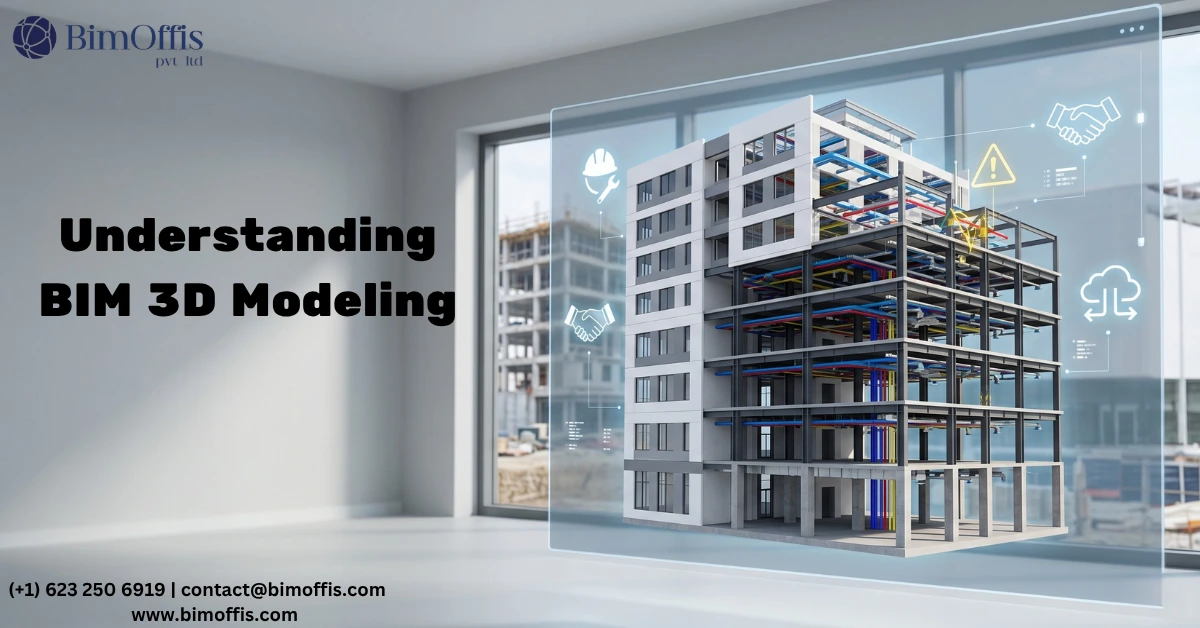
BIM 3D modeling means building a digital version of a building where every discipline’s design exists in the same three-dimensional space simultaneously. The architect’s walls, structural beams, mechanical ductwork, and electrical cable trays all sit in one model. They occupy correct positions relative to each other, at the same time.
Software can then automatically check whether any systems conflict. It scans the model and flags every location where two elements occupy the same space or violate required clearances. That process is called clash detection. It is one of the most practically valuable things BIM makes possible.
Beyond Geometry, The Data Layer
Most BIM introductions miss this completely.
Geometry is only part of what separates BIM from regular 3D modeling. The other part is data. Every element carries attached information. A wall carries its material composition, fire rating, and thermal performance. A door carries its dimensions, hardware specification, and fire rating. Mechanical equipment carries manufacturer details, maintenance requirements, and performance data.
That information lives inside the model itself, not in a separate spreadsheet. When the design changes, the information updates with it. Need a door schedule? The model generates it automatically. Need a material takeoff? The model produces it from its own elements.
Coordinated geometry plus embedded data, that combination is what makes BIM fundamentally different from anything before it.
Why It Actually Matters in Practice
The Coordination Argument
Research consistently shows that significant construction costs trace back to rework, work done twice because something was wrong the first time. Much of that rework comes from coordination failures caught too late.
BIM clash detection catches those conflicts during design. Not every single one, but the vast majority of geometric conflicts that would otherwise surface on site. The structural beam blocking the duct route shows up in a coordination meeting. Someone fixes it in the model. Nobody cuts out installed work on site.
That shift, from discovering failures during construction to catching them during design, saves serious money on complex projects.
The Documentation Argument
Keeping documentation current is a constant struggle in traditional workflows. Every design change requires manually updating every affected drawing. On large projects with hundreds of sheets, that process is slow and error-prone.
Things fall out of sync. Floor plans show the current design. Sections show something from three weeks ago. Contractors work from superseded drawings.
In BIM workflows, documentation comes directly from the model. Change the model and the drawings update automatically. Floor plans, sections, and elevations always show the same thing. Door schedules update when you add a door. Material takeoffs update when you change a wall spec.
That automatic consistency saves real time and reduces costly errors.
The Shared Understanding Argument
When architects, structural engineers, MEP consultants, and contractors all work from the same coordinated model, everyone sees the same building. Not different drawing sets produced at different times. The same current model.
Misunderstandings drop significantly. Contractors interpret designs from the same source as architects. MEP consultants coordinate against the live structural model. RFIs caused by conflicting interpretations become far less common.
Who Needs This
Any team working on a project complex enough to have real coordination challenges benefits from BIM.
Healthcare facilities have dense MEP infrastructure. Coordinating systems competing for the same ceiling void through 2D drawings creates errors. These surface during commissioning, the worst possible time.
Data centers face the same density problem with harder deadlines. A coordination failure during commissioning is a serious, costly problem. Every major data center team uses BIM coordination as standard practice.
Large commercial buildings, mixed-use developments, and complex residential projects all carry enough coordination complexity that drawing-based methods produce costly gaps.
Simpler projects may not need the full BIM investment. But any project where multiple discipline teams work simultaneously on systems that must fit together in the same space benefits from model-based coordination.
The Honest Bottom Line
BIM 3D modeling is not a technology trend. It is a practical response to a real, long-standing construction problem.
Firms that have adopted it properly, not just the software, but the workflows, standards, and coordination processes, deliver better-coordinated projects with fewer surprises. Those still relying on drawing-based coordination see more on-site conflicts and higher rework costs.
That gap is not a coincidence. It is what happens when a real problem meets something that actually works.
Ready to see how BIM 3D modeling can streamline your project and reduce costly design conflicts? Get your free BIM project quote
Frequently Asked Questions from Clients
What is BIM 3D modeling in simple terms?
It is a coordinated digital model where every discipline’s design exists in the same three-dimensional space simultaneously, with data embedded in every element.
How is BIM 3D modeling different from regular 3D CAD?
CAD produces geometry that carries no information beyond its shape, while BIM produces intelligent objects that know what they are, what they consist of, and what data they carry.
What is clash detection and why does it matter?
Clash detection automatically finds every location where systems from different disciplines conflict in the model, catching coordination failures during design rather than during construction where fixing them costs significantly more.
How does BIM 3D modeling improve project documentation?
Documentation derives directly from the model, so when the design changes, every drawing, schedule, and takeoff updates automatically without anyone manually reconciling separate drawing sets.
Which project types benefit most from BIM 3D modeling?
Healthcare facilities, data centers, and large commercial developments benefit most because their MEP density and coordination complexity make traditional drawing-based coordination genuinely inadequate.
Does BIM 3D modeling actually save money on construction projects?
Yes, by catching coordination failures during design rather than during construction, it eliminates the rework costs that consistently represent a significant proportion of complex project budgets.