Let me start with something that does not get said enough in conversations about sustainable architecture.
A lot of buildings that get called sustainable are not performing the way they were supposed to. The targets were right. The ambition was genuine. But somewhere between the design intent and the finished building, the performance outcomes that everyone agreed were important did not quite materialise.
When you trace that back, it almost always comes down to the same thing. Sustainability decisions rested on assumptions and general principles rather than on actual performance data for that specific building in that specific location. The team applied best practice rules of thumb and hoped the building would behave accordingly.
Most of the time, hoping is not good enough. Knowing is better. And 3D modeling services are what give design teams the ability to know rather than hope.
What Actually Changes When You Have the Right 3D Tools
The most important thing 3D modeling services do for sustainable architecture is move performance analysis from after the design to during it.
Here is why that matters so much. In a traditional workflow, the building gets designed. Then the sustainability consultant runs the energy models and daylighting analyses against what the team already designed. If the results are not good, the team faces a genuinely difficult choice. Accept performance that falls short of the targets, or make late-stage changes to a design that is already largely settled. Neither option is great.
When 3D modeling services are part of the design process from early on, that situation does not arise in the same way. The performance analysis runs against an accurate digital model of the building while the design is still flexible. The results feed back into decisions at the point when those decisions can still change without significant cost or disruption.
The architect is not choosing between a design they are happy with and a building that performs. Instead, they use performance data to find the version of the design that does both. That is a completely different working experience, and it produces significantly better outcomes.
Making the Invisible Things Visible
Here is something worth thinking about for a moment.
Most of what sustainable architecture is actually trying to achieve is invisible. Heat moves through walls in ways you cannot see. Daylight penetrates floor plates at angles that shift with the season and time of day. Air flows through spaces in patterns that determine whether a building feels comfortable or not. Meanwhile, the carbon embodied in building materials sits in choices that look identical on a drawing regardless of their environmental impact.
3D modeling services make these invisible things visible in ways that genuinely change how architects and engineers think about them.
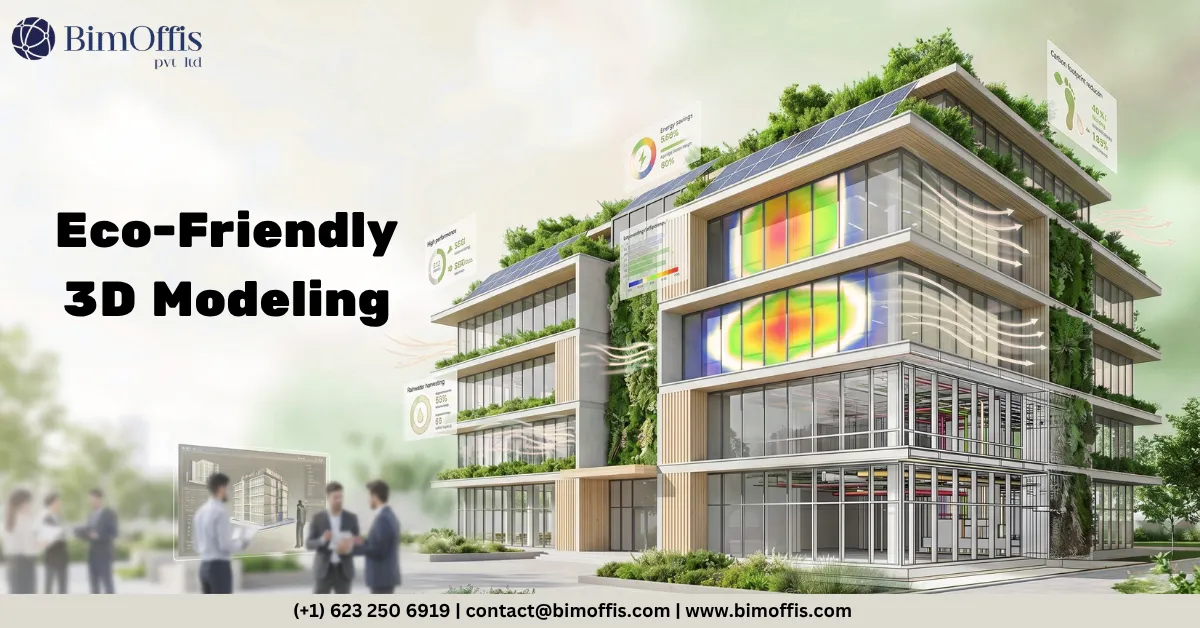
A daylighting model produced from accurate 3D geometry shows exactly where sunlight reaches at specific times of year, how deep natural light penetrates in winter, where glare becomes a problem in summer, and where artificial lighting will need to compensate. This information transforms how window positions, shading devices, and internal layouts get designed. It replaces educated guesswork with actual knowledge about how the building will behave.
An energy model running against the 3D model shows how different insulation specifications affect heating loads, how glazing ratios affect solar gain and cooling demand, and how different mechanical system configurations interact with the passive performance of the building envelope. The design team stops making assumptions about these relationships and starts making decisions informed by what the model actually shows.
Where 3D Modeling Services Make the Biggest Difference
Early Decisions About Orientation and Form
The most consequential sustainable design decisions happen at the earliest stages of a project, when the building is still just a massing exercise on a site. How the building sits relative to the sun. What shape it takes. How much surface area it exposes to the external environment and in which directions.
3D modeling services allow the team to properly test these decisions before anything gets locked in. A massing study that runs solar analysis against multiple orientation options gives the team real data for a decision that will affect the building’s energy performance for its entire operational life. Getting this right costs almost nothing in construction terms and can significantly reduce operational energy demand compared to a less considered configuration.
This is the highest leverage sustainable design intervention available, and 3D modeling is what makes it properly testable.
Material Choices and Embodied Carbon
As operational energy performance has improved across the industry, embodied carbon has become a more significant part of a building’s whole-life environmental impact. The carbon emitted in manufacturing, transporting, and installing materials is no longer a footnote. For many building types it now equals or exceeds the operational carbon over the building’s lifetime.
3D modeling services support embodied carbon analysis by producing accurate quantity data for every material in the building. When the building exists as a detailed 3D model, the quantities of concrete, steel, timber, insulation, glazing, and everything else come directly from the model. Those quantities feed into lifecycle assessment tools that calculate the embodied carbon impact of different material choices.
The impact of switching from one structural system to another becomes immediately visible in the results. The team evaluates trade-offs between structural performance, cost, and embodied carbon with real numbers rather than general principles. That is a genuinely different level of decision-making quality.
Passive Design Strategies That Actually Work
Natural ventilation, solar shading, thermal mass, cross-ventilation, all of these passive strategies depend on getting the geometry right. A natural ventilation strategy that works perfectly in theory may not work in practice if the building geometry does not create the pressure differentials and airflow paths the strategy depends on.
3D modeling services allow passive strategies to be tested against the actual building geometry before they become fixed. Computational fluid dynamics analysis reveals how air will move through the building under different wind conditions. Thermal mass calculations show how different structural solutions affect internal temperature stability. Furthermore, shading studies confirm whether a proposed overhang will actually protect the glazing it is designed to shade at the critical times of year.
Testing these things in a model during design is what separates passive strategies that perform from ones that look good on a diagram and underdeliver in reality.
The Workflow That Actually Produces Results
The sustainable design workflow that delivers the best outcomes is not one where the 3D model and the performance analysis tools get used at a single point in the design process. It is one where they work together continuously from the earliest stages.
Early massing studies run solar and energy analysis to inform orientation and form decisions. Schematic designs run daylighting and ventilation analysis to inform window placement and shading strategy. Design development runs detailed energy modeling to optimise the building envelope. Construction documentation includes lifecycle assessment to verify the embodied carbon impact of final material selections.
At each stage the analysis feeds back into design decisions at the point when those decisions are still flexible. The result is a building whose sustainability performance was designed in from the beginning rather than added on at the end.
The Honest Bit
3D modeling services are genuinely powerful tools for sustainable architecture. But they are not magic.
A building designed without serious sustainability intent will not become a high-performing building because someone ran energy models against it. The models will accurately show that it performs poorly. Improving the performance requires design changes, and design changes require genuine commitment from the client and the project team.
What 3D modeling services do is give that commitment the tools to translate into actual performance. Guesswork gives way to analysis. Assumption gives way to knowledge. Aspiration gives way to measurable, verifiable outcome.
The Bottom Line
3D modeling services matter in sustainable architecture because they change what design decisions get based on. Invisible performance characteristics become visible during design when there is still time to act on what the analysis shows. Testing alternatives becomes practical in ways that would be impossible without the digital model. And the accurate quantity data that lifecycle assessment depends on comes directly from the model rather than from manual estimates.
The buildings that consistently achieve high levels of sustainable performance are the ones where the 3D model and the analysis tools were part of the design process from the beginning. That is what 3D modeling services make possible, and that is why they matter.
Design smarter, reduce waste, and achieve your sustainability goals with expert 3D modeling solutions, get a free quote today.
Frequently Asked Questions from Clients
What are 3D Modeling Services in sustainable architecture?
They create digital building models that support energy-efficient and eco-friendly design decisions.
How do 3D models improve sustainable building design?
They enable performance analysis, material optimization, and energy simulations.
Can 3D modeling reduce construction waste?
Yes, accurate models improve planning and minimize material waste.
Which software is used for sustainable architectural modeling?
Revit, Rhino, SketchUp, and energy analysis tools are commonly used.
Do 3D modeling services support green building certifications?
Yes, they help meet requirements for certifications such as LEED and BREEAM.
What are the benefits of 3D modeling for sustainable architecture?
It improves collaboration, reduces costs, enhances efficiency, and supports environmental goals.