Let me start with something that becomes obvious the moment you work on a large-scale commercial building project.
The complexity is different. Not just more of the same complexity you get on smaller projects, but genuinely different in kind. The number of disciplines involved, the volume of decisions that need coordination, the documentation that needs to stay current through months of continuous design development, and the large number of people who need to understand the building at any given moment, all of it operates at a scale that fundamentally changes what the architectural team needs to manage.
As a result, the tools that work well enough on smaller projects start to show their limits.
Architectural BIM modeling services exist to address that complexity directly. Not as a technology upgrade that makes existing workflows slightly more efficient, but as a fundamentally different approach to how a large-scale commercial building gets designed, coordinated, and documented.
What Architectural BIM Modeling Services Actually Cover
More Than Just 3D Drawing
The first thing worth getting clear is what architectural BIM modeling services actually involve on a serious commercial project.
It is not just producing a 3D model of the building instead of 2D drawings. That misunderstands what makes BIM modeling genuinely valuable on large-scale projects. The value comes from what the model enables, namely coordinated documentation, accurate scheduling, clash detection with other disciplines, and data that flows through the project lifecycle rather than being recreated at each stage.
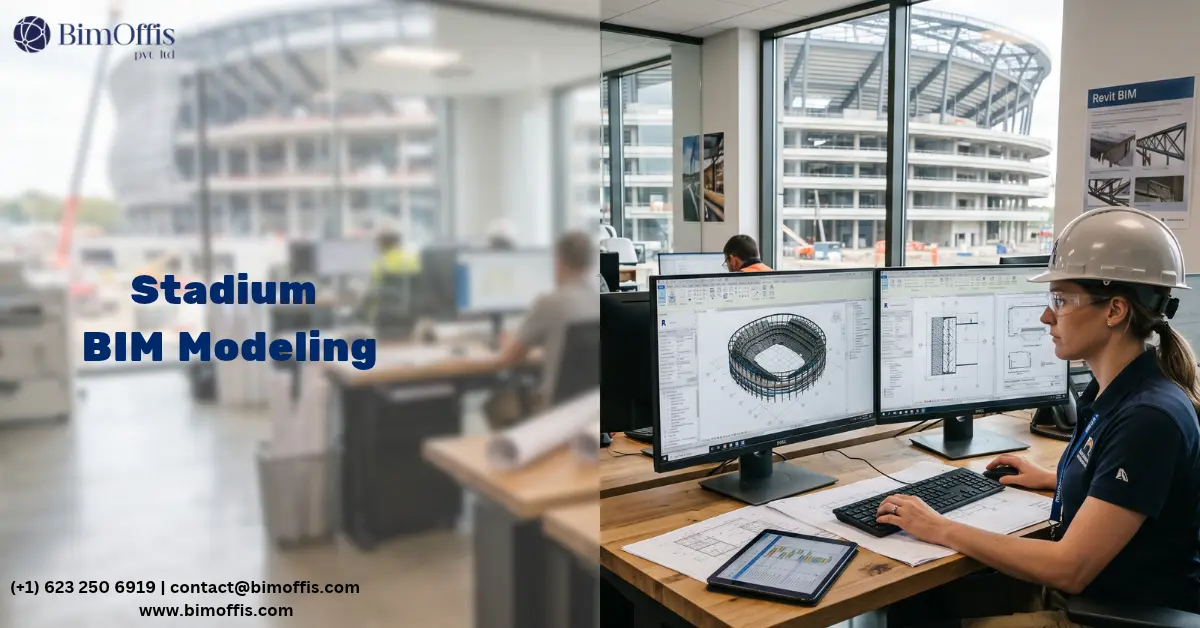
On a large-scale commercial building, therefore, architectural BIM modeling services typically cover the complete architectural model from concept through construction documentation. Wall systems get modeled with correct layer compositions and accurate thermal and acoustic performance data. Floor and ceiling systems get represented accurately enough to support coordination with structural and MEP models. Curtain wall and facade systems get developed to the level of detail required for coordination with the facade engineer and the cladding contractor. Doors, windows, and specialty elements exist as parametric families carrying the data required for schedules and specifications.
All of this exists in a single coordinated model that generates documentation automatically, stays current through design changes, and provides the coordination environment that the structural and MEP disciplines work against.
Why Large-Scale Commercial Buildings Need BIM Modeling
The Documentation Challenge
A large commercial office building might have forty floors of similar but not identical floor plates, hundreds of different door types, multiple curtain wall systems with different performance requirements in different locations, and structural variations that accumulate through the building height. Documenting all of this accurately through traditional 2D drawing methods is genuinely difficult.
In a 2D workflow, every drawing is a separate document. Furthermore, every change to the design requires identifying every affected drawing and updating each one manually. On a project of this scale, with a design that evolves continuously through development, keeping the documentation current is a constant battle. Things get missed. Drawings drift apart from each other. Consequently, the construction document set that goes out to tender reflects the design as it existed at various points in the past rather than the current design.
Architectural BIM modeling services, however, solve this structurally. Every view of the building derives from the same model. Change the design and every affected view updates automatically. The floor plan reflects the current design. The section reflects the current design. Moreover, the door schedule reflects the current design. The documentation stays current without anyone having to manually reconcile separate drawing files.
The Coordination Challenge
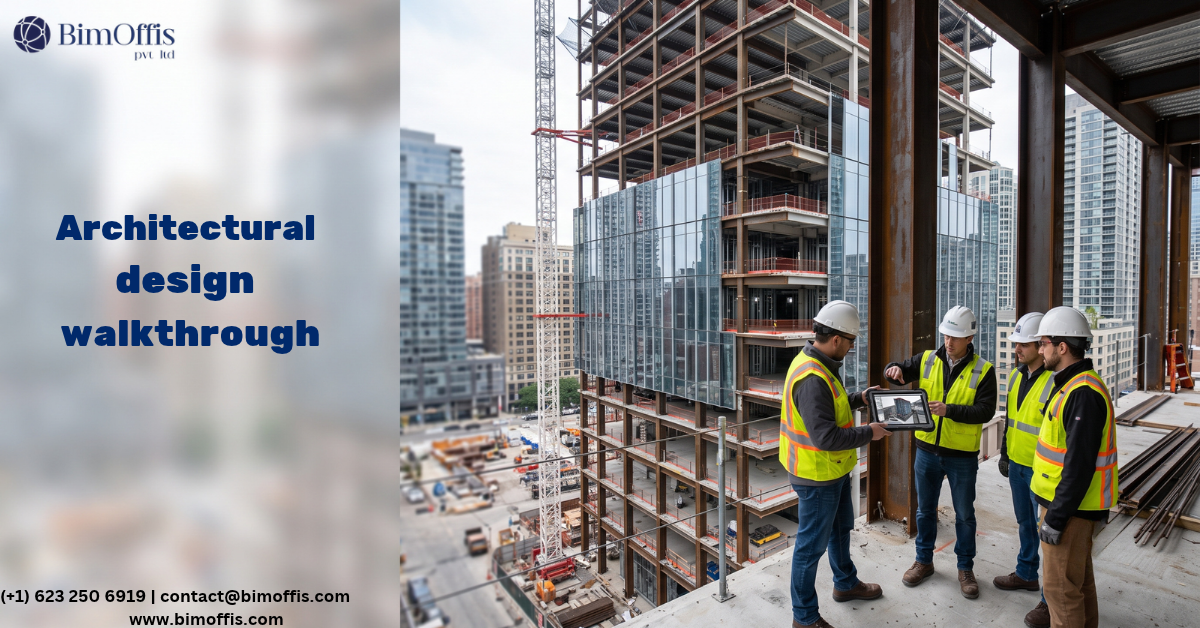
Large commercial buildings involve multiple design disciplines working in parallel. Structural engineers design a frame that needs to work with the architectural layout. MEP consultants route services through ceiling voids that architectural decisions define. Facade engineers develop cladding systems that need to coordinate with the structural frame and the interior fit-out sequence.
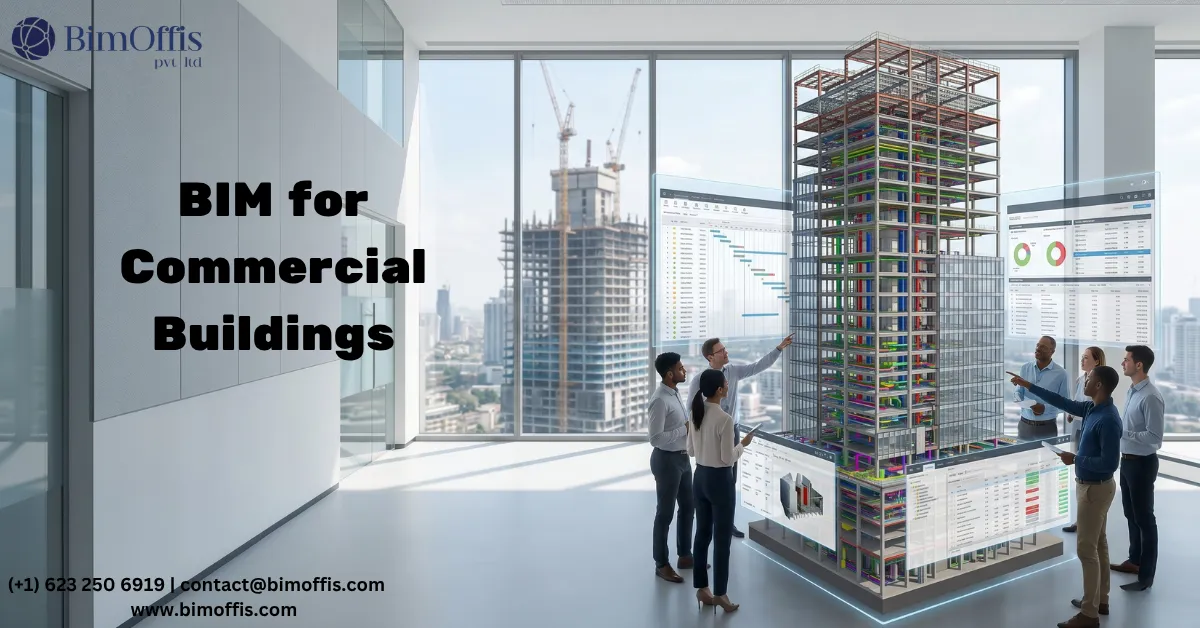
When the architectural design exists as a coordinated BIM model, therefore, all of these disciplines can work against the same reference. The structural engineer links the architectural model and designs the frame in its actual context. The MEP engineer routes services with reference to the actual ceiling void geometry. Furthermore, the facade engineer coordinates their system against the actual structural grid and architectural geometry.
This coordinated approach catches conflicts during design when resolving them costs modeling time. On large commercial projects, the alternative, finding coordination conflicts during construction, is genuinely expensive. Changes at construction stage on a large commercial building ripple through procurement, installation sequences, and programme in ways that small adjustments during design simply do not.
The Scheduling and Quantification Challenge
Large commercial buildings require accurate and detailed scheduling for procurement, tendering, and construction planning. Door schedules, window schedules, room data sheets, material specifications, and equipment lists all need to reflect the current design accurately and update when the design changes.
In a traditional 2D workflow, schedules are separate documents that someone maintains independently from the drawings. When the design changes, the schedule needs updating separately. As a result, discrepancies between drawings and schedules create procurement errors and site confusion.
In an architectural BIM model, however, schedules generate directly from the model data. Add a door to the model and it appears in the door schedule automatically. Change a wall specification and the quantity takeoff updates with it. The schedule and the drawings always stay consistent because they come from the same source.
What Good Architectural BIM Modeling Looks Like on Commercial Projects
Families Built for the Project
The quality of an architectural BIM model depends significantly on the quality of the families within it. Generic families downloaded from online libraries and dropped into a model without customisation produce models that look right in 3D but carry incorrect data, behave incorrectly in schedules, and create coordination problems when other disciplines work against them.
Good architectural BIM modeling services, therefore, build or customise families for the specific project. Wall types carry correct thermal performance data. Door families have correct leaf and frame dimensions. Curtain wall families accurately represent the specified system geometry and performance characteristics. These families carry the data the project needs and behave correctly in every workflow the model supports.
LOD Progression Through Design Stages
Large commercial projects move through clearly defined design stages. Concept, schematic design, design development, construction documentation, and construction. The level of detail appropriate to the architectural BIM model evolves through these stages, and managing that evolution appropriately is part of what good architectural BIM modeling services provide.
A model at concept stage needs to support spatial planning and massing decisions. A model at design development, on the other hand, needs to support coordination with structural and MEP disciplines. A model at construction documentation needs to generate accurate, complete drawing sets and schedules. Each stage has different requirements, and consequently the model needs management to meet those requirements without being over-developed at early stages in ways that create unnecessary work.
Coordination Throughout, Not Just at Milestones
The coordination value of architectural BIM modeling on large commercial projects comes from continuous coordination throughout design development, not just at formal milestones.
When the architectural model gets updated as design decisions are made and immediately checked against the structural and MEP models, conflicts surface when they are still easy to resolve. When coordination only happens at formal milestones, however, weeks of design development may have occurred on top of an unresolved conflict, making the resolution significantly more complex.
Good architectural BIM modeling services, therefore, maintain the model in a state that supports continuous coordination rather than batch coordination at project milestones.
The Commercial Value on Large Projects
The business case for architectural BIM modeling services on large-scale commercial buildings is not difficult to make.
Documentation that stays current through design changes reduces the risk of construction document sets containing inconsistencies. Coordination that happens continuously during design, furthermore, reduces the risk of construction-stage conflicts requiring expensive resolution. Schedules that generate from the model reduce the risk of procurement errors from schedule and drawing inconsistencies.
On a large commercial project, each of these risk reductions carries a financial value that is straightforward to estimate. The cost of a significant coordination conflict discovered during construction on a large commercial building, in rework, programme delay, and the ripple effects through procurement and installation, can easily exceed the cost of the entire architectural BIM modeling service that would have prevented it.
The Bottom Line
Architectural BIM modeling services on large-scale commercial buildings deliver value that compounds across every stage of the project. Better coordination during design, more reliable documentation through development, more accurate scheduling and quantification, and a model that supports the construction team through build-out and the facilities management team through the building’s operational life.
For large commercial buildings where complexity, coordination requirements, and documentation volume exceed what traditional methods can manage reliably, this is not a premium service. It is, ultimately, what good project delivery on projects of this scale actually requires.
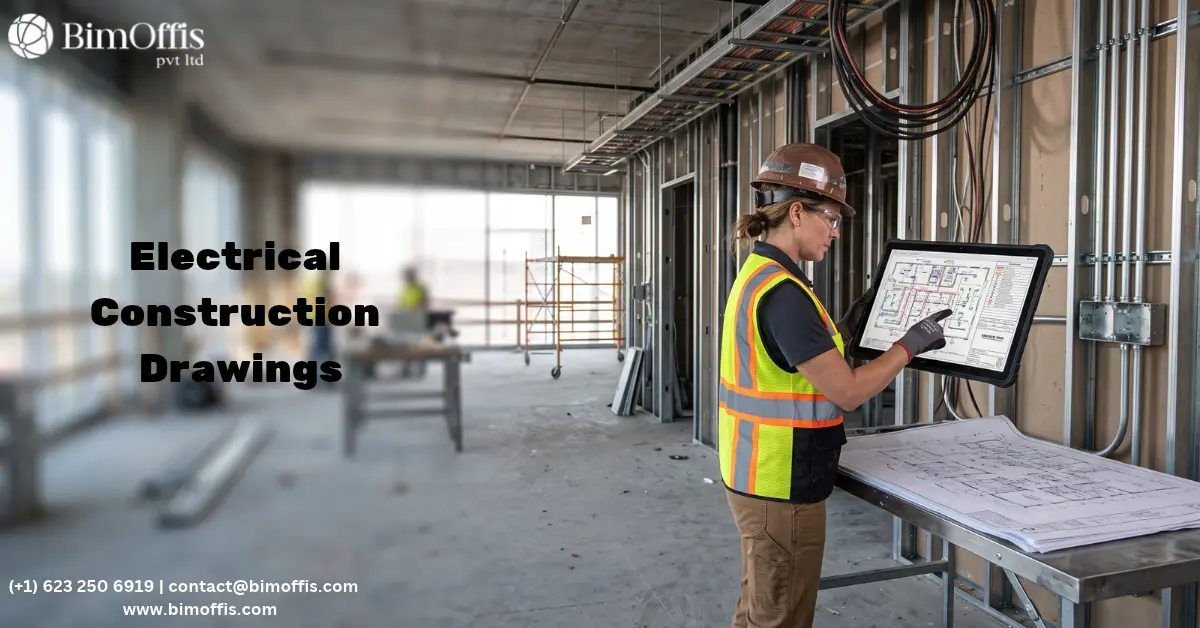
Get a free quote for Electrical BIM Services to improve MEP coordination and achieve clash-free construction design.
Frequently Asked Questions from Clients
What are Architectural BIM Modeling Services?
Architectural BIM Modeling Services create intelligent 3D models for planning, design, and coordination.
Why is BIM important for commercial buildings?
BIM improves collaboration, accuracy, and project efficiency across large teams.
How does BIM reduce errors in commercial projects?
It enables clash detection and coordinated design before construction begins.
Which software is commonly used for Architectural BIM?
Autodesk Revit is widely used for architectural BIM modeling.
Can BIM support large-scale commercial developments?
Yes, BIM efficiently manages complex designs, data, and multidisciplinary coordination.
What are the benefits of Architectural BIM Modeling Services?
They improve visualization, cost control, scheduling, and decision-making throughout the project lifecycle.