Let me ask you something that comes up on industrial projects all the time.
How do you show someone a facility that does not exist yet?
Not just hand them a floor plan and hope they can visualise it. Actually show them what it feels like to walk through the production floor, how the equipment sits relative to the structure, where the maintenance access routes go, and how the loading dock connects to the warehouse.
For years the answer was scale models, 2D drawings, and a lot of verbal explanation. The people on the other side of the table did their best to follow along, nodded at the right moments, and signed off on things they only half understood. Layout changes mid-construction, operational bottlenecks after commissioning, equipment access problems nobody anticipated until someone tried to use the facility for real. A lot of those traced back to decisions that nobody fully understood when they approved them.
3D walkthrough animation exists to close that gap. On industrial and plant projects specifically, it does something that almost nothing else can do.
What a 3D Walkthrough Animation Actually Is
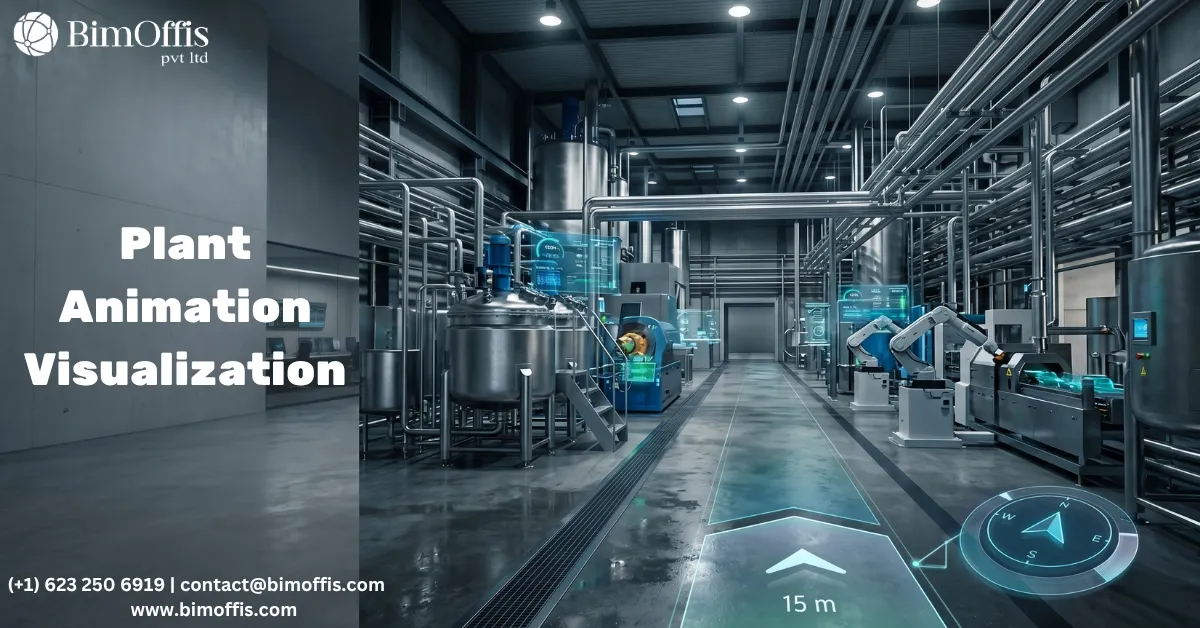
A 3D walkthrough animation is a video that moves the viewer through a space existing as a digital model rather than a physical building. The camera travels through the facility the way a person would, showing the environment from human eye level, at human scale, in a way that communicates what it actually feels like to be there.
This differs from a rendered still image, which captures one moment from one viewpoint. A walkthrough animation moves. It shows how spaces connect to each other. It shows how you get from the entrance to the production floor, from the production floor to the loading area, from the ground level to the mezzanine. Furthermore, it shows the facility as a sequence of experiences rather than a collection of separate views.
For industrial facilities, that sequence matters enormously. The relationship between process areas, the flow of materials and personnel through the building, the way equipment sits relative to access routes and emergency exits, these are things that floor plans and elevations communicate very poorly. A walkthrough animation communicates them immediately.
Why Industrial Projects Need This More Than Most
The Complexity Is Genuinely Different
A manufacturing plant or process facility is complex in a way that a commercial office building simply is not. The density of equipment, the integration of process systems with the building structure, the routing of services and pipework through tight spaces, all of this creates an environment that traditional documentation handles poorly.
The people who need to understand the facility before construction include investors making capital decisions, operations teams who will run the plant for the next twenty years, safety engineers assessing access and egress, and contractors pricing and planning the work. Most of these people cannot extract a clear picture from a set of engineering drawings. Expecting them to make good decisions based on those drawings sets everyone up for problems.
A 3D walkthrough animation gives all of them the same clear, accurate picture of the facility without requiring any technical drawing literacy.
Catching Layout Problems Before They Get Built
This is the practical benefit that matters most on industrial projects and the one that gets talked about least.
The production flow through a manufacturing facility determines how efficiently it operates. The routing of personnel, materials, and waste through a processing plant affects both productivity and safety. The positioning of equipment relative to maintenance access routes determines how effectively the facility can be maintained over its operational life. These are not small details. They are fundamental to whether the facility works the way it needs to.
All of these things are difficult to evaluate from a floor plan. They become immediately apparent when someone watches a walkthrough animation of the planned facility. A production manager who sees the walkthrough will notice the bottleneck in the material flow. The maintenance engineer will spot the access problem before equipment gets installed. The safety officer will identify the egress issue before the team finalises the layout.
Catching these things during a walkthrough review costs some modeling time and a design conversation. Catching them after construction costs a lot more, and sometimes the only fix involves taking the facility apart and starting again.
Getting Everyone on the Same Page
Industrial projects involve more stakeholder groups than most project types, and those groups often have very different levels of technical understanding. The board approving the capital expenditure, the operations team specifying requirements, the engineering consultants designing the systems, the contractors building it, the regulatory authorities approving it, all of these people need to understand the facility, and they bring very different backgrounds to that understanding.
A 3D walkthrough animation works effectively across all of those groups simultaneously. The board member who has never read an engineering drawing understands what they are approving. The operations team can evaluate the layout against their actual working practices. The contractor can see the construction challenges before they become site problems. Everyone leaves the review with the same picture of the facility in their head.
What Actually Makes a Good Industrial Walkthrough Animation
It Has to Be Accurate
The most important quality in any industrial 3D walkthrough animation is accuracy. It needs to represent the actual facility design, not an idealised version.
For industrial projects, that means correct equipment dimensions and positions, correct structural clearances, correct process system routing, and correct maintenance access routes. An animation misrepresenting any of these creates false expectations. The operations team approves a layout based on what the animation showed them, and then the real facility turns out to be different in ways that matter. At that point, the animation becomes a liability rather than an asset.
The best industrial walkthrough animations pull their geometry directly from the engineering models and BIM data the design team already uses. The animation and the design stay the same thing, presented differently, rather than two separate representations that may have diverged.
The Camera Route Has to Make Sense
A walkthrough animation tells a story about a facility. The camera route determines whether that story makes sense to the audience.
On an industrial project, the camera should follow routes that people will actually use when the facility operates. The journey starts at the main entrance and moves through in the sequence that mirrors the operational flow. Raw material arrival, the production process, and finished goods dispatch all need clear representation. Key pieces of equipment deserve close attention, showing what the working environment around them actually looks like. Maintenance access routes and emergency egress paths should both feature prominently.
Smooth and purposeful camera movements communicate far more effectively than mechanical or arbitrary ones. The viewer should feel like someone who understands the facility is guiding them through it, not like a piece of software moving through a model.
The Detail Level Has to Be Right
A fully detailed engineering model of a large process plant contains an enormous amount of information. Showing all of it in a walkthrough animation produces something visually overwhelming that actually communicates less than a more selective approach.
Good industrial walkthrough animation makes clear decisions about what to show in detail and what to simplify:
- Major equipment needs to be accurate and clearly identifiable
- Process systems need enough detail to communicate routing and connections
- Structural elements need accuracy sufficient to show clearances and access
- Secondary elements can be simplified where they do not add to the communication objectives
How Industrial Walkthrough Animation Differs From Commercial Building Animation
It is worth being direct about this because the two types look similar on the surface but serve quite different purposes.
Commercial building walkthroughs focus on spatial experience and aesthetic quality. The goal is to communicate what the building will feel like to be in. The materials, the light, the proportions, the character of the spaces.
Industrial walkthroughs, on the other hand, focus on operational logic. How the facility works, how people and materials move through it, how equipment relates to the structure, how maintenance and safety requirements get accommodated in the layout. The aesthetics of the space are largely irrelevant. What matters is whether the viewer understands how the facility functions and whether it will work the way it needs to.
That difference in purpose drives a different approach to camera choreography, equipment detail levels, and the decisions about what the animation includes and what it leaves out.
The Bottom Line
3D walkthrough animation answers the question that matters most on industrial projects before construction starts. What will this facility actually be like to work in and will it do what it needs to do?
It catches layout and flow problems when changing them costs design time rather than construction cost. It communicates complex facilities to stakeholders who cannot read engineering drawings. It gets everyone involved in the project to the same level of understanding before any irreversible decisions get made.
On industrial and plant projects where facility complexity genuinely exceeds what traditional drawings can communicate, a good 3D walkthrough animation is one of the most useful tools available.
Want to improve coordination in your MEP projects? Explore our Electrical BIM solutions for clash-free and efficient construction design.
Frequently Asked Questions from Clients
What is an industrial 3D walkthrough?
An industrial 3D walkthrough is an animated visualization of a plant, facility, or industrial process.
How are plant animations used in industry?
They help explain layouts, workflows, equipment operations, and safety procedures.
What are the benefits of industrial 3D walkthroughs?
They improve communication, training, planning, and stakeholder understanding.
Which industries use plant animation services?
Manufacturing, oil and gas, power, chemical, and infrastructure sectors commonly use them.
What software is used for industrial 3D walkthroughs?
Tools such as Revit, Navisworks, 3ds Max, and Blender are widely used.
Can industrial walkthroughs support project approvals?
Yes, they help clients and stakeholders visualize projects before construction or installation begins.