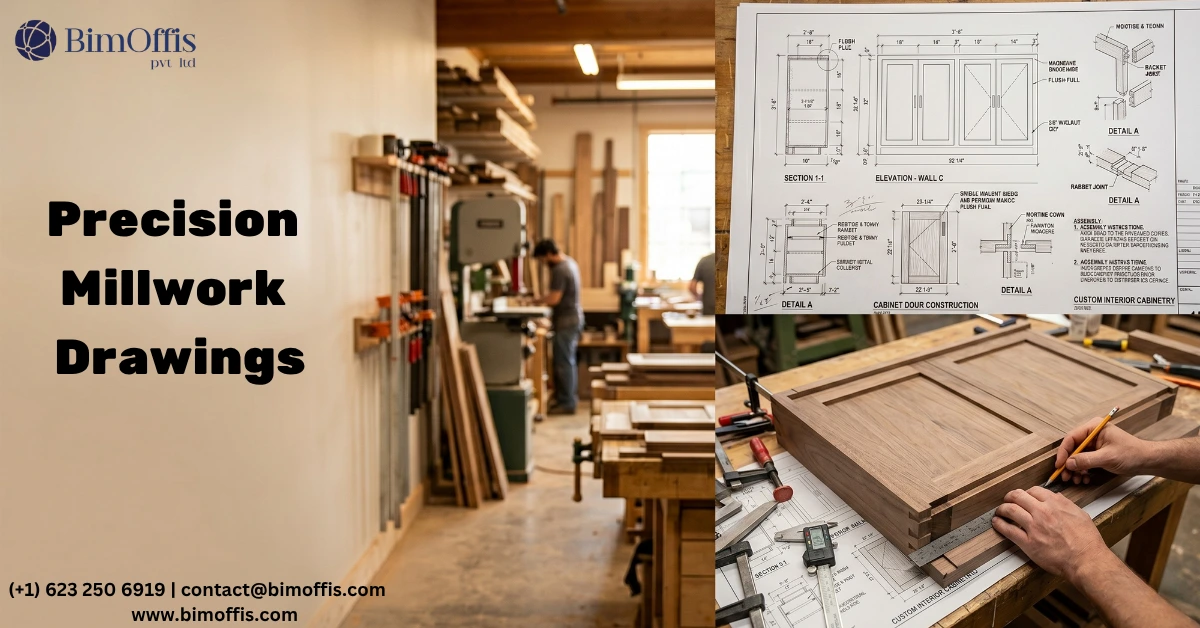
The Part of Custom Woodwork Nobody Talks About
Here is something most people never realise until a project goes sideways.
When a custom woodwork project fails, the carpenter rarely did a bad job. Most of the time, the craftsman knew exactly what he was doing. The materials were good, the design was solid, and everyone started the project with good intentions. However, somewhere between the designer’s idea and the finished installation, something got lost in translation.
A measurement got assumed. A material detail never got clearly communicated. A connection between two panels got left open to interpretation. And by the time anyone noticed, the pieces were already fabricated, already finished, and already on their way to the job site.
That is when the real cost shows up. Remakes pile up. Delays push the schedule back. Clients lose confidence. Budget overruns hit numbers that nobody planned for.
Fortunately, this is the exact problem that millwork shop drawing services prevent. Moreover, once you understand how they work, running a serious custom woodwork project without them becomes very hard to justify.
What Millwork Shop Drawing Services Actually Are
Many people confuse shop drawings with architectural drawings. However, they are not the same thing at all.
Architectural drawings communicate the design concept. They tell you what a space should look like, where things sit, and the general layout. Primarily, architects create them for the client, the contractor, and the permit office.
Shop drawings, on the other hand, serve a completely different purpose. Fabricators and installers rely on them to build and fit the work correctly. Every measurable detail lives inside a proper shop drawing. Every dimension down to a fraction of an inch, every material specification, every finish choice, every joinery detail, every piece of hardware, and every step of the installation sequence.
When a woodworker picks up a well-prepared set of shop drawings, nothing remains to figure out. All the decisions already got made. All the details already got checked. The only job left is building it.
Millwork shop drawing services handle this entire process. Experienced drafters study the design intent and, as a result, produce a complete set of documents that a fabrication shop works from directly, without guesswork and without gaps.
Why Getting the Dimensions Right Is Non-Negotiable
Custom millwork is genuinely unforgiving work. No standard size exists to fall back on. Every piece gets made for a specific space, a specific design, and specific site conditions unique to that project.
Think about a custom built-in running wall to wall across a fifteen foot living room. If the fabricator works from unclear drawings and cuts the unit a quarter inch too wide or too narrow, that piece does not fit properly. The gaps show up immediately. The doors hang incorrectly. Furthermore, fixing the problem means going back to square one entirely.
That outcome is not a minor inconvenience. Days of lost time, wasted material, and a client who now questions every other decision on the project follow closely behind.
Precision in custom woodwork is not simply a goal worth working toward. Instead, it is the standard the whole project depends on. Either the piece fits and works exactly as designed, or a real problem exists.
How Shop Drawings Protect Precision at Every Stage
They Catch Conflicts Before Anyone Starts Building
One of the most valuable things a proper shop drawing process does is cross-reference the millwork against everything else happening on the project.
Electrical layouts, plumbing lines, HVAC ductwork, and structural columns all get checked against the shop drawings before fabrication begins. Therefore, if a conflict exists, it shows up on paper first, where resolving it stays easy and cheap.
Finding out that a custom cabinet blocks an electrical panel during the drawing review takes about ten minutes to fix. In contrast, discovering the same problem after the cabinet arrives finished on the job site turns into an entirely different and far more expensive conversation.
They Give the Fabricator Real Numbers
Every single component in a shop drawing set carries exact dimensions. The fabricator does not need to call anyone. He does not need to interpret a vague note on an architectural drawing and hope he read it correctly. The number sits right there on the drawing, and he builds to it.
This sounds simple, but it genuinely separates projects that run smoothly from projects that fall apart. Clear information produces accurate work. Unclear information, on the other hand, produces expensive problems that nobody wants to deal with.
They Lock In the Materials and Finishes
Wood species, veneer grain direction, edge profiles, paint or stain specifications, and hardware model numbers all get documented inside the shop drawing set. Consequently, no surprises appear when the pieces arrive on site.
What the client approved during the design review matches exactly what gets built and delivered. Nobody ends up staring at a cabinet in the wrong finish wondering how it happened.
They Show How Everything Connects
The way two pieces of custom woodwork join together matters just as much as the dimensions of the individual pieces. Poor joinery details may not show up immediately, but they always show up eventually. A drawer box without proper detailing starts failing within a year. A panel connection that nobody thought through carefully shifts and opens a visible gap over time.
Shop drawings show the full construction method so the fabricator builds real strength and longevity into the work, not just a surface that looks good on installation day and deteriorates shortly after.
They Make the Installation Straightforward
On any complex millwork project, the sequence in which pieces get installed significantly affects how smoothly everything goes. Installing the wrong panel first can leave the installation crew in a situation where the final piece simply cannot go in without damaging work already in place.
Shop drawings lay out the correct installation order clearly. As a result, the crew on site knows exactly how to approach the work from start to finish, and nothing gets unnecessarily damaged along the way.
The Review and Approval Step Most People Underestimate
Before fabrication starts, the completed shop drawings go through a formal review with the architect or designer of record. Many people treat this step as a formality. In reality, it is one of the most important checkpoints on the entire project.
During this review, real issues get caught and resolved. A dimension that does not match the actual field measurement gets corrected. A detail drawn differently from what the designer intended gets clarified. A hardware choice that creates a problem with a door swing gets reconsidered before it causes trouble.
Catching any of these issues during the drawing review costs almost nothing. In contrast, catching them after fabrication is complete costs significantly more in time, money, and damaged professional relationships.
Additionally, the review creates a documented record showing that everyone agreed on what gets built. If a question later arises about what was specified or approved, the answer sits right there in the stamped and signed drawing set. That record protects the designer, the contractor, the fabricator, and the client simultaneously.
The Simple Truth About Custom Woodwork
Good craftsmanship matters enormously. Quality materials matter. A strong design matters. However, none of those things deliver the result everyone is working toward if the information behind the project stays vague, incomplete, or undocumented.
Millwork shop drawing services hold everything together. They translate a design into something a craftsman can actually build from with confidence. They prevent the errors that derail project timelines and damage professional reputations. Furthermore, they give everyone involved, including the designer, the contractor, the fabricator, and the client, the clarity they need to do their job properly.
If custom woodwork is part of your next project and shop drawings are not already part of your process, that needs to change. The cost of doing them right stays small. The cost of skipping them, however, rarely does.
Ready to find out what your project will cost? Find out here.
Frequently Asked Questions from Clients
What are millwork shop drawing services?
Millwork shop drawing services create detailed technical drawings used for fabrication and installation. They include dimensions, materials, finishes, hardware, and construction details.
Why are shop drawings important for custom woodwork?
They eliminate guesswork by providing precise instructions for fabricators and installers. This helps prevent costly mistakes, delays, and rework.
How do shop drawings improve project accuracy?
They document exact measurements and specifications for every component. This ensures the finished millwork fits perfectly within the intended space.
Can shop drawings help identify design conflicts?
Yes, they reveal clashes with electrical, plumbing, HVAC, or structural elements before fabrication begins. Resolving issues early saves both time and money.
Who reviews and approves shop drawings?
Typically, the architect, designer, contractor, and client review the drawings before production. This confirms that everyone agrees on what will be built.
Are shop drawings worth the investment?
Absolutely. The cost of preparing accurate shop drawings is far lower than the expense of remakes, installation problems, and project delays.