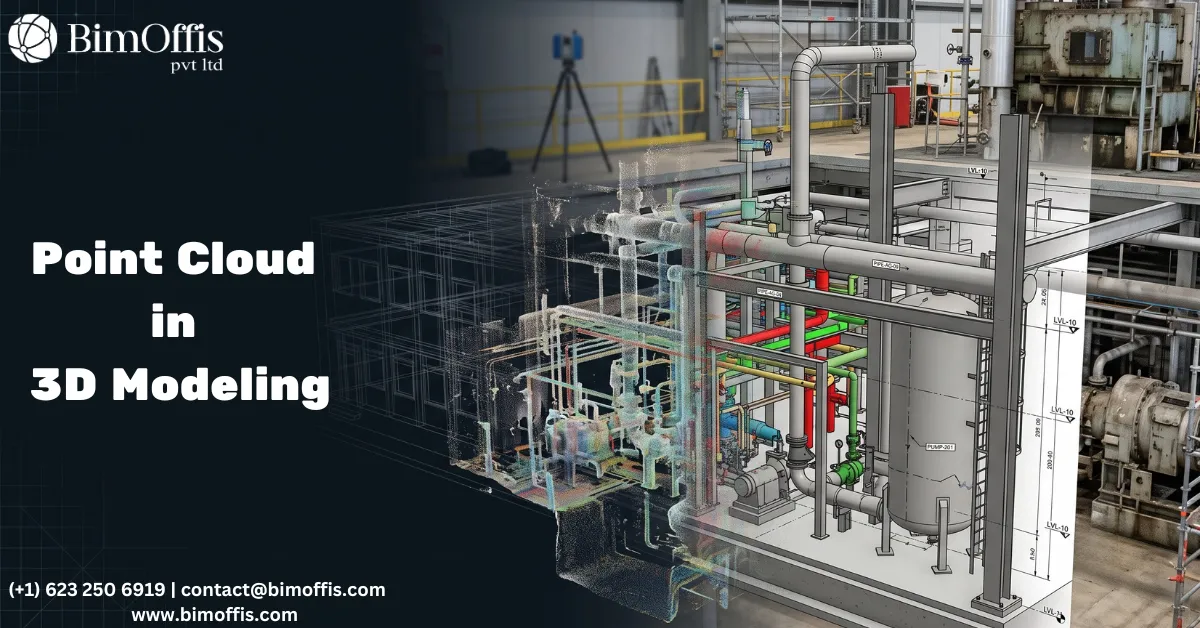
Point cloud technology captures, processes, and analyzes 3D data through detailed measurements and coordinates. Industries such as manufacturing, automobile, and media & entertainment now widely use it. In particular, construction and real estate teams have adopted point clouds as a reliable tool for accurate and efficient 3D modeling.
What is a Point Cloud?
A point cloud is a 3D representation of an object or space. It consists of data points set within a 3D coordinate system. As a result, point clouds create detailed, realistic models of real-world objects and spaces.
In construction, point clouds depict actual site conditions clearly. They combine various spatial measurements into a single, connected dataset. This dataset then represents the entire focus area in one consolidated profile.
Additionally, point cloud technology strengthens digital modeling across different BIM applications. It makes digital visualization and positioning more detailed and accurate. Moreover, it makes the process more sustainable and durable. Because of this, modeling professionals can work with data points more easily, creating immersive descriptions of physical, spatial, and environmental scans.
The Main Benefits of Point Cloud Modeling
Point cloud data modeling offers several advantages to project planners and managers. Here are the most important ones:
Accurate representation of complex data
Point cloud scanning technologies capture data of any complexity or size. They represent this data accurately through finite data elements and points across various file formats. Consequently, teams achieve flawless data captures and create finely structured, detailed building models.
Saves considerable time
Teams create point clouds quickly using high-end 3D scanning and CAD conversion technologies. Therefore, the entire point cloud to BIM modeling process, and its related workflows, moves faster, saving significant time during model creation and program execution.
Enables remote collaboration
Point cloud datasets follow a collaborative format for resource engagement and team communication. As a result, team members collaborate closely and exchange information efficiently, maximizing the value of virtual model creation.
Ensures quality assurance
Teams collect point cloud data from various sources and formats, then place it in a shared space for consistent representation. This scanned environment follows a high-end quality assurance process, so it delivers the finest output.
Improves cost-efficiency
Point cloud laser scanning uses lean practices that require minimal resources and speed up modeling significantly. Specialized software for structured light scanning also lets engineers manage the entire operation without extensive specialization. Thus, the process becomes more cost-efficient overall.
Enhances design capabilities
Point cloud data helps architects create immersive, accurate 3D models, models that are hard to achieve through traditional methods. With point clouds, teams visualize designs and explore options more effectively. They can view the entire data point structure upfront, so they identify issues early and find feasible solutions faster.
Final Thoughts
Point cloud technology has revolutionized 3D modeling by providing precise, data-rich representations of real-world objects and spaces. Its applications span multiple industries, enabling efficient visualization, design, and analysis. Thanks to advanced scanning technologies and sophisticated software, point clouds deliver unmatched accuracy and clarity in construction projects.
Furthermore, point clouds form an intrinsic part of BIM workflows. They ensure better planning, stronger collaboration, and more sustainable outcomes. This makes them essential for digital 3D modeling and construction practices today. Ultimately, by bridging the gap between physical and virtual worlds, point clouds continue to drive innovation in digital construction.
Transform laser scan data into accurate BIM models by working with our Point Cloud to BIM experts for your next project.
Frequently Asked Questions from Clients
What is a point cloud in 3D modeling?
A point cloud is a collection of millions of scanned data points representing the exact geometry of an object or building.
How is a point cloud created?
It is generated using 3D laser scanners or LiDAR technology.
Why is point cloud data important?
It provides accurate existing-condition data for BIM modeling and renovation projects.
Which industries use point cloud technology?
Architecture, engineering, construction, manufacturing, and facility management.
How does point cloud improve BIM modeling?
It increases model accuracy, reduces rework, and improves project coordination.
What software is used for Point Cloud to BIM?
Autodesk ReCap, Revit, Navisworks, and other BIM platforms.