Let me start with something that anyone who has managed a complex construction project already knows.
The design phase is where everyone feels good about how things are going. The drawings look coordinated. The disciplines have exchanged their packages. The coordination meetings have happened. Everyone has signed off and the project moves into construction.
Then the first major MEP installation begins and the problems start surfacing.
A duct run that was supposed to fit above the ceiling grid does not fit because nobody accounted for the bracket depth. A plumbing riser shown clear of the structural frame actually conflicts with a beam that shifted slightly during design development. Nobody updated the MEP drawings to reflect it. An electrical cable tray route that worked on paper occupies the same physical space as a fire protection main that got rerouted three weeks before construction documents went out.
These are MEPF coordination failures. They happen on projects constantly. They are expensive, they delay programmes, and the frustrating part is that most of them are entirely preventable.
Why MEPF Coordination Is So Difficult
The Density Problem
MEPF stands for mechanical, electrical, plumbing, and fire protection. On any significant commercial, healthcare, or industrial building, these four disciplines together represent an enormous amount of physical infrastructure. All of it needs to fit within the building fabric simultaneously.
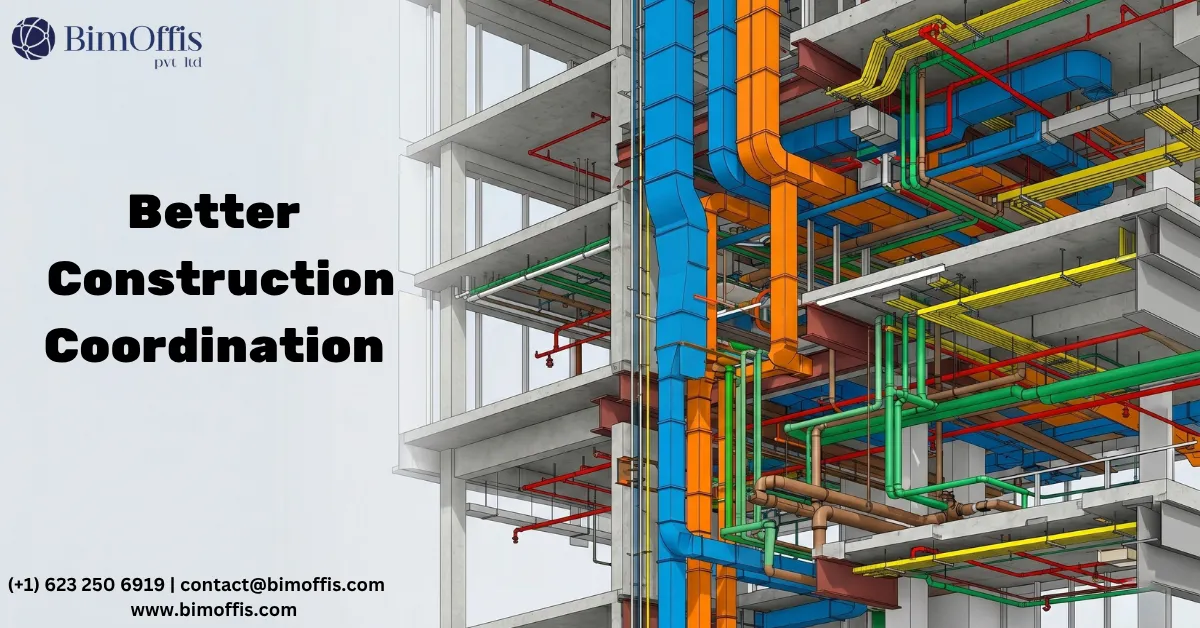
The ceiling void on a typical commercial floor plate is where most of this infrastructure lives. Mechanical ductwork, electrical cable trays and conduits, plumbing pipework, fire protection mains and branch lines, structural elements, and data and communications cabling all compete for the same limited space. Every system needs its own clearances. Every system has specific routing requirements. Every system typically came from a different consultant working in relative isolation.
When you try to bring all of that together in a two-dimensional coordination process, something is almost always going to get missed.
The Sequential Design Problem
MEPF systems typically follow a design sequence that creates coordination risks. Structural design happens first, establishing the grid and structural element depths. Mechanical design follows, claiming the largest ceiling void portions for ductwork. Plumbing follows after that. Electrical follows plumbing. Fire protection often comes last.
By the time fire protection begins, the ceiling void is already heavily committed to other systems. By the time electrical is underway, the ideal routes may already be occupied. Each discipline designs within the constraints the preceding disciplines left behind. The coordination between them gets checked at the end rather than managed throughout.
The result is a drawing set where each individual discipline’s design is internally logical but the disciplines do not all fit together in the physical space they share.
The Drawing Exchange Problem
Traditional MEPF coordination happens through drawing exchange. Disciplines issue their drawings to each other and to a coordination lead who overlays them and manually checks for conflicts. This process catches the obvious conflicts. A major duct run directly through a structural beam. A plumbing riser in the middle of a door opening. But it consistently misses the subtle ones.
A conflict that only exists in three dimensions, where two systems clear each other in plan but occupy the same space vertically, does not show up on a 2D overlay. A conflict that results from a bracket or support system rather than the primary element may not appear on the drawings at all. A conflict arising from a design change in one discipline that the other disciplines never received exists in the built reality but not in the drawing set.
The Solutions That Actually Work
BIM-Based MEPF Coordination
The most effective solution to MEPF coordination challenges is moving the coordination process into a three-dimensional BIM environment where all disciplines exist simultaneously in the same coordinated model.
When the mechanical model, the electrical model, the plumbing model, the fire protection model, and the structural model all exist as accurate three-dimensional geometry in the same federated environment, automated clash detection finds every conflict between systems. Not just the obvious ones that 2D overlay would catch. Every conflict, including the ones that only exist in three dimensions, the ones that support systems and brackets cause, and the ones that design changes in one discipline created without the others knowing.
The team flags conflicts in a coordination meeting during design, when resolving them costs modeling time and a design conversation. The mechanical engineer adjusts a duct route. The electrical engineer reroutes a cable tray. The fire protection engineer changes an elevation. The resolution happens at a desk before any fabrication or installation starts.
This is fundamentally different from resolving the same conflict on site. On site, the mechanical contractor has already installed the duct. The electrical contractor has fabricated the cable tray to the dimensions on their drawings. The fire protection contractor arrives to find the space they need is occupied. That site resolution involves cutting out installed work, refabricating elements, and absorbing the programme delay while everyone waits for the problem to resolve.
Defining Coordination Zones Early
One of the most practical MEPF coordination techniques is establishing clear coordination zones in the ceiling void before any discipline starts detailed routing.
A coordination zone drawing allocates specific horizontal bands within the ceiling void to specific disciplines. Structural elements sit at the top of the void. Mechanical ductwork occupies the zone below. Plumbing sits in the zone below that. Electrical cable trays sit below plumbing. Fire protection runs at the lowest level.
When every discipline understands at the start of design which zone their systems need to route within, the coordination conflicts that come from disciplines designing independently reduce significantly. The individual coordination problems that arise, localised conflicts where something needs to deviate from its zone to connect to equipment or penetrate a wall, are far more manageable than the wholesale coordination exercise that results from disciplines designing without zone discipline.
Early Involvement of Installation Contractors
A coordination problem that design teams miss is often something an experienced installation contractor would spot immediately. They have installed similar systems in similar spaces before and they know where the practical problems arise.
Involving MEPF installation contractors in the coordination process during design development rather than after construction documents go out brings that practical knowledge in at a point when acting on it is still manageable.
Mechanical contractors who have installed ductwork in hundreds of buildings know which coordination conflicts are genuinely difficult to resolve during installation and which are easy to work around. Electrical contractors know which cable tray configurations create access problems during maintenance. Plumbing contractors know where the practical constraints of pipe installation create conflicts that look fine on drawings but cause problems on site.
This knowledge, applied during design coordination rather than discovered during construction, reduces the conflicts that make it to site significantly.
Clear Coordination Protocols and Responsibilities
A significant proportion of MEPF coordination failures trace back not to technical complexity but to process failures. Nobody clearly owned responsibility for maintaining the coordinated model. Design changes never reached all affected disciplines. Coordination meetings happened but the decisions made in those meetings never appeared in the drawings before the next set went out.
Clear coordination protocols define who does what, how design changes reach all affected disciplines, how coordination meeting decisions get tracked and implemented, and how the coordinated model stays current through design development. These protocols reduce the process failures that turn into site problems.
These protocols do not require sophisticated technology. They require clarity about who does what and consistent enforcement from project leadership.
What Happens When MEPF Coordination Fails on Site
It is worth being direct about the consequences of MEPF coordination failures that reach the construction site. Understanding the cost is what motivates the investment in better coordination during design.
When a coordination conflict surfaces during installation, work stops immediately while everyone figures out what to do. The project manager gets involved. The design team gets called. Other affected trades receive notification. This takes time that nobody budgeted for.
Then the resolution process starts. Someone redesigns the conflicting elements. The revised design needs checking against everything else to confirm the resolution does not create a new conflict. Everyone receives documentation of the resolution. Then the revised work needs fabrication or installation from scratch.
The programme impact ripples forward through all the trades whose installation sequence depended on the affected systems being in place. The cost of the rework, the programme delay, and the associated preliminaries and acceleration costs can easily run to many times the cost of the BIM coordination that would have caught the conflict during design.
The Bottom Line
MEPF construction coordination challenges are real and they are consistent across project types and scales. The density of systems, the sequential design process, and the limitations of 2D coordination all contribute to a situation where coordination failures regularly reach site and cause expensive problems.
The solutions that actually work address the root causes. BIM-based coordination puts all disciplines in the same three-dimensional environment and finds conflicts during design. Coordination zones give disciplines a routing framework before conflicts arise. Early contractor involvement brings practical installation knowledge into the design process. Clear protocols ensure the coordination process actually happens rather than just appears to be happening.
For any project with meaningful MEPF complexity, the investment in proper coordination during design is not a premium. It is the practical alternative to paying for the same problems on site at significantly higher cost.
Eliminate costly MEPF clashes before construction begins and keep your project on schedule, get a free quote today.
Frequently Asked Questions from Clients
What is MEPF Construction Coordination?
MEPF Construction Coordination aligns mechanical, electrical, plumbing, and fire protection systems within a project.
Why is MEPF coordination important?
It helps prevent clashes, reduce rework, and improve construction efficiency.
What are common MEPF coordination challenges?
Design conflicts, space constraints, communication gaps, and schedule issues are common challenges.
How does BIM improve MEPF coordination?
BIM enables clash detection, real-time collaboration, and accurate 3D visualization.
Which software is used for MEPF coordination?
Revit and Navisworks are widely used for MEPF BIM coordination.
What are the benefits of effective MEPF coordination?
It improves project quality, reduces costs, and accelerates construction timelines.