Laser scan to BIM has changed how renovation project teams approach existing buildings. Let me explain why by starting with something that plays out on renovation projects constantly and costs more than it should every time it happens.
The design team takes on a renovation project. They receive the existing drawings for the building, drawings produced during the original construction that may be ten, twenty, or thirty years old. They assume those drawings reflect the building as it currently stands and start designing the renovation against them.
Then someone visits the site.
The wall shown at a certain thickness on the drawing is actually thicker. The ceiling void assumed to be available for new MEP routing is shallower than the section drawing indicated because of a beam added during a previous modification nobody documented. A column sits in a position that differs from its drawn location by enough to make the new layout awkward.
The design work done before that site visit is now unreliable. Some of it needs redoing. The project is behind before the main works have even started. This situation is not unusual on renovation projects. It is practically the norm. Laser scan to BIM exists to prevent it.
What Laser Scan to BIM Actually Is
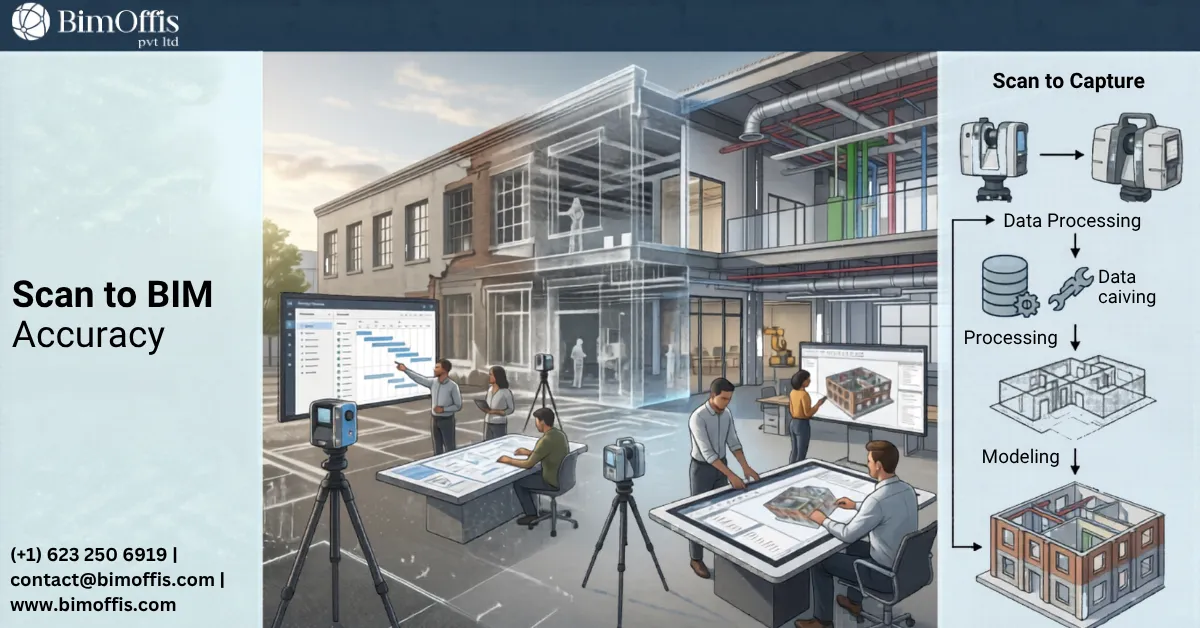
Laser scan to BIM is the process of capturing an existing building using laser scanning technology and converting that captured data into an accurate BIM model that reflects the building as it actually stands today.
The laser scanner works by emitting pulses of laser light in every direction from a fixed position. Each pulse hits a surface and returns to the scanner. The scanner measures the travel time to calculate the exact distance to that surface. Repeat this process from multiple positions throughout the building and you build up a complete three-dimensional point cloud, a dense map of millions of data points representing every visible surface with millimetre-level accuracy.
That point cloud is not the BIM model. It is the raw captured reality of the building. Modelers work with the point cloud as their reference, constructing walls, floors, columns, beams, MEP systems, and every other element at the accuracy the scan data provides.
The result is an as-existing BIM model that reflects the building as it actually is right now. Not as it was designed. Not as someone measured it with a tape measure on a previous visit. As it physically exists today, with every modification and deviation from the original design accurately represented.
How Laser Scan to BIM Improves Renovation Project Planning
Eliminating the Survey Accuracy Problem
The most direct improvement laser scan to BIM delivers to renovation project planning is the elimination of the survey accuracy problems that undermine renovation design from the start.
Traditional measured surveys depend on a surveyor physically capturing every relevant dimension, in the right sequence, without missing anything significant. On a simple space with clear sightlines and accessible surfaces, that process works reasonably well. On a complex existing building with dense MEP infrastructure, difficult access, and construction that contractors have modified multiple times, it consistently produces errors.
Those errors travel into the renovation design. Architects design against dimensions that are slightly wrong. MEP engineers plan routes through spaces that are slightly smaller than the survey showed. Contractors arrive on site and find the renovation design does not quite fit the building it was designed for.
Laser scan to BIM removes these errors at the source. The scanner captures the building comprehensively and at a level of accuracy no manual survey can match. The BIM model built from the scan reflects reality rather than an approximation of it. The renovation design team works from actual existing conditions rather than assumed ones.
Making Renovation Coordination Possible
Here is something that renovation projects relying on traditional surveys cannot properly do but laser scan to BIM makes straightforward.
When the existing building exists as an accurate BIM model, the renovation design team can coordinate new work against the existing conditions in three dimensions. New structural elements can be checked against existing structure. New MEP systems can be coordinated against existing services that will remain in place. New architectural elements can be positioned with confidence that the existing conditions are accurately represented in the model.
Automated clash detection runs across the full renovation scope, new design and existing conditions together. The team identifies conflicts between new and existing work during design rather than during construction. The coordination quality that comes from working in a fully three-dimensional environment is simply not achievable when the existing conditions reference is a set of 2D survey drawings.
Furthermore, this coordination capability becomes especially valuable on phased renovation projects where some building areas remain occupied during works. Understanding exactly what existing services need protecting, diverting, or temporarily supporting during the works requires the kind of spatial accuracy that laser scan to BIM provides and traditional survey cannot.
Improving Programme and Cost Certainty
One of the most significant practical benefits of laser scan to BIM for renovation project planning is the improvement in programme and cost certainty it delivers.
Renovation projects have a well-earned reputation for cost overruns and programme delays. A significant proportion of those overruns trace back to the same root cause: the team discovered during construction that the existing conditions were not what the survey suggested.
When existing conditions information is accurate from the start, the renovation design reflects reality. The contractor prices what they will actually encounter rather than what a survey approximated. The programme accounts for real construction conditions rather than assumed ones. Consequently, the project delivers closer to its planned cost and programme because the planning rested on accurate information.
Additionally, accurate existing conditions information reduces the risk of unforeseen conditions claims during construction, which are a persistent source of dispute and cost on renovation projects where the existing building holds surprises the design team did not anticipate.
What Laser Scan to BIM Captures That Traditional Survey Cannot
Complex Geometry and Tight Spaces
Traditional survey struggles with complex geometry, tight spaces, and areas with limited physical access. The surveyor cannot easily measure elements they cannot reach. They cannot easily capture curved surfaces, irregular geometry, or elements in confined plant rooms and riser spaces.
Laser scanning captures all of these without the surveyor needing physical access to every surface. The scanner fires through open space and records every visible surface from each position. Multiple scan positions build up a comprehensive picture of even the most complex and tightly constrained spaces in the building.
For renovation projects involving plant rooms, service risers, and complex existing MEP infrastructure, this comprehensive capture is particularly valuable. These are precisely the areas where renovation works most often encounter existing conditions that differ from what the drawings show.
Existing MEP Systems
Existing MEP systems in buildings undergoing renovation are often the most poorly documented aspect of the existing conditions. Different contractors working over the years with different documentation standards leave a confusing picture of what is actually installed and where.
Laser scan to BIM captures the installed position of existing MEP elements with the same accuracy it captures structural and architectural elements. The BIM model built from the scan shows existing ductwork, pipework, cable trays, and equipment at their actual installed positions. The renovation designer can therefore plan new works around what is actually there rather than around a historical drawing record that may bear limited resemblance to the current installation.
When Laser Scan to BIM Delivers the Most Value
Laser scan to BIM delivers value on virtually any renovation project involving a building of any complexity. However, certain project types see particularly significant returns.
Renovation projects on buildings with dense existing MEP infrastructure see the greatest coordination benefit. The more existing services the renovation needs to work around, the more valuable accurate three-dimensional existing conditions information becomes. Similarly, projects involving changes to occupied buildings benefit from the reduced construction disruption that comes from better upfront planning. When the contractor knows exactly what they will encounter before they start, they can plan their works more efficiently and minimise disruption to ongoing building occupation.
Projects with tight programme constraints benefit from the reduction in contractor-caused delays that accurate existing conditions information enables. When the contractor prices and programmes against accurate information, the project runs closer to programme rather than slipping due to conditions encountered on site that differed from the tender information.
The Bottom Line
Laser scan to BIM improves renovation project planning by replacing the inaccurate existing conditions information that causes most renovation project problems with accurate, three-dimensional, data-rich building records that the design team can actually rely on.
The improvements show up in renovation designs that fit the buildings they are designed for, coordination that catches conflicts during design rather than during construction, programmes that reflect real construction conditions, and costs that do not spiral because the team encountered surprises on site.
For any renovation project where the existing building represents a significant unknown, laser scan to BIM is not a premium service. It is the foundation that makes reliable renovation project planning genuinely possible.
Transform Your Renovation with Accurate BIM Models.
Frequently Asked Questions from Clients
What is Laser Scan to BIM?
Laser Scan to BIM converts laser-scanned data into accurate BIM models.
How does Scan to BIM help renovation projects?
It provides precise existing-condition data for better planning and design.
What is a point cloud in Scan to BIM?
A point cloud is a collection of scanned data points used to create BIM models.
Can Laser Scan to BIM reduce renovation errors?
Yes, it minimizes inaccuracies by capturing real-world building conditions.
Which projects benefit from Laser Scan to BIM?
Renovation, retrofit, restoration, and facility management projects benefit significantly.
What software is commonly used for Scan to BIM?
Revit, Navisworks, and point cloud processing software are widely used.