3D Laser Scan to BIM Technology: Industries Leading the Way
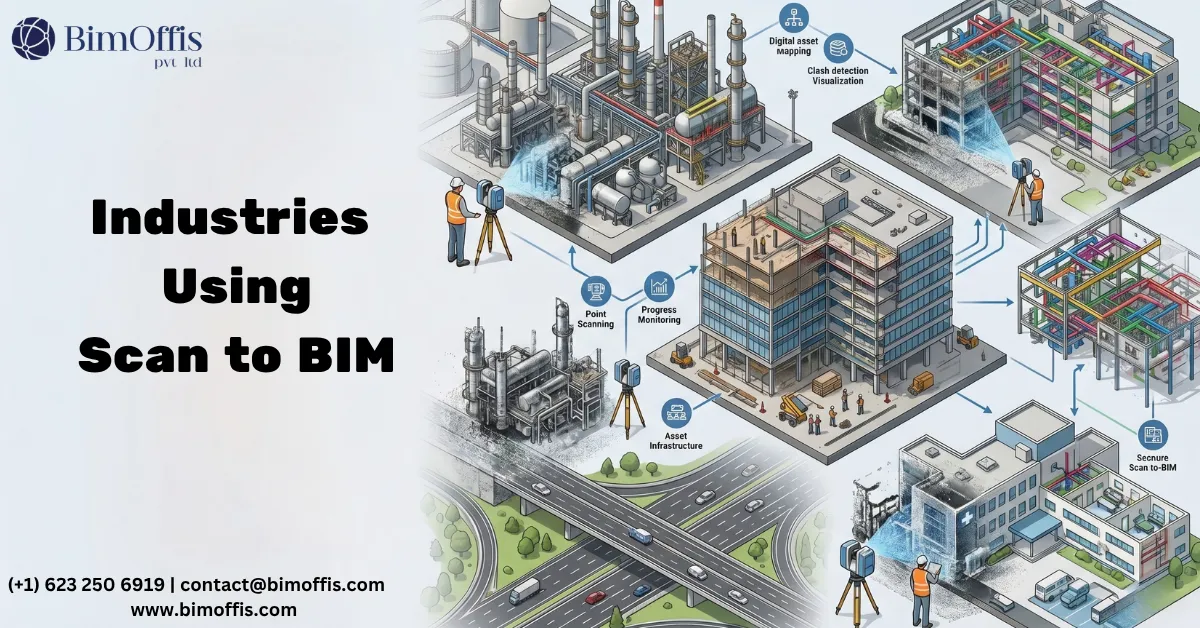
3D laser scan to BIM technology has moved well beyond its origins as a specialist tool. Today, industries from oil and gas to healthcare to heritage conservation use it as a standard part of how they document, plan, and manage built assets.
The reason is simple. Every industry that works with existing buildings, structures, or facilities faces the same core problem. Their documentation of what actually exists is either inaccurate, incomplete, or both. As a result, this gap hurts design work, maintenance planning, and operational decisions. Fortunately, 3D laser scan to BIM technology solves this problem more effectively than any previous method.
Oil and Gas: Why This Industry Adopted 3D Laser Scan to BIM Early
The Challenge of Complex Facilities
The oil and gas industry was among the earliest serious adopters of laser scanning. Furthermore, it developed 3D laser scan to BIM workflows at scale before most other sectors.
The reason is clear. Oil refineries, processing plants, and offshore platforms rank among the most complex built environments on the planet. They carry dense pipework, structural steelwork, equipment, and instrumentation. In addition, these configurations change continuously throughout the operational life of a facility. Worse, teams almost always document these facilities poorly, because the pace of modifications outstrips traditional documentation processes.
How Scan to BIM Solves the Problem
3D laser scan to BIM technology solves this problem directly. A laser scan captures every pipe, fitting, valve, and structural element at a level of accuracy that traditional surveys cannot match. As a result, engineers build a BIM model from that scan and design teams use it to coordinate modifications before physical work begins.
On a live processing plant, downtime costs hundreds of thousands of dollars per day. Therefore, getting modifications right before work starts is not a quality goal. It is an economic necessity.
Healthcare: Precision That Patient Safety Demands
Why Healthcare Facilities Need Accurate Data
Healthcare facilities represent one of the most demanding environments for this technology. Consequently, they also show some of its clearest value.
Hospitals and clinical facilities carry MEP infrastructure at a density that exceeds almost every other building type. For instance, operating theatres, intensive care units, and diagnostic imaging suites have mechanical, electrical, medical gas, and data infrastructure competing for the same ceiling and wall zones. In addition, infection control requirements and regulatory compliance obligations add further constraints that make accurate documentation critical.
The Benefits of Scan to BIM in Clinical Environments
3D laser scan to BIM technology lets healthcare teams document existing infrastructure accurately without lengthy physical surveys that would disrupt clinical operations. Moreover, the resulting BIM model supports renovation planning, MEP coordination, space planning, and compliance documentation, all from a single accurate digital record.
Furthermore, accurate scan data reduces the risk of teams discovering unexpected site conditions during works. Programme delays in hospitals carry a patient impact that goes far beyond financial cost.
Manufacturing and Industrial Facilities: Keeping Production Running
The Documentation Problem in Manufacturing
Manufacturing plants and industrial facilities face a version of the same challenge as oil and gas operations. Specifically, they are complex environments that change continuously and teams almost always document them poorly.
How Scan to BIM Supports Facility Improvement
3D laser scan to BIM technology gives facility managers an accurate digital record of their plant. This record supports capital project planning, equipment replacement, production line reconfiguration, and maintenance management. Additionally, teams can build this record without extended production shutdowns, because laser scanning is fast and minimally intrusive.
For example, automotive manufacturers, food processors, pharmaceutical producers, and electronics manufacturers all benefit from accurate scan data. In particular, it reduces the risk of conflicts between new equipment and existing services during installation. Discovering these conflicts in a model is far less disruptive than discovering them during works.
Heritage Conservation: Preserving What Cannot Be Replaced
Why Traditional Surveys Fall Short
Heritage conservation is one of the strongest natural fits for 3D laser scan to BIM technology. In fact, it delivers value here that no alternative approach can replicate.
Historic buildings present documentation challenges that traditional survey methods handle poorly. For instance, irregular geometry, complex profiles, non-standard construction, and centuries of modifications produce conditions that are genuinely difficult to capture accurately with manual equipment. Moreover, the quality of existing conditions documentation directly determines the quality of conservation decisions.
What Scan to BIM Delivers for Historic Buildings
3D laser scan to BIM technology captures the precise geometry of historic building fabric. This includes carved stonework, vaulted ceilings, irregular wall profiles, and deformed structural elements. As a result, conservation teams use this data to support faithful restoration, structural assessment, and the replication of historic details. Additionally, the resulting BIM model provides a permanent digital record that serves future conservation work for decades.
Commercial Real Estate: Managing Assets More Effectively
The Limitations of Traditional Property Records
Commercial real estate owners use 3D laser scan to BIM technology to produce accurate as-built documentation for buildings in their portfolios. Consequently, this improves how they manage, lease, and plan works for those assets.
Most property portfolios rely on original design drawings and institutional memory. However, this combination is unreliable. Scan-based BIM models replace it with a single accurate record that supports lease negotiations, space planning, fit-out design, and compliance management.
Supporting Fit-Out Design Teams
Furthermore, fit-out design teams benefit directly from scan data. Specifically, they need accurate existing conditions models to work from. Therefore, scan data removes the risk of basing designs on drawings that no longer reflect the building as it currently stands.
Infrastructure and Civil Engineering: Documenting What Exists Before Changing It
The Complexity of Existing Infrastructure
Infrastructure projects, including bridges, tunnels, railway stations, roads, and utilities networks, increasingly use 3D laser scan to BIM technology before design work begins. Specifically, teams use it to document existing conditions ahead of extensions, upgrades, or maintenance works.
Existing infrastructure geometry is frequently complex. As a result, traditional survey methods struggle to capture it accurately. However, 3D laser scan to BIM technology captures this geometry comprehensively and at sufficient accuracy for structural assessment, clearance analysis, and coordination of new elements.
The Cost of Getting It Wrong
Design errors discovered during infrastructure construction are expensive and disruptive to correct. Therefore, investing in accurate existing conditions data pays back clearly through avoided surprises during works.
Education and Public Buildings: Supporting Better Stewardship of Public Assets
Managing Large Portfolios of Aging Buildings
Universities, schools, government buildings, and public facilities use 3D laser scan to BIM technology to build accurate digital records of their building portfolios. As a result, this improves how they manage maintenance, plan capital works, and demonstrate compliance with building regulations.
Public sector asset managers often oversee large portfolios of aging buildings. In this context, accurate geometric data combined with intelligent BIM model data transforms how they understand their assets and plan investment.
Improving Day-to-Day Facilities Management
Additionally, facilities management teams gain the accurate infrastructure records they need to respond quickly and correctly to maintenance issues. Consequently, scan-based BIM models improve both long-term planning and day-to-day operational decisions across public building portfolios.
The Bottom Line: Why Every Industry Needs Accurate Existing Conditions Data
3D laser scan to BIM technology has found a place across diverse industries because it solves a universal problem. Specifically, the gap between what documentation says exists and what actually exists creates risk, cost, and poor decisions in every sector that works with built assets.
In conclusion, the industries using this technology most effectively share one key insight. They recognise that accurate existing conditions documentation is not a project overhead. Instead, it is the foundation that design quality, coordination reliability, maintenance effectiveness, and asset value all build on.
Unlock accurate building data and faster project delivery with advanced Scan to BIM solutions.
Frequently Asked Questions from Clients
What is 3D Laser Scan to BIM?
It converts laser-scanned building data into accurate BIM models.
Which industries use Scan to BIM technology?
Construction, infrastructure, healthcare, manufacturing, and facility management industries use it extensively.
Why is Scan to BIM valuable for renovation projects?
It provides accurate existing-condition data for planning and design.
How does Laser Scan to BIM improve facility management?
It supports maintenance, asset tracking, and space management with precise building data.
Can Scan to BIM be used for industrial facilities?
Yes, it helps document complex industrial environments and equipment layouts.
What are the key benefits of 3D Laser Scan to BIM?
Improved accuracy, reduced rework, better coordination, and faster project delivery.