3D laser scanning BIM for heritage restoration has transformed how conservation teams approach some of the most complex documentation challenges in the construction industry. Let me explain why by starting with a challenge that anyone who has worked on heritage building restoration knows well.
You are responsible for restoring a building that might be two hundred years old, possibly more. The original construction drawings, if they ever existed, are long gone. The building has seen multiple modifications over its history, and each intervention left its own mark on the fabric in ways nobody properly documented. The geometry is irregular in ways that standard construction simply is not. Walls are not perfectly plumb. Floors are not perfectly level. Arches have profiles that craftsmen shaped by hand, following no precise mathematical formula.
Before any restoration work can begin, therefore, someone needs to understand exactly what is there. Not approximately. Exactly. Traditionally, surveyors on scaffolding with measuring equipment produced drawings that were as accurate as human measurement in difficult conditions could make them. Reasonably good in straightforward areas. Increasingly approximate in areas that were difficult to access or complex in geometry.
3D laser scanning BIM for heritage restoration has changed this process fundamentally. The impact on what is achievable has been significant as a result.
What 3D Laser Scanning BIM Brings to Heritage Restoration
Capturing What Is Actually There
The core contribution of 3D laser scanning BIM for heritage restoration is the ability to capture existing conditions with accuracy and completeness that traditional survey methods cannot match.
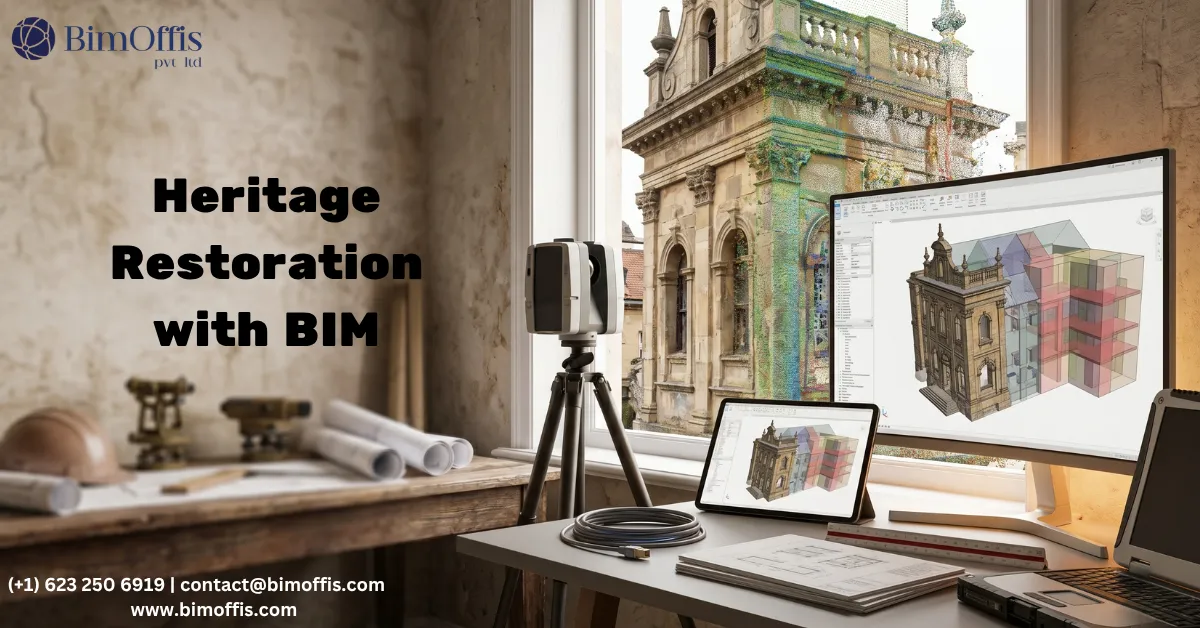
A laser scanner positioned in a heritage building fires laser pulses in every direction from a fixed position. Each pulse returns with information about the distance to the surface it hit. From multiple scanner positions throughout the building, a complete three-dimensional point cloud builds up, representing every visible surface with millimetre-level accuracy.
This point cloud captures things that traditional surveys struggle with. Carved stone cornices reveal their precise profiles. Vaulted ceilings show their exact geometry. Columns that lean slightly from vertical record their actual positions. Craftsmen built arches to eye rather than mathematical specification, and the scanner captures their true shape faithfully.
All of this gets captured automatically and comprehensively. The survey team does not need to reach every surface physically. They do not need to make judgment calls about whether a measurement is close enough. The scanner captures reality and the point cloud records it precisely.
Building the BIM Model From the Scan
The point cloud from the laser scan becomes the reference from which modelers build a BIM model of the existing building. This is where 3D laser scanning BIM for heritage restoration becomes specifically valuable rather than just any building survey.
A BIM model of a heritage building, built from laser scan data, is an intelligent and queryable record of the building’s existing condition. Every element reflects the actual geometry of the real building, not an idealised or simplified version. Irregularities, variations, and deviations from anything standard all appear in the model rather than being smoothed over for drawing convenience.
That accuracy matters enormously when restoration work involves matching or replicating historic fabric. The restorer who needs to replicate a stone moulding has access to the precise profile of the original from the BIM model. Furthermore, this digital record stays permanently available for future conservation teams to reference.
Where 3D Laser Scanning BIM Makes the Biggest Difference
Documentation of Existing Conditions
Before any heritage restoration project starts, the design team needs a comprehensive record of the existing building condition. This record serves multiple purposes. First, it establishes the baseline against which the restoration work gets measured. In addition, the record captures the condition of fabric that may change during works and needs accurate reproduction. Moreover, it provides the existing conditions reference against which new design work coordinates.
3D laser scanning BIM for heritage restoration produces this documentation faster and more accurately than traditional survey methods. A building that would take weeks to survey manually gets scanned in days. The resulting point cloud and BIM model provide geometric accuracy that manual survey simply cannot achieve in complex or difficult-to-access areas.
For heritage conservation bodies and planning authorities, this documentation additionally provides a permanent record of the building’s condition at the time of restoration. Future conservation teams can draw on this record for decades to come.
Structural Assessment and Analysis
Heritage buildings carry structural conditions that are often poorly understood. The original construction methods and centuries of loading, settlement, and modification are difficult to assess without accurate geometric information.
3D laser scanning BIM gives structural engineers accurate geometric data about the real condition of the structure. They can see exactly how much a wall has leaned and how significantly a floor has deflected. They can also measure how an arch has deformed over time. This information feeds directly into structural assessments based on the real condition of the building rather than assumptions about original construction intent.
For heritage buildings where structural condition is a significant conservation concern, this accuracy consequently determines whether an assessment genuinely reflects the risk or is working from insufficiently precise data.
Replication of Historic Fabric
One of the most technically demanding aspects of heritage restoration is replicating historic fabric. Carved stonework, decorative plasterwork, ornamental metalwork, and timber joinery were all made by skilled craftspeople working with methods that bear no relationship to modern construction standards.
3D laser scanning BIM for heritage restoration makes accurate documentation of this fabric possible in ways that transform the replication process. A stone carving that needs replication because the original is too damaged to retain gets scanned at high resolution. That scan produces a precise three-dimensional record of its geometry. This geometry feeds directly into the workshop drawing or digital manufacturing process for the replacement element.
The same approach applies to decorative plasterwork profiles, timber mouldings, and ironwork details. Furthermore, the 3D laser scanning BIM workflow replaces the painstaking process of manual measurement and profile tracing with a fast, comprehensive, and highly accurate digital capture.
Monitoring and Change Detection
Heritage buildings often need monitoring over time. Structural movement, material deterioration, and the effects of environmental conditions all need tracking. Detecting changes before they develop into serious conservation problems is far preferable to discovering them once damage is advanced.
3D laser scanning BIM supports monitoring through repeat scanning at intervals. A new scan compares directly with an earlier scan to identify and quantify changes in the building fabric. Wall movement that would be imperceptible to visual inspection becomes visible in the comparison. Moreover, deterioration that has progressed slightly since the last survey shows up clearly in the data.
This monitoring capability transforms long-term conservation management. Rather than relying on periodic visual inspection to identify problems, the conservation team consequently has access to precise geometric data that reveals changes at the earliest possible stage.
What Good Practice Looks Like in Heritage Contexts
Scan Resolution Appropriate to the Task
Different elements of a heritage building require different scanning resolution. Overall structural surveys work at relatively lower point density. Detailed documentation of carved fabric and complex profiles, however, requires high-resolution scanning. This captures the fine detail that conservation and replication work depends on.
Good practice therefore involves planning the scanning programme to achieve the right resolution in the right areas. Applying a single approach across the whole building rarely serves all purposes well.
BIM Models That Reflect Heritage Reality
The BIM model produced from a heritage building scan needs to reflect the actual geometry of the building. This includes its irregularities and deformations rather than imposing a simplified regular geometry that misrepresents the real condition.
This requires modelers who understand the purpose of the model and the heritage context it serves. A model that smooths over irregularities in a historic wall surface may be simpler to produce. However, it delivers less value for the conservation work the model is supposed to support. Consequently, the modeling approach must prioritise accuracy over convenience at every stage.
Integration With Conservation Management
The most valuable 3D laser scanning BIM for heritage restoration work does not stop at producing a model. Instead, it integrates the model into the broader conservation management of the heritage asset. This connects the geometric record with material condition data, conservation treatment records, and monitoring data. The result is a comprehensive digital record that serves the building’s conservation management over time rather than a one-off project deliverable.
The Bottom Line
3D laser scanning BIM for heritage restoration has become one of the most valuable tools available because it solves problems the conservation profession has lived with for as long as heritage buildings have needed restoring. Inaccurate existing conditions documentation. Difficult and time-consuming manual survey of complex fabric. Imprecise geometric data for structural assessment. Painstaking manual measurement for the replication of historic details.
The technology does not replace conservation expertise, craft skills, or deep knowledge of historic fabric. What it does, however, is give the people who have that expertise the accurate geometric information they need to apply it most effectively.
For any heritage restoration project where the complexity of the existing building fabric makes traditional survey methods inadequate, 3D laser scanning BIM for heritage restoration is not a technical luxury. It is, ultimately, the foundation that makes accurate, evidence-based restoration genuinely achievable.
Protect historic structures with precise 3D Laser Scanning BIM and restoration-ready documentation.
Frequently Asked Questions from Clients
What is 3D Laser Scanning BIM for heritage restoration?
It captures precise building data and converts it into BIM models for restoration projects.
Why is laser scanning important for historic buildings?
It records existing conditions accurately without damaging the structure.
What is a point cloud in heritage restoration?
A point cloud is a digital representation of a building created from laser scan data.
How does Scan to BIM support conservation projects?
It provides accurate documentation for restoration planning and decision-making.
Can 3D Laser Scanning capture complex historic details?
Yes, it accurately records intricate architectural features and irregular geometries.
Who uses 3D Laser Scanning BIM in restoration projects?
Architects, conservation specialists, engineers, and heritage consultants use it extensively.