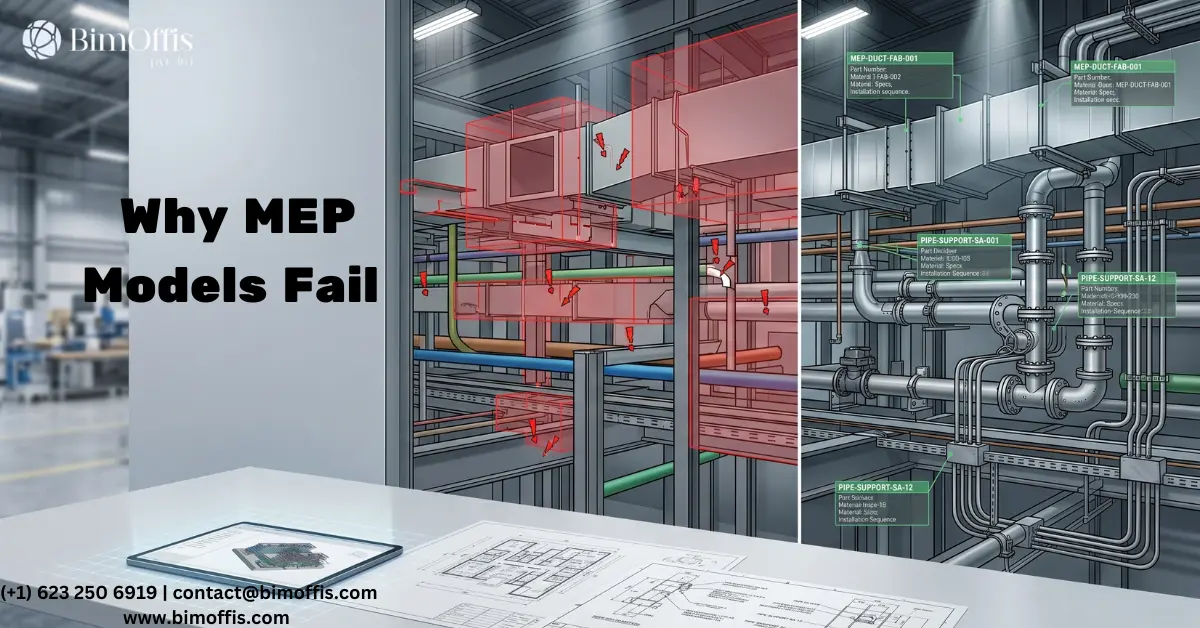
MEP modeling services teams deal with a problem nobody talks about openly on project sites. But quietly, behind the scenes, it derails MEP-heavy construction projects all the time.
Coordination wraps up. The model looks clean. Clashes are resolved. Everyone signs off and moves forward feeling good about the process. Then the ductwork fabricator opens the file and, within half an hour realizes half of what’s modeled can’t actually be built the way it shows.
Schedules slip. Costs go up. Everyone starts pointing fingers. And the question that should have been asked three months earlier finally surfaces: Did anyone ever actually build this model for fabrication? Or did the team only ever build it for coordination?
Those two things are completely different. Treating them as the same thing ranks among the most expensive mistakes you can make on a commercial or industrial construction project.
Understanding the Real Difference Between Coordination and Fabrication Models
This is where the confusion starts and it’s worth being direct about it.
A coordination model exists to resolve spatial conflicts. Its whole job involves making sure a duct doesn’t punch through a beam, a pipe doesn’t clash with conduit, and every trade gets enough physical room to do their work. That’s genuinely valuable and nobody dismisses that contribution.
A fabrication model carries a completely different purpose. It needs to represent exactly how real components get manufactured and assembled in the field. Every fitting, every transition, every connection point must reflect actual fabrication logic, standard manufacturer sizes, real connection geometry, field installation sequences, and the physical reality of how two pieces of material join together on site.
When someone hands a coordination model to a fabricator and treats it as fabrication-ready, that gap between purposes shows up almost immediately. And it never presents as a small problem.
Top Reasons Why MEP Coordination Models Fail in Fabrication
Fittings Are Modeled for Clearance Not Real Geometry
This probably ranks as the most common issue across MEP modeling services projects and it causes enormous downstream problems.
During coordination modeling, teams often represent fittings as simplified placeholder geometry. A transition piece becomes a basic tapered shape. Someone places an elbow at roughly the right location just to demonstrate clearance. During coordination nobody asks whether that fitting corresponds to an actual manufactured product from a real supplier catalogue.
Fabricators work from real catalogues with real dimensions. They need to know:
- Whether that elbow measures a standard 45 or 90 degree angle
- What the actual bend radius looks like
- Whether it arrives as a single piece or needs fabrication in sections
- How it physically connects to the adjacent straight run
When the coordination model shows a generic shape matching no real fitting, the fabricator rebuilds that entire section from scratch. Multiply that across a full floor of ductwork or a mechanical room full of pipework and you understand immediately why fabrication teams get frustrated and schedules collapse.
Routing Logic Ignores Field Installation Sequence
MEP Coordination models show where things go. Fabrication models must account for how things actually get installed in sequence, and those two considerations frequently conflict with each other.
A pipe run that looks perfectly clean in the coordination model might demand installation before an adjacent structural element sits in place. Ductwork might run through a ceiling space that makes perfect geometric sense but physically cannot lift into position because of how the surrounding structure sequences during construction.
MEP modeling services teams building coordination models focus on spatial resolution. Construction sequence rarely enters their thinking. Fabricators think about almost nothing else. That disconnect creates expensive field problems that earlier conversations could have prevented entirely.
Elevation and Offset Values Are Too Approximate
Getting a duct within an inch of the right elevation usually works fine for clash detection. For fabrication purposes it can completely break the installation.
Spool lengths depend on exact dimensions. Hanger locations require precise elevation data to calculate properly. Connection points to equipment carry zero tolerance for approximation. When fabricators pull dimensions from a coordination model and those numbers represent rough estimates rather than exact values, cut lengths come out wrong and pieces fail to align on site.
The installation sequence stops while the crew takes field measurements and the shop fabricates new spools. Time and money, both gone.
Placeholder Equipment Creates Hidden Dimensional Errors
This one catches projects off guard more regularly than anyone expects.
Coordination teams frequently use generic placeholder equipment, standard pump dimensions, approximate AHU footprints, assumed boiler sizes. Real specified equipment carries real dimensions, real connection point locations, and real service clearance requirements that almost never match the placeholder exactly.
When fabricators start working around actual delivered equipment and discover the coordination model used a unit even slightly different in size or connection location, every connected spool needs adjustment. The discrepancy seems minor. On a large mechanical room it rarely stays minor.
What Needs to Change in MEP Modeling Workflows
Define the Deliverable Purpose Before Modeling Starts
The most effective solution costs nothing and takes one honest conversation. Before modeling begins, the team needs to agree on what this model will actually serve.
When fabrication appears anywhere on the project roadmap, that reality needs to shape the modeling approach from day one. Practically this means:
- Using manufacturer specific fitting content from the very start
- Modeling to fabrication tolerances rather than coordination tolerances only
- Coordinating directly with fabricators on their specific workflow requirements
- Flagging routing decisions that work spatially but create fabrication headaches
Waiting until coordination completes before having this conversation arrives too late. The rework cost already sits baked into the project by then.
Bring Fabricators Into Coordination Early
Most projects bring fabricators in after coordination signs off. That approach runs exactly backwards.
Getting fabrication input during active coordination catches routing decisions that look fine on screen but create real problems in the shop or on site. Yes it adds one step early in the process. In return it removes several much more expensive steps later. Projects that handle this well pull fabricators into model reviews during coordination, not after the fact.
Document the Model Handover Properly
When a coordination model changes hands it needs clear written documentation covering:
- What the team built the model for and what they did not build it for
- What level of fitting accuracy the team used throughout
- Where placeholder equipment appears and what assumptions the team made
- What additional modeling work the fabricator needs before proceeding
Right now most model handovers amount to a file transfer with zero context attached. That communication gap is exactly where expectations break down and projects start going sideways.
How Strong MEP Modeling Services Teams Handle This
The firms doing this well aren’t doing anything magical. They simply ask better questions earlier in the process.
Before a single element gets modeled, strong teams establish a BIM Execution Plan defining model purpose and deliverable requirements clearly. Throughout the project they maintain open communication between coordination teams and fabrication teams. Whenever fabrication represents a downstream requirement, they use manufacturer specific content rather than generic geometry. And they document their modeling assumptions clearly so whoever receives the model understands exactly what they’re working with.
None of these steps require complicated workflows. They require discipline.
Final Thought
MEP coordination models deliver genuine value on construction projects. The problem isn’t that they exist, it’s that teams regularly hand them off for a purpose nobody ever designed them to serve.
The solution doesn’t require a new software platform or a bigger modeling budget. It requires an honest conversation at the start of every project about what the model needs to do, who needs to use it, and what level of detail actually serves the full project lifecycle.
MEP modeling services teams that understand this distinction deliver better project outcomes, not just better looking models. On complex construction projects that difference shows up exactly where it matters most, on site, on schedule, and within budget.
Ready to find out what your project will cost? Find out here.
Frequently Asked Questions from Clients
What is the difference between a coordination model and a fabrication model?
Coordination model finds clashes. Fabrication model shows exactly how parts get built and installed. Both look similar but do different jobs.
Why do MEP coordination models fail in fabrication?
Because they are built for clash detection only. Fittings are simplified and dimensions are approximate, not accurate enough for real manufacturing.
What are MEP modeling services?
A service that creates detailed 3D models of mechanical, electrical, and plumbing systems for construction projects
Can one model work for both coordination and fabrication?
Yes, but only if fabrication was planned from day one. Most coordination models need heavy rework before fabrication can start.
What is a BIM Execution Plan?
A simple document that defines how the model will be built and what it will be used for. It keeps everyone on the same page from the start.
Why do placeholder equipment cause problems?
Real equipment is never exactly the same size as a placeholder. Even small differences break pipe and duct connections on site.