How Machine Learning Is Changing BIM Clash Detection
If you’ve spent any real time on a BIM coordination project, you already know the frustration. You run a clash detection report and suddenly stare at 3,000+ results that mean almost nothing until someone manually digs through every single one. The industry has accepted this problem for years, not because it’s fine, but because no better way existed. That’s starting to change.
Machine learning is stepping into the coordination workflow. The impact is more practical than the headlines suggest. It’s not about robots replacing coordinators. It’s about giving coordinators their time back.
The Honest Problem With How Clash Detection Has Worked
Let’s not sugarcoat it. Traditional clash detection tools do exactly what they’re designed to do: they find every geometric intersection in a model and report it. All of them. Without context, without judgment, and without any understanding of what actually matters on a job site.
You Get Data, Not Answers
A mid-size commercial project can spit out thousands of clashes in a single Navisworks run. Some are real coordination nightmares, a 16-inch duct trying to pass through a structural beam with no room to reroute. Others are complete non-issues, a conduit crossing another conduit at an angle that never causes a field problem.
The software treats both the same. So your coordination team spends the first chunk of every review cycle sorting through results. They figure out which ones need attention and which ones to close immediately. That’s skilled time going toward essentially clerical work.
Clash Fatigue Is Something Nobody Talks About Enough
Here’s what nobody puts in the project report: when coordinators grind through thousands of flagged items, they get tired. Tired coordinators miss things. The really critical clashes, the ones that would cause a three-week delay in the field, can bury themselves under sheer volume.
This isn’t a failure of skill. It’s a failure of workflow. The tool produces more noise than signal, and the humans downstream deal with the consequences.
Where Machine Learning Actually Helps
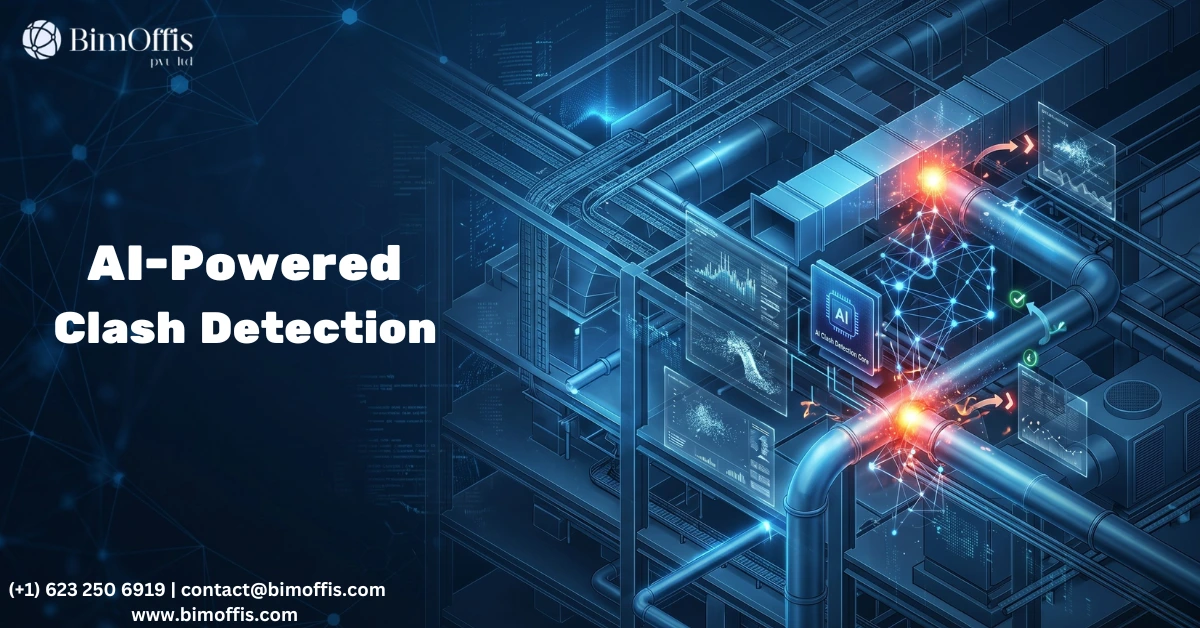
AI doesn’t fix clash detection by making it fancier. It fixes it by adding an intelligence layer between the raw data and the coordination team. That layer handles initial sorting, classification, and pattern recognition before a human ever opens the report.
Clash Prioritization That Actually Makes Sense
When an AI model trains on historical project data, it can examine a new batch of clashes and make reasonable judgments about which ones matter. It’s not guessing. It draws on patterns from how hundreds of similar conflicts resolved on previous projects.
What coordination teams get instead of a flat list is something closer to a working document:
- High-priority clashes – real spatial conflicts that need resolution before the model moves forward
- Clearance and access issues – soft clashes worth flagging for review but not necessarily urgent
- Geometric overlaps that won’t affect construction – conditions the software flags but experienced coordinators would close without a second look
- Duplicate entries – the same conflict appearing multiple times across discipline models
That pre-sorted output cuts through the noise before the coordination team even sits down. On complex projects, this alone cuts active triage time by more than half.
Recognizing the Same Problem in 40 Different Places
One of the more useful things AI does here is recognize when a single underlying issue generates dozens of individual clash reports. Say your HVAC routing consistently conflicts with the structural grid at every bay on a particular floor. Traditional clash detection gives you 40 separate entries. AI surfaces the root cause, the routing approach itself, so the team addresses it once rather than chasing it across the model.
That shift from instance-level to pattern-level thinking is significant. It also changes design team conversations. Instead of sending a clash report with hundreds of line items, you can focus the discussion on three or four coordination problems driving everything else.
The System Gets Smarter Over Time
Machine learning improves with data. Every resolved clash, every closed false positive, every RFI tracing back to a coordination miss, all of it becomes training material. For firms working in specific sectors, the system starts recognizing complexity patterns unique to healthcare projects, data centers, or high-rise residential.
Senior coordinators carry that institutional knowledge in their heads. AI makes it portable.
What This Means Day-to-Day for Coordination Teams
Shorter, More Focused Model Review Meetings
When AI handles the initial sort, teams walk into coordination meetings with a much cleaner picture. The meeting doesn’t start with “okay let’s go through the list.” It starts with the three real issues that need a decision. That changes the energy in the room and the pace of progress.
Clearer Communication Back to Design
One practical frustration in coordination work is translating a clash report into something an architect or structural engineer can act on. When AI-assisted reports include severity classifications and context about what drives the conflict, that communication becomes straightforward. You hand someone a brief, not a spreadsheet.
Real Cost Implications Over a Project Lifecycle
Senior BIM coordinators aren’t cheap, and they shouldn’t be. When their time goes toward sorting false positives instead of solving real problems, that’s a measurable cost. Getting that time back, consistently, across every model review cycle, adds up over a full project.
What AI Isn’t Going to Do
This is worth saying plainly. Machine learning won’t replace the judgment of a good coordination team. It doesn’t know that a particular subcontractor needs extra clearance for their crew. It doesn’t understand sequencing decisions that make certain clashes acceptable in one context and critical in another. That contextual knowledge still lives with people.
What AI does is clear out the low-value work so those people can focus on problems that actually need them. That’s not a small thing.
Where Things Are Headed
The tools are still developing. Integration with Navisworks, Revit, and BIM 360 keeps improving, and training datasets grow as more firms use these systems in production. Coordinators who build familiarity with AI-assisted workflows now will have a real advantage as the technology matures.
Projects aren’t getting simpler. Building complexity keeps increasing, more systems, tighter tolerances, more stakeholders. Workflows need to keep pace. AI in BIM powered clash detection isn’t a silver bullet, but it’s one of the most practical tools the industry has picked up in a while.
Ready to find out what your project will cost? Find out here.
Frequently Asked Questions from Clients
What is AI-powered clash detection in BIM?
It uses machine learning to automatically find and sort clashes in a BIM model, saving teams from reviewing thousands of results manually.
How is it different from traditional clash detection?
Traditional tools flag everything equally. AI ranks clashes by importance and filters out the ones that don’t matter.
Can AI miss important clashes?
Yes, it can, especially on unique projects with limited historical data. Human review is still necessary.
Does it work with Navisworks or Revit?
Yes. It integrates with platforms like Navisworks, Revit, and BIM 360 through plugins and built-in features.
Is it useful for small projects?
It helps, but the biggest benefit is on large, complex projects with high clash volumes.
Does the AI get better over time?
Yes. The more project data it learns from, the smarter and more accurate it becomes.