Understanding the Challenges in Renovation Projects
Anyone working on renovation projects has faced this situation before.
A design team receives existing building drawings that appear accurate at first glance. The plans show walls, columns, floor levels, and ceiling heights clearly enough to begin the project.
However, problems often appear during the first site visit.
For example, a wall shown as 200mm thick may actually measure 260mm. Similarly, a column may sit several hundred millimeters away from its marked location. In many cases, ceiling voids become smaller because previous contractors added structural elements without updating the drawings.
As a result, design teams face unexpected clashes, delays, and additional costs.
Over time, most buildings change through renovations, repairs, and undocumented modifications. Traditional surveys frequently miss these changes, especially in older structures. Consequently, inaccurate information continues into the design and construction stages.
This is exactly where Scan to BIM creates value.
What Scan to BIM Actually Means
How Laser Scanning Captures Buildings
Scan to BIM becomes much easier to understand once the technical language is simplified.
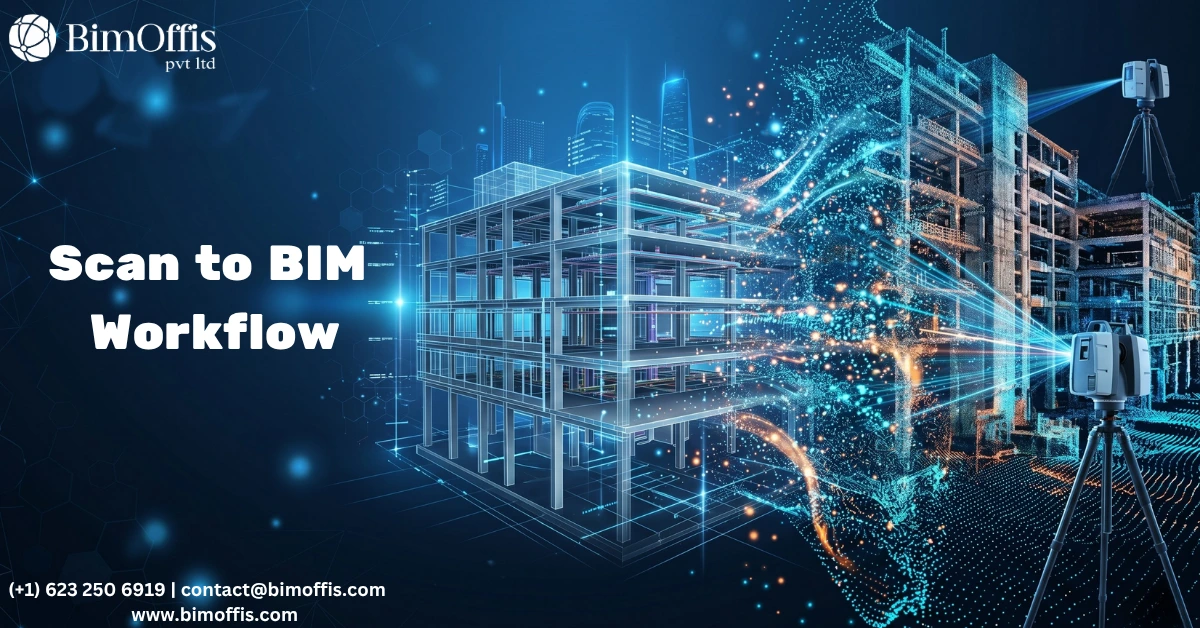
A laser scanner sits inside the building and sends millions of laser pulses across the space. Each pulse hits a surface and returns to the scanner. The scanner then calculates the exact distance between itself and the object.
Meanwhile, survey teams place scanners in multiple positions throughout the building. This process captures walls, ceilings, floors, columns, and services from every angle.
As a result, the collected information creates a highly accurate three-dimensional dataset called a point cloud.
Converting Point Clouds into BIM Models
The point cloud itself is not the BIM model.
Instead, BIM specialists use the scan data as a reference while modeling architectural, structural, and MEP elements inside BIM software.
Therefore, the final model reflects the building exactly as it exists today rather than how someone originally designed it years ago.
Additionally, this workflow allows design teams to coordinate projects using reliable existing-condition data.
Why Scan to BIM Improves Real Projects
Reducing Survey Errors
Traditional surveys rely heavily on manual measurements, handwritten notes, and sketches. Even experienced surveyors can make mistakes under difficult site conditions.
For example, common issues include:
Incorrect dimensions
Missed features
Misread heights
Estimated wall thicknesses
Undocumented alterations
Unfortunately, these small inaccuracies often create major downstream problems.
Architects may design layouts that do not fit onsite. Likewise, MEP engineers may route systems through spaces that are smaller than expected. Eventually, contractors discover clashes during installation, which increases both cost and project delays.
However, Scan to BIM significantly reduces these risks because teams work with highly accurate scan data instead of assumptions.
Capturing Complex Building Conditions
Some buildings contain conditions that traditional surveys struggle to document properly.
For instance, industrial facilities often contain dense pipework, machinery, and structural steel. Similarly, heritage buildings include irregular geometry and decorative details that manual measurements cannot easily capture.
Scan to BIM works particularly well for:
Industrial plants
Heritage structures
Commercial buildings with crowded ceiling voids
Multi-level basements
Restricted-access environments
Furthermore, laser scanning captures complete spatial information in three dimensions. Consequently, architects and engineers gain a clearer understanding of existing conditions before construction begins.
Improving Project Speed
Traditional surveys for large buildings often require several weeks of onsite measurements and drawing production.
By comparison, Scan to BIM reduces project timelines considerably.
Faster Site Surveys
Teams can scan large buildings within a few days instead of several weeks.
Faster Coordination
Accurate scan data helps architects, engineers, and contractors coordinate earlier in the design stage.
Fewer Site Revisits
Because teams work from reliable information, they spend less time revisiting the site to verify dimensions.
As a result, projects move through the design phase more efficiently.
Common Applications of Scan to BIM
Renovation and Refurbishment Projects
Renovation projects remain one of the strongest applications for Scan to BIM technology.
Before redesigning or extending older buildings, architects and engineers need highly accurate existing-condition information. Therefore, Scan to BIM helps teams reduce uncertainty during coordination and construction.
Moreover, accurate BIM models help contractors avoid expensive onsite surprises.
Heritage and Listed Buildings
Historic buildings also benefit greatly from laser scanning technology.
Many heritage structures either lack reliable drawings or contain decades of undocumented changes. Consequently, restoration teams require accurate digital records before starting conservation work.
Scan to BIM supports heritage projects by:
Recording existing conditions accurately
Supporting restoration planning
Assisting conservation approvals
Reducing invasive investigations
Creating permanent digital documentation
Additionally, conservation specialists can preserve valuable historical information for future generations.
Industrial Facilities
Industrial buildings contain highly complex environments filled with machinery, services, and structural systems.
Therefore, Scan to BIM helps industrial projects through:
Accurate retrofit coordination
Better clash detection
Improved maintenance planning
Reliable expansion studies
Stronger asset management
As a result, facilities reduce operational disruption during upgrades and renovations.
Infrastructure Projects
Infrastructure sectors increasingly use Scan to BIM for bridges, tunnels, rail assets, and highways.
For example, accurate digital models support:
Structural inspections
Maintenance planning
Condition assessments
Upgrade coordination
Long-term asset management
Consequently, infrastructure owners rely less on outdated drawings and more on reliable digital information.
Important Factors to Consider
Managing Point Cloud Data
Point cloud datasets often become extremely large. Therefore, project teams need proper management strategies.
Successful workflows usually require:
High-performance hardware
Efficient software platforms
Organized data structures
Clear collaboration procedures
Without proper planning, large datasets can slow down project workflows significantly.
Choosing Experienced BIM Specialists
The quality of the final BIM model depends heavily on the modeling team.
Even excellent scan data can produce poor outcomes if teams rush the process or misunderstand project requirements.
Therefore, experienced Scan to BIM specialists remain essential for successful delivery.
Defining the Scope Clearly
Clear scope definition also plays a major role in project success.
Before starting the project, teams should define:
Required Levels of Detail
Systems that require modeling
Intended model usage
Software compatibility requirements
Coordination expectations
As a result, everyone understands the project objectives from the beginning.
The Bottom Line
Scan to BIM continues to transform renovation, retrofit, and existing building projects across the AEC industry.
More importantly, the technology gives design teams greater confidence when working with complex existing conditions. Furthermore, accurate BIM models improve coordination, reduce construction surprises, and support better project delivery.
Firms using Scan to BIM workflows often achieve:
Better design accuracy
Faster coordination
Fewer onsite clashes
Improved efficiency
Stronger cost control
Ultimately, better information leads to better decisions throughout every stage of the construction process.
Ready to find out what your project will cost? Find out here.
Frequently Asked Questions from Clients
What is scan to BIM?
It is the process of laser scanning an existing building, converting that scan data into a point cloud, and building an accurate BIM model from it.
How accurate is laser scanning compared to traditional surveys?
Laser scanning captures millimeter-level accuracy across the entire building, while traditional surveys carry human error margins that consistently cause design problems downstream.
What is a point cloud?
It is a three-dimensional map of millions of data points captured by the laser scanner, representing every visible surface of the building with precise spatial accuracy.
What types of projects benefit most from scan to BIM?
Renovation, heritage, industrial, and infrastructure projects benefit most because existing conditions in these building types are too complex for traditional survey methods to capture reliably.
Does scan to BIM save time compared to traditional surveys?
Yes, laser scanning a large building typically takes two to five days on site, significantly compressing the overall survey timeline compared to traditional measured survey methods.
What is the biggest risk in a scan to BIM project?
Vague scope definition going in, without clearly defining what needs modeling, at what LOD, and for what end use, the model rarely serves the project team as well as it should.