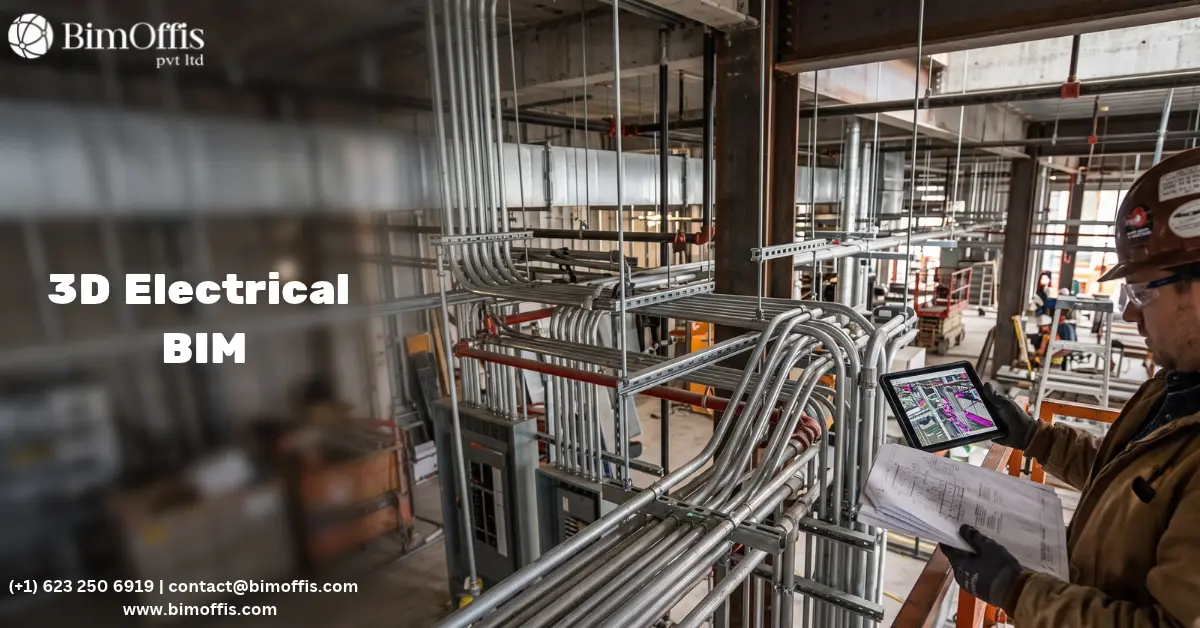
The electrical contractor arrives on site to begin installation. The cable trays are ready, the conduits are specified, and the panel locations are confirmed. Then someone discovers that the route the electrical design assumes is available is already occupied. A mechanical duct got there first. Or a structural beam sits exactly where the main cable tray run needs to go. Or the ceiling void that was supposed to accommodate the electrical infrastructure turned out to be 200mm shallower than anyone realised.
Work stops. The electrical contractor waits while someone figures out an alternative route. That alternative route needs approval, coordination with affected trades, and a design response from the engineer. By the time installation resumes, the programme has slipped, and the cost of the delay has landed on someone’s change order.
This situation is common. It is also almost entirely preventable. Electrical BIM services are the primary reason serious construction projects increasingly manage to avoid it.
What Electrical BIM Services Actually Cover
Electrical BIM services means building the electrical design of a building as an intelligent three-dimensional model rather than a set of 2D drawings.
Every element of the electrical system exists as a modeled object in three-dimensional space. Cable trays occupy their actual physical volume at their actual routing positions. Conduits run their actual routes through the building. Panels, switchboards, transformers, and distribution boards sit at their actual installed positions with their actual dimensional envelopes. Furthermore, lighting fixtures, power outlets, and data points appear at the correct locations and correct mounting heights.
That three-dimensional model then sits alongside the architectural, structural, and MEP models in a coordinated environment. Automated clash detection checks every element against every other element simultaneously, flagging every conflict before it becomes a site problem.
The services typically cover the full scope of electrical systems:
- Power distribution from incoming supply through to final circuits
- Lighting layouts with fixture types and mounting heights
- Cable tray and conduit routing coordinated against all other building systems
- Earthing and bonding systems
- Emergency power and UPS systems on relevant projects
- Data, communications, and security systems
- Fire alarm and detection systems
- Building management system infrastructure
Why the Coordination Value Is So Significant
Electrical Systems Compete for the Same Space as Everything Else
The ceiling void on a typical commercial floor plate is one of the most contested spaces in any building. Structural beams occupy it. Mechanical ductwork runs through it. Plumbing pipes cross it. Sprinkler systems cover it. Data and communications cabling threads through it. On top of all that, the electrical cable trays and conduits need to route through it as well.
Every one of these systems needs specific clearances. Cable trays need maintenance access above them. Conduits need separation from other services for safety and practicality. Moreover, high voltage and low voltage systems need spatial separation from each other. The intersection of all these requirements in a limited ceiling void makes electrical coordination one of the most complex challenges on any project with meaningful services density.
Electrical BIM services make this complexity manageable by putting all these competing requirements in the same three-dimensional space simultaneously. The automated clash detection does not just find obvious conflicts. It finds every location where any element of the electrical design occupies the same space as any element of any other system, or violates required clearances, regardless of how subtle the conflict is.
The Cost of Getting This Wrong on Site
Here is something worth understanding about the economics of electrical coordination failures.
When a conflict gets discovered on site, fixing it involves more than just rerouting a cable tray or conduit. The electrical contractor stops work while someone assesses the conflict. The project manager, engineer, and affected trade all spend time on something that should never have been a problem. A design response confirms the alternative route. Coordination with other trades ensures the alternative does not create a new conflict. Furthermore, acceleration costs often follow to recover the lost programme time.
The total cost of a single significant coordination failure on site typically runs many times the cost of the electrical BIM services that would have prevented it. On complex projects with dense services, where multiple coordination failures are likely without proper BIM coordination, therefore, the business case for electrical BIM services is not even particularly close.
What Electrical BIM Services Deliver Beyond Coordination
Accurate Documentation From the Model
When the electrical design exists as a coordinated BIM model, the documentation supporting construction and procurement comes directly from that model rather than from manual compilation.
Cable tray schedules, panel schedules, circuit schedules, and equipment lists all generate from the model automatically. When the design changes, the schedules update with it. Consequently, the documentation always reflects the current design rather than a version that existed before the last round of coordination revisions.
For electrical contractors managing their own procurement and installation planning, this accuracy matters considerably. Quantities come from a coordinated model reflecting what will actually be installed rather than from drawings that may have been superseded by coordination changes.
Supporting Prefabrication
Electrical BIM services also support prefabrication in ways that 2D drawing-based design simply cannot.
When cable tray routes are accurately modeled and coordinated, sections of cable tray can be prefabricated off-site to the exact dimensions the model specifies. Conduit assemblies can be fabricated to precise lengths and bend configurations. As a result, the prefabricated elements arrive on site ready to install in the coordinated positions without requiring site adjustment.
Prefabrication based on uncoordinated 2D drawings carries a significant risk that prefabricated elements will not fit when they arrive on site. Electrical BIM services remove that risk entirely because the geometry used for prefabrication comes from a model already checked against everything else in the same space.
Facilities Management and Operations
The electrical BIM model also carries value beyond the construction phase. A coordinated electrical model updated to reflect as-built conditions gives the building owner and facilities management team a genuinely useful record of the electrical infrastructure.
Panel locations, circuit layouts, cable routes, and equipment specifications all exist in a model the facilities team can query directly rather than requiring someone to interpret 2D as-built drawings. For buildings with complex electrical infrastructure, this operational value compounds significantly. Fault diagnosis, system upgrades, and future fit-out work all benefit from an accurate record of what is installed and where.
Where Electrical BIM Services Matter Most
Data Centers
Data center electrical infrastructure is some of the most complex and most coordination-intensive in the construction industry. Redundant power distribution, UPS systems, PDUs, bus ducts, and structured cabling infrastructure all interact in environments where coordination failures discovered during commissioning threaten the project’s go-live date.
Every serious data center project team uses electrical BIM services as a matter of course. The alternative is discovering conflicts during installation and commissioning at a point where fixing them is maximally disruptive and maximally expensive.
Healthcare Facilities
Healthcare buildings carry electrical infrastructure at a density that makes 2D coordination genuinely inadequate. Theatre suites, intensive care units, and diagnostic imaging facilities have power, lighting, medical equipment, emergency power, and data infrastructure all competing for the same limited ceiling and wall zones.
Electrical BIM services make coordination of this complexity achievable. The density of systems competing for the same space simply cannot be managed reliably through manual checking of overlaid 2D drawings.
Large Commercial and Mixed-Use Buildings
Commercial office buildings, mixed-use developments, and large residential schemes all carry electrical systems complex enough that proper coordination through electrical BIM services translates directly into smoother installation, fewer site conflicts, and more predictable construction programmes. The benefits show up consistently on every project where the services density justifies proper BIM coordination.
The Bottom Line
Electrical BIM services exist because electrical systems are complex, because they share space with every other building system, and because the cost of coordination failures in electrical installation is high enough to make prevention significantly more economical than cure.
The coordination value that comes from putting the electrical design into a properly built, properly coordinated BIM model catches conflicts during design rather than during installation. Everything else, the documentation accuracy, the prefabrication support, and the facilities management value, builds on top of that foundation.
For any project with meaningful electrical complexity, therefore, getting the coordination right during design is ultimately what makes the installation run the way it should.
Learn how Electrical BIM services enable clash-free construction.
Frequently Asked Questions from Clients
What are electrical BIM services?
They involve building the complete electrical design as an intelligent 3D model that coordinates against all other building systems before construction starts.
Why do electrical systems cause so many coordination problems on site?
Because cable trays, conduits, and panels compete for the same ceiling void space as structural beams, mechanical ductwork, plumbing, and sprinkler systems simultaneously.
How does electrical BIM prevent installation conflicts?
Automated clash detection checks every electrical element against every other building system in the model, flagging every conflict during design rather than during installation on site.
How do electrical BIM services support prefabrication?
Cable tray and conduit assemblies get fabricated off-site to exact model dimensions because the geometry comes from a fully coordinated model rather than uncoordinated 2D drawings.
Which project types benefit most from electrical BIM services?
Data centers, healthcare facilities, and large commercial buildings benefit most because their electrical infrastructure density makes 2D drawing-based coordination genuinely inadequate.
Does the electrical BIM model have value after construction?
Yes, a coordinated model updated to reflect as-built conditions gives facilities teams an accurate record of panel locations, circuit layouts, and cable routes they can query directly.