Clash Detection vs Clash Avoidance: Understanding Collaboration in BIM
Collaboration among the team of experts involved in the creation of designs is more important than ever. The higher the level of collaboration, the lower the number of clashes. However, to truly understand the collaboration requirements and the success probability of a built asset, both clash detection and clash avoidance need to be discussed and understood together.
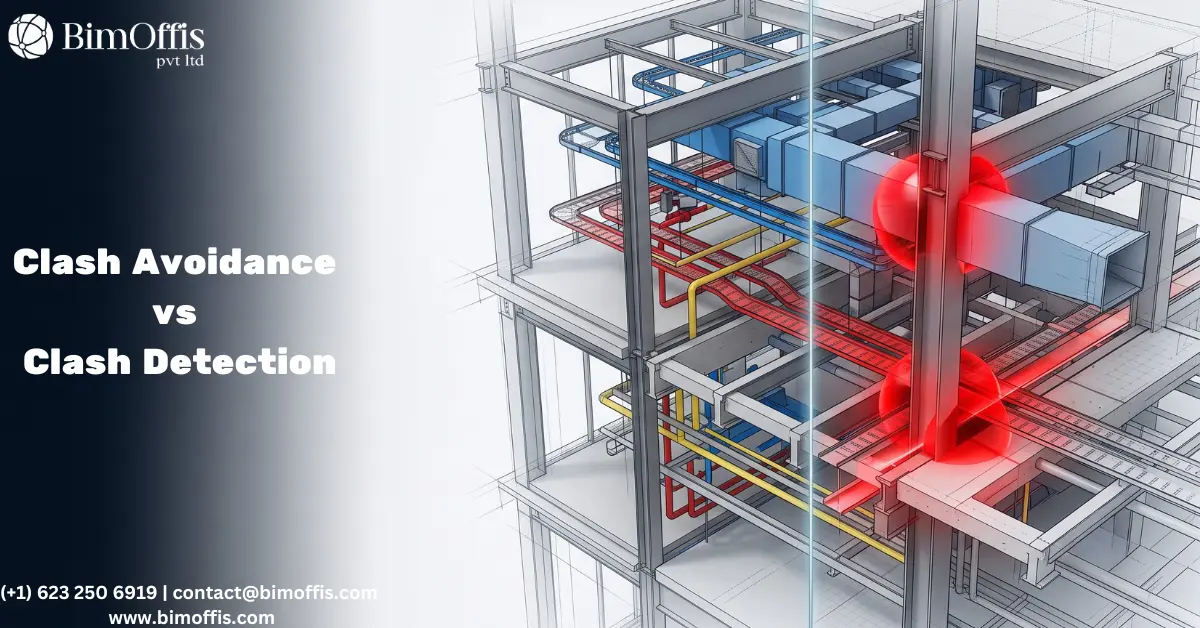
Clash detection refers to identifying clashes in a construction design. A clash occurs when two or more elements occupy the same space. There are three kinds of clashes: Soft, Hard, and Workflow clashes. Identifying these clashes during the pre construction phase saves both time and money.
Clash avoidance is part of the broader clash detection process, but it happens earlier. Clash avoidance is an attempt to prevent spatial overlaps and ensure spatial coordination from the outset. Coordination among the different components of a built asset is one of the key benefits of adopting BIM.
Clash Detection
- Clash detection is a reactive process. This means clashes are identified only after the construction drawings have already been prepared.
- In clash detection, the underlying software automatically detects overlaps between structures and different components.
- Clash detection is largely a pre construction process. Clashes in the design are detected before construction begins.
- Several clash detection software tools are available for this process, along with separate tools that help refine and improve clash set rules.
- Clash detection is largely a one person, software driven process. Much of the detection work is handled by the software itself.
- Clash detection and the correction of identified clashes take time. The designer or the person responsible has to go back and forth repeatedly until an optimal, clash free design is achieved.
Clash Avoidance
- Clash avoidance is a proactive process. It refers to the steps taken to prevent spatial overlaps and semantic conflicts in BIM models before they occur.
- Clash avoidance is strengthened by collaboration among the entire construction team, not just the design software.
- Clash avoidance is exercised throughout the construction process, from the very first stage of design all the way to the final stages, with strategies and techniques applied continuously.
- Clash avoidance goes beyond relying solely on clash detection tools. It involves investigating the root causes of clashes, which can reveal work practices that inhibit or restrict effective clash avoidance.
- Clash avoidance is a collaborative exercise. In this approach, the awareness and engagement of all stakeholders and AEC professionals is essential.
- Because problems are addressed earlier and more proactively, the time required to prevent clashes is significantly less compared to detecting and fixing them later.
Key Takeaway
Clash detection catches problems after they exist in the design; clash avoidance works to keep those problems from appearing in the first place. The two processes are not competing approaches but complementary ones. Strong collaboration among architects, engineers, and construction teams from day one reduces reliance on late stage clash detection and improves the overall efficiency, cost, and success probability of the built asset.
Learn more about clash detection services and clash report generation:https://bimoffis.com/get-free-quote/ .
Frequently Asked Questions from Clients
What is clash avoidance?
Clash avoidance is a proactive BIM approach that prevents design conflicts before they occur.
What is clash detection?
Clash detection identifies conflicts between architectural, structural, and MEP models before construction.
What is the difference between clash avoidance and clash detection?
Clash avoidance focuses on preventing clashes, while clash detection identifies and resolves existing clashes.
Which software is used for clash detection?
Autodesk Navisworks and Revit are commonly used for BIM clash detection.
Why is clash avoidance important?
It minimizes rework, reduces project delays, and improves collaboration among project teams.
Can clash avoidance and clash detection be used together?
Yes, combining both approaches delivers better coordination and more efficient project execution.