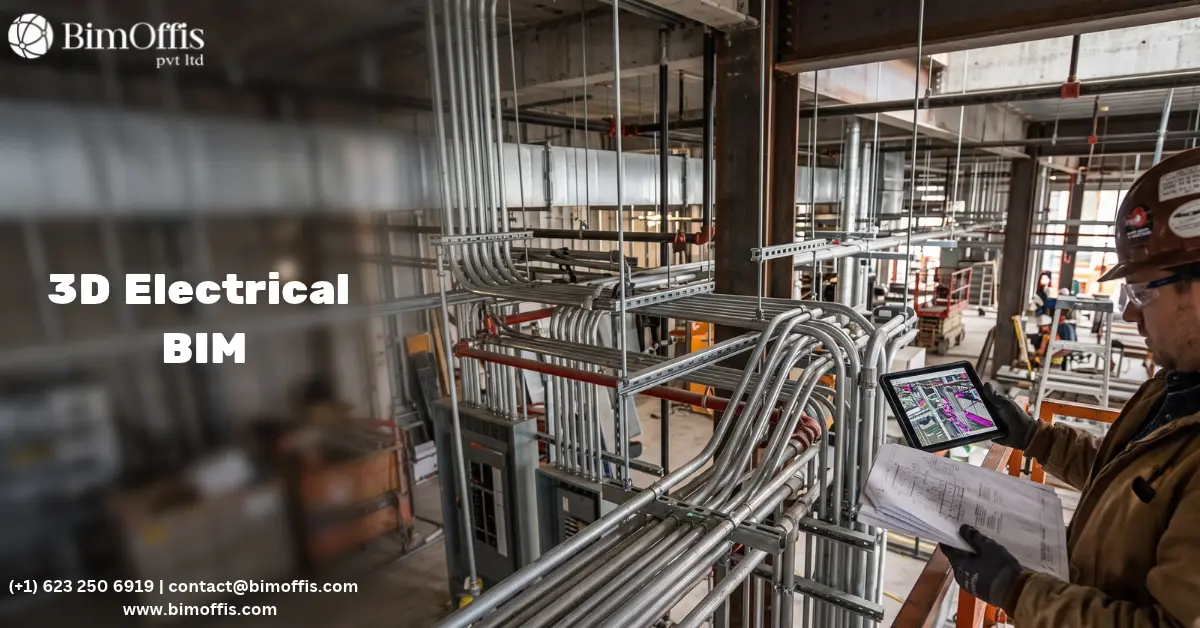
Let me start with something that electrical engineers working on complex building projects know from experience.
Electrical systems do not exist in isolation. They share space with mechanical systems, plumbing systems, structural elements, and architectural finishes. They need clearances that other trades also need. Furthermore, they route through ceiling voids, wall cavities, and risers that every other building system is also trying to use. The people designing those other systems are often working in parallel, making assumptions about what space is available, without a clear picture of what the electrical design actually needs.
That is the environment electrical engineering projects operate in. BIM in electrical engineering is what changes how that environment gets managed.
What BIM in Electrical Engineering Actually Means
BIM in electrical engineering means designing electrical systems as intelligent three-dimensional objects in a coordinated model rather than as symbols and lines on a 2D drawing.
A cable tray in an electrical BIM model is not a rectangle on a plan. It is a three-dimensional object occupying its actual volume at its actual routing position, with its actual width, depth, and required clearances accurately represented. A distribution board is not a symbol on a single-line diagram either. It is a modeled object sitting at its actual installed position with its actual dimensional envelope. Every element of the electrical design, from incoming supply through distribution to final circuits, exists in three-dimensional space that coordinates against every other system in the building.
That coordination is what makes BIM in electrical engineering genuinely valuable on real projects. Not the technology, not the software, but the coordination quality that accurate three-dimensional electrical modeling makes possible.
The Coordination Problem BIM Solves
Why Electrical Coordination Is Harder Than It Looks
On any significant building project, the ceiling void is one of the most contested spaces. Mechanical ductwork claims significant portions of it. Structural beams run through it. Plumbing pipes cross it. Sprinkler systems cover it. Data cabling threads through it. On top of all that, the electrical cable trays, conduits, and lighting infrastructure need to fit through what remains.
Every system has clearance requirements. Cable trays need maintenance access above them. High voltage and low voltage systems need spatial separation. Emergency systems need specific routing that avoids other services. When you try to coordinate all of these requirements through 2D drawings and manual checking, you catch the obvious conflicts and miss the subtle ones.
The subtle ones get discovered during installation. An electrician arrives to install cable tray and finds that the mechanical contractor installed ductwork through the route the electrical drawings assumed available. Work stops. Everyone looks for a solution. That solution takes time, costs money, and pushes the programme back.
How BIM Changes This
BIM in electrical engineering puts the electrical design into a coordinated three-dimensional environment alongside the mechanical, plumbing, structural, and architectural models. Automated clash detection then checks the electrical model against every other system simultaneously.
Every conflict gets flagged during design, not during installation. The cable tray that would have clashed with the mechanical duct gets rerouted during a coordination meeting. The conduit that would have passed through a structural beam gets redirected before anyone starts drilling. Moreover, the clearance violation that would have required rework on site gets resolved at a desk.
On complex projects, this shifts the coordination conversation from site management to design management. Problems that would have consumed days of site time get resolved in hours during design coordination.
What BIM in Electrical Engineering Delivers on Real Projects
Documentation That Reflects the Actual Design
When the electrical design exists as a coordinated BIM model, the documentation supporting procurement and construction comes directly from that model.
Panel schedules, cable tray schedules, circuit schedules, and equipment lists all generate from the model automatically. When the design changes through coordination, the schedules update automatically with it. Consequently, the documentation always reflects the current coordinated design rather than a version that existed before the last round of coordination changes.
For electrical engineers and contractors, this accuracy has direct procurement implications. Quantities and specifications come from a model reflecting what will actually get installed rather than from drawings that coordination revisions may have superseded.
Reliable Prefabrication
BIM in electrical engineering makes prefabrication reliable in ways that 2D drawing-based design cannot.
When cable tray routes exist as accurately modeled and coordinated three-dimensional geometry, sections of cable tray can be prefabricated off-site to the exact dimensions the model specifies. Conduit assemblies get fabricated to precise lengths and bend configurations. As a result, the prefabricated elements arrive on site ready to install in the coordinated positions without requiring adjustment.
Prefabrication from uncoordinated 2D drawings carries real risk. If the drawings do not accurately reflect the three-dimensional constraints of the installation environment, prefabricated elements may not fit when they arrive on site. BIM in electrical engineering removes that risk because the fabrication geometry comes from a model already checked against everything else in the same space.
A Record That Supports Building Operations
The electrical BIM model carries value beyond the construction phase. When the team updates the model to reflect as-built conditions, it becomes a genuine operational asset for the building owner and facilities management team.
Panel locations, circuit layouts, cable routes, distribution board specifications, and equipment data all exist in a model that facilities teams can query directly. When a fault occurs, the facilities team finds the relevant circuit, traces the route, and identifies the isolation points from the model rather than from paper records or 2D as-built drawings. For buildings with complex electrical infrastructure, that operational value compounds over the building’s life. Every maintenance intervention, every system upgrade, and every future fit-out project benefits from an accurate record of what is installed and where.
Where BIM in Electrical Engineering Makes the Most Difference
Data Centers
Data center electrical infrastructure combines the highest system density with the tightest coordination tolerances and the hardest commissioning deadlines. Redundant power distribution, UPS systems, PDUs, bus ducts, and structured cabling all interact in environments where a coordination failure discovered during commissioning threatens the project’s go-live date.
Every serious data center project uses BIM in electrical engineering as standard. The alternative is discovering conflicts during installation and commissioning at the worst possible point in the project timeline.
Healthcare Facilities
Healthcare buildings carry electrical infrastructure at a density that makes 2D coordination genuinely inadequate. Theatre suites, intensive care units, and diagnostic imaging facilities have power, lighting, medical equipment power, emergency power, and data infrastructure all competing for the same limited ceiling and wall zones.
BIM in electrical engineering makes coordination of this complexity achievable. The density of competing systems simply cannot be managed reliably through overlaid 2D drawings and manual checking.
Large Commercial and Mixed-Use Developments
Large commercial buildings, mixed-use developments, and high-rise residential projects all carry electrical systems complex enough to benefit significantly from BIM coordination. The ceiling void coordination challenge on a large commercial floor plate with dense MEP systems is genuinely difficult to manage without accurate three-dimensional electrical modeling. Furthermore, the benefits show up consistently on every project where the services density justifies proper BIM coordination.
What Makes BIM in Electrical Engineering Work Well
Getting genuine value from BIM in electrical engineering requires more than just using the software.
Families need to accurately represent real equipment and systems. A cable tray family that does not reflect the actual dimensional envelope of the tray it represents produces clash detection results that miss real conflicts. Equipment families need correct dimensional footprints, correct connector positions, and correct clearance zones.
Coordination needs to happen throughout design development, not just as a final check before construction documents go out. Early coordination catches conflicts while the design is still flexible. By the time construction documents go out, therefore, the electrical design has been checked against all other disciplines multiple times and the remaining coordination issues are genuinely complex rather than ones that earlier coordination could have caught.
The team also needs to maintain the model through construction so it reflects the as-built installation at handover rather than the design intent at construction document issue.
The Bottom Line
BIM in electrical engineering matters because electrical systems are complex, because they share space with every other building system, and because the cost of coordination failures in electrical installation is significant enough to make prevention substantially more economical than cure.
The value shows up in coordination quality during design, in installation efficiency during construction, and in operational usefulness after handover. For any project with meaningful electrical complexity, that value is real and measurable.
Getting the coordination right during design is what makes the installation run the way it should. BIM in electrical engineering is how that coordination actually happens properly on complex projects.
Discover BIM electrical engineering solutions for your next project.
Frequently Asked Questions from Clients
What is BIM in Electrical Engineering?
BIM in Electrical Engineering uses intelligent 3D models to design and manage electrical systems.
How does BIM improve electrical project coordination?
It enables real-time collaboration and identifies clashes before construction.
Which software is used for Electrical BIM?
Autodesk Revit and Navisworks are widely used for Electrical BIM workflows.
Does BIM reduce electrical installation errors?
Yes, BIM helps detect conflicts early and minimizes rework on site.
What types of projects use Electrical BIM?
Commercial, residential, industrial, healthcare, and infrastructure projects use Electrical BIM.
Why is clash detection important in electrical engineering?
Clash detection prevents conflicts between electrical, structural, and MEP systems.