If you’re getting into 3D design, architecture, or gaming, you’ve probably heard the word rendering a lot. At first, it sounds technical, but honestly, it’s pretty simple.
Rendering is just the process of turning a 3D model into a final image or scene that looks real. It’s the step where your design actually comes to life, lighting, shadows, textures, all of it.
There are two main types of rendering:
- Real-time rendering
- Traditional rendering
Both are powerful, but they work very differently.
Rendering, in simple terms
Think of rendering like editing a photo.
You start with something basic, then adjust lighting, colors, and details until it looks good.
In 3D, it’s similar but instead of editing a photo, you’re creating the whole visual from scratch.
What is Real-Time Rendering?
Real-time rendering is all about speed and instant feedback.
You move something, change lighting, or adjust the camera and you see the result immediately. No waiting.
This is exactly how video games work.
When you move around in a game, everything updates in real time. That’s real-time rendering in action.
Why it’s so useful
- You get instant feedback
- You can explore your design live
- It saves a lot of time
For example, if you’re showing a house design to a client, you can actually walk them through the space instead of showing static images.
What is Traditional Rendering?
Traditional rendering focuses on quality and realism.
Instead of showing results instantly, it takes time to carefully calculate lighting, reflections, shadows, and textures. Because of that, the final result looks much more realistic.
Why people still use it
- The output looks almost like a real photograph
- Lighting and shadows are more accurate
- Great for final presentations or marketing visuals
Yes, it takes longer but the results can be stunning.
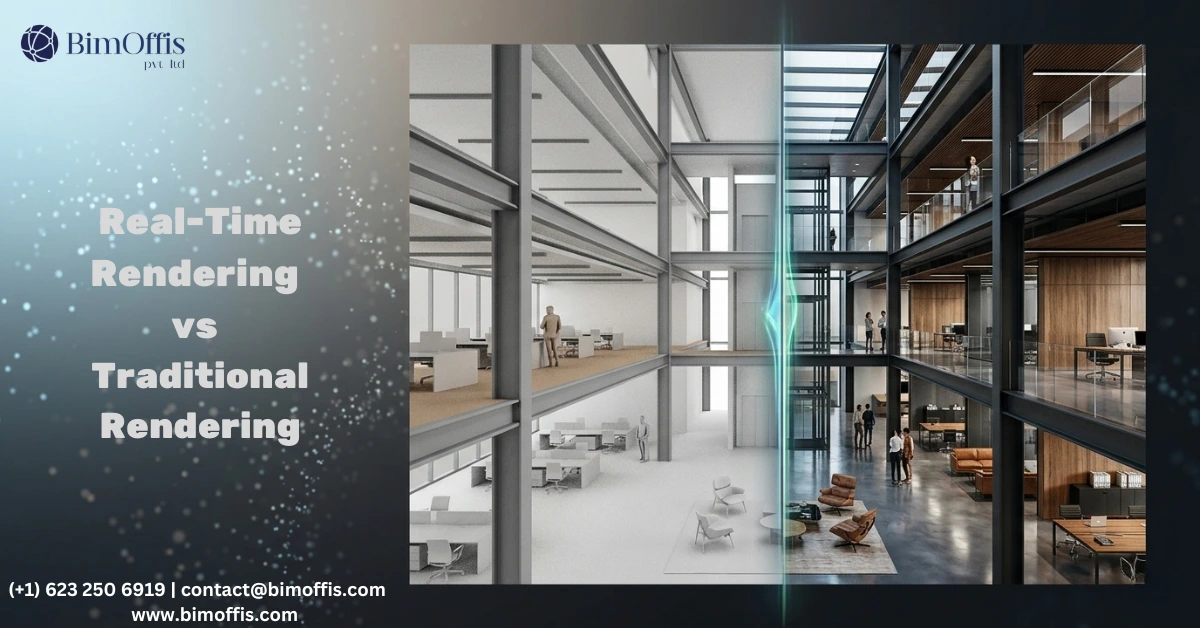
The Core Difference
Let’s not overcomplicate it:
- Real-time rendering = fast and interactive
- Traditional rendering = slower but highly realistic
That’s the main idea.
A simple example
Imagine you’re designing a living room.
With real-time rendering:
- You can change wall colors instantly
- Move furniture around easily
- Try different lighting in seconds
With traditional rendering:
- You create one final image
- It looks extremely realistic
- But you have to wait for it to render
So one helps you experiment, the other helps you present perfectly.
Why real-time rendering is becoming so popular
These days, speed matters a lot. Clients don’t want to wait hours just to see small changes.
Real-time rendering makes things much easier.
1. Instant changes
You don’t have to guess you can see results immediately.
2. Better communication
Clients understand designs faster when they can explore them.
3. Faster workflow
You can make decisions quickly without interrupting your process.
But traditional rendering still matters
Even with all the speed of real-time tools, traditional rendering isn’t going anywhere.
Because when it comes to final output, quality still matters.
If you’re creating:
- Product ads
- Cinematic scenes
- Final architectural visuals
You’ll want the best possible realism and that’s where traditional rendering shines.
Can real-time replace traditional rendering?
Real-time rendering is improving fast, and in many cases, it already looks very good. But for maximum realism, traditional rendering still has the edge.
That’s why most professionals don’t pick one they use both.
- The smart way to use both
- Use real-time rendering for design and previews
- Use traditional rendering for final output
This way, you save time and still get high-quality results.
What’s happening in the industry?
The gap between the two is getting smaller.
Real-time tools are becoming more realistic, and traditional rendering is getting faster thanks to better hardware.
So instead of replacing each other, both are evolving together.
Which one should you choose?
It depends on your work.
Go with real-time rendering if:
- You need quick results
- You want interactivity
- You’re working on games or walkthroughs
Go with traditional rendering if:
- You need high-quality final images
- You’re working on marketing or presentations
- You want photorealistic results
Final thoughts
There’s no “better” option just the right tool for the situation. Real-time rendering gives you speed and flexibility. Traditional rendering gives you realism and detail. If you’re serious about 3D work, learning both is the best move.
Frequently Asked Questions from Clients
What is rendering in 3D?
Rendering is the process of converting a 3D model into a final image or scene with lighting, textures, and shadows.
What is real-time rendering?
Real-time rendering shows changes instantly. It is commonly used in video games and interactive design tools.
What is traditional rendering?
Traditional rendering (offline rendering) takes more time but produces highly realistic images with accurate lighting and details.
What is the main difference between real-time and traditional rendering?
Real-time rendering is fast and interactive, while traditional rendering is slower but more realistic.
Where is real-time rendering used?
It is used in video games, virtual reality, architectural walkthroughs, and interactive design.
When should I use traditional rendering?
Use it for final presentations, marketing images, product visuals, and cinematic scenes where quality matters most.