Building Information Modeling (BIM) has become increasingly popular in the building design industry, with its ability to generate 3D models for project planning and management.
What is BIM management?
BIM technology can make a dramatic difference in design project success and delivery. This includes training and coaching them in various BIM software platforms and providing them with the necessary tools and resources for a project to succeed.
They also create monthly reports for senior managers to analyze how projects are performing, develop Autodesk Revit templates and BIM workflows to streamline production, troubleshoot issues that arise during the project, and automate certain components of the design process to speed up analysis, decision-making, and documentation.
BIM managers take the lead on the technical side of the project so that design managers can spend more time on the building design. Finally, BIM managers make sure that BIM models capture all elements of an intended design.
This can all be a tall order when you’re looking to hire in-house BIM managers.
In-house BIM management
Firms can take a few routes toward hiring an in-house BIM manager. They’ll either promote an existing design team member to this position, hire a headhunter to recruit for this competitive position, or form committees to tackle BIM management responsibilities as a team.
In-house BIM management requires spearheading BIM implementation for the company, coming up with BIM execution plans, delivering training, managing BIM projects, developing BIM content, coordinating the work of design consultants working in BIM, and inventing new workflows to speed up collaboration and production.
As such, in-house BIM management requires a team of highly skilled professionals well-versed in the latest BIM technologies.
Pros
In-house BIM management has several advantages to consider. Here are some of the most notable ones:
More control
In-house BIM management provides more security. Firms can keep a closed network where no one outside the company has access to their projects or standards, and directly control the development of their BIM standards and how they’re implemented in projects.
This can be valuable when you have tight deadlines and don’t have time to wait for a consultant to make changes for you.
You’ll also be able to directly control employee training and onboarding. External consultants and BIM outsourcing companies will usually teach their best practices and standards not yours.
Plus, they’ll never be knowledgeable enough about a building designer’s often nuanced approach to designing buildings. BIM consultants have to learn their clients’ industry in order to properly consult on it.
Utilizing in house resources reduces that learning curve and makes BIM implementation easier.
Increased security
If security concerns you, in-house BIM management might be the best way to go. That’s because outsourcing the management of a BIM project may require you to rely on an external party to handle your sensitive data and other confidential information.
When design teams host their projects locally on their server versus in the cloud, they can keep all of their data within a closed environment. In-house BIM management means your own trusted personnel manages your data, so you can keep it secure.
Cons
Despite the advantages of in-house BIM management, there are also some drawbacks. BIM management is a daily job that needs a lot of attention. When firms try to create this position (or positions) from within, people always get pulled into working on billable project work, abandoning their duties as a BIM manager.
Cost
Hiring an In-house BIM manager can be more costly. It means you need to cover their full-time salary, fund their professional development, and invest in your own BIM management tools.
Plus, BIM management is often a two-person job (at least). That’s because the person you hire might be great technically, but may not have the skills to fully implement BIM throughout your organization.
You’ll have to lean on another team member who may be better suited. That cost estimation can add up quickly and be a major financial burden for smaller organizations.
Need for skilled professionals
Using BIM for all phases of a project, from schematic design to construction administration and final deliverables at varying levels of detail, requires various different skill sets from the team members working on the project.
Even if you hire a single BIM manager to manage all of your projects, they might lack all the skills needed to do their job effectively.
For example, running clash detection during the design development or construction phase of a project is a skill that most BIM managers don’t have. You have to be knowledgeable in VDC software, such as Navisworks or Revizto.
That person would also have to be somewhat familiar with various construction methodologies to effectively run a BIM coordination meeting after running clash detection.
Filling all of these different roles and skill sets can be tough, and talent is already scarce for in-house roles. Finding a BIM manager who is great technically, understands building design and construction, and has the leadership capability to lead BIM coordination and BIM implementation within an office is rare, making this an extremely difficult position to fill.
Also, most BIM managers typically only last 2-3 years at a company. They’re either overworked and under-supported (leading to burnout), or they don’t have enough work to fill their time and end up doing billable project work, abandoning their core responsibilities altogether.
When hiring an in-house BIM manager, you also need to have a senior person skilled enough to check and manage that person’s work.
Outsourced BIM management
Essentially, outsourcing your BIM management to another company means you’re contracting experienced professionals familiar with industry standards and processes to do the job for you.
Pros
BIM consultants also come with a set of productivity tools that they can bring into your firm and customize for your specific needs. Based on your goals and the inefficiencies they uncover, they will know exactly which BIM tools and software to implement within your organization.
Save money
Outsourcing BIM management can cut your costs as well, both on training and infrastructure costs and by helping you use your resources efficiently. In fact, you can outsource a BIM service provider team for about the same cost as hiring a single person to do the job in-house.
A good BIM management outsourcing partner can also scale up or down depending on the size and complexity of your project, getting you the best value for your money. You might also get free access to some tools and resources as added perks.
Increase scalability
As your firm expands, outsourced BIM management teams can expand along with you, providing new tools, staff, and resources as your needs continue to develop. It’s already challenging to find one competent BIM manager. Finding multiple managers to effectively support your growing organization could take years and cost thousands of dollars in recruiting expenses.
BIM managers can be divided into two categories: those with strong technical skills and those who excel at implementing new systems. As your business grows, you will require both skill sets, and finding an individual who possesses both can be difficult.
However, both capabilities are necessary to help you address the expanding requirements of your enterprise. Working with an outsourced partner allows you to scale up or down at will.
Cons
As with the in-house option, outsourcing has some downsides. Here are the main cons of outsourcing BIM management:
Cultural Misalignment
Not all BIM consulting firms are the same. They each have different approaches to managing BIM projects.
Security concerns
When outsourcing BIM management, keep in mind that you may need to store data externally, and with that comes the inherent risk of your outsourced partners sharing your information with others.
Lack of control
Outsourcing involves having another party develop and implement your standards, and not all BIM experts have the same level of expertise. To ensure that you are always involved in the process, it is helpful to have bi-monthly check-ins to ensure that everything is on track.
In general, when you outsource your BIM management, you are essentially relying on your service provider.
Which to choose?
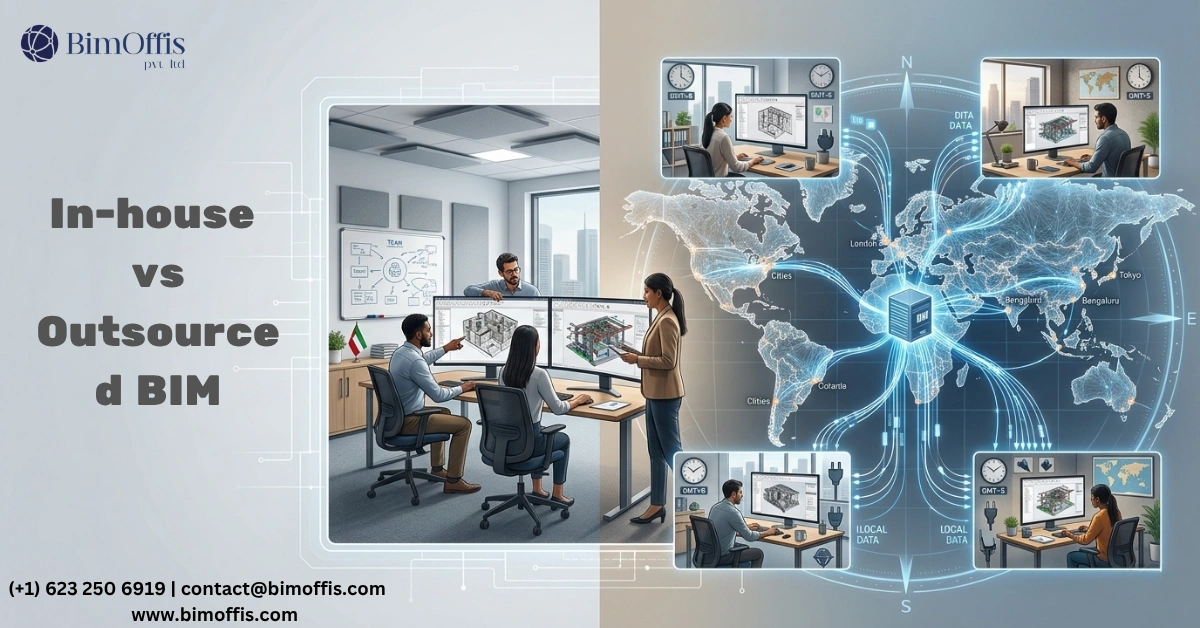
Now you’re faced with a choice: hire in-house or outsource your BIM management? To help decide, start by considering your goals. Are you looking to expand your office and get more work? Do you want to increase your in-house production capabilities? If so, outsourcing BIM management might offer a solution.
If you’re a large organization with enough resources, you might consider a hybrid approach and have an in-house person to handle the security issues posed by outsourcing, having them directly manage your outsourced partner.
Weighing these factors can help you make the best decision for your BIM project.
Conclusion
Choosing between in-house and outsourced BIM management really depends on your project needs, budget, and long-term goals.
If you want full control, better security, and a dedicated internal team, in-house BIM can be a good option. On the other hand, if you’re looking for flexibility, cost savings, and access to experienced professionals, outsourcing BIM may be the better choice.
There is no one-size-fits-all solution. Many companies are now also using a hybrid approach, combining in-house control with outsourced expertise to get the best of both worlds.
In the end, the right decision is the one that helps you improve efficiency, manage costs, and deliver projects more smoothly.
Frequently Asked Questions from Clients
What is BIM management?
BIM management involves planning, coordinating, and managing BIM processes in a construction project.
What is the difference between in-house and outsourced BIM?
In-house BIM is handled by your own team, while outsourced BIM is managed by an external company.
Which is better, in-house or outsourced BIM?
It depends on your needs. In-house gives more control, while outsourcing offers flexibility and cost savings.
Is outsourcing BIM cost-effective?
Yes, outsourcing can reduce costs related to hiring, training, and infrastructure.
Does in-house BIM offer better security?
Yes, because all project data stays within your organization.
What are the challenges of in-house BIM?
High costs, hiring skilled professionals, and managing workloads can be challenging.