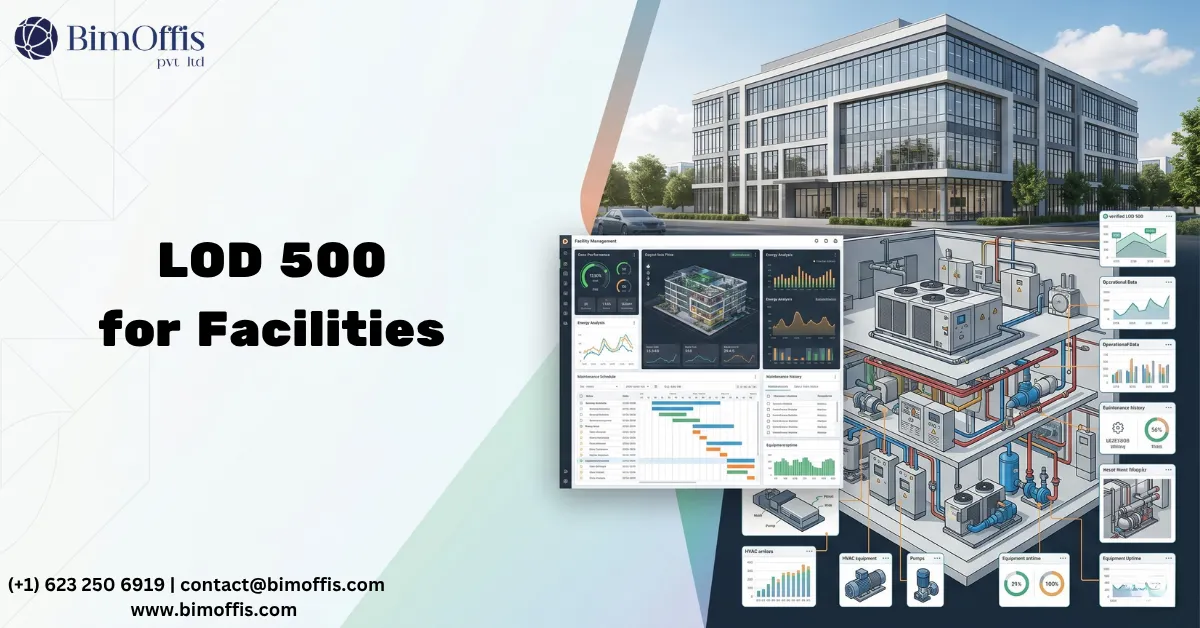
BIM LOD 500 represents the highest level of model development in the BIM process. This is the point where the model changes. It shifts from a design and construction tool into a verified record of what was actually built. For facility managers and asset owners, this transition matters enormously.
Let me explain why by starting with something that facility managers deal with regularly.
Something breaks in the building. A pump fails. A valve needs isolation. A section of pipework starts leaking behind a ceiling. The maintenance team needs to find the element, understand what it connects to, locate the nearest isolation point, and get someone in to fix it.
In most buildings, the next step involves searching through filing cabinets or shared drives for as-built drawings. Those drawings may not be current. They may not show the element at the right level of detail. They may not reflect modifications made since the original construction. Sometimes the drawings help. Sometimes they do not. Occasionally the maintenance team traces pipework through a ceiling void with a torch. The documentation simply does not tell them what is actually there.
BIM LOD 500 exists to make that situation obsolete.
What BIM LOD 500 Actually Means
Beyond Design Intent
LOD stands for Level of Development. It describes how much information a BIM model contains. It also shows how reliable that information is at each stage of a project.
LOD 100 is a conceptual massing model. LOD 200 adds approximate geometry in a schematic model. Design development shows up at LOD 300, where the model carries specific geometry and dimensions. LOD 400 goes further, adding fabrication ready detail along with installation information. BIM LOD 500, meanwhile, is the as-built model. It is verified against actual installed conditions, reflecting the building as it physically exists after construction is complete.
The Critical Distinction
The difference between LOD 400 and BIM LOD 500 comes down to design intent versus verified reality. A LOD 400 model shows how the building was designed and coordinated to be built. A BIM LOD 500 model shows how the building was actually built. Every element reflects verified installed positions, dimensions, and specifications.
This verification is what makes BIM LOD 500 genuinely useful for facility management. It is not just another project deliverable that sits in a file after handover.
Supports Facility Management
Finding Things Quickly and Accurately
The most immediate practical benefit of BIM LOD 500 for facility managers is speed. Teams can find any element in the building quickly and accurately. When the building exists as a verified as-built model, locating any component becomes simple. It turns into a model query rather than a drawing search.
Picture a maintenance engineer who needs to isolate a section of cooling pipework. They open the model, find the relevant pipework run, and trace it to the nearest isolation valve. Within seconds, they have the exact location, elevation, and access route in hand. On a large building with complex MEP infrastructure, the gap between verified model information and outdated drawings becomes significant. Multiply this across every maintenance event over a year, and the productivity improvement becomes genuinely substantial.
Accurate Asset Data for Management
BIM LOD 500 models carry verified data attached to every element. Equipment families include manufacturer information, model numbers, installation dates, warranty periods, and maintenance requirements. Structural elements carry material grades and section sizes. MEP systems carry system classifications, performance specifications, and connection information.
This data supports asset management in ways that 2D drawings simply cannot. Paper records, spreadsheets, and institutional knowledge all carry a risk. That knowledge disappears when experienced staff leave. The facility management team works better from a model holding all asset data in one queryable, reliable source.
Asset replacement planning also becomes significantly more accurate with verified information. The model shows what is installed, when it was installed, and what its expected service life is. As a result, the facility management team can plan capital expenditure against real asset data rather than estimates.
Supporting Planned Maintenance
Reactive maintenance, fixing things after they break, is the most expensive way to maintain a building. Planned maintenance, servicing equipment on a schedule before failures occur, costs less and causes far less disruption to building operations.
BIM LOD 500 supports planned maintenance in a direct way. It gives the facility management team a verified record of every maintainable element in the building. Service intervals, access requirements, and maintenance procedures all attach to the relevant model elements. Maintenance schedules get built directly from model data rather than from incomplete paper records.
When maintenance work requires access to areas above ceilings or behind walls, the BIM LOD 500 model helps in advance. It shows exactly what is in those areas before anyone opens them up. This preparation reduces the time maintenance interventions take. It also reduces the risk of accidentally damaging adjacent services during access.
Asset Management
A Reliable Record for the Building’s Entire Life
Buildings operate for decades. Over that time, they change considerably. Teams upgrade systems, reconfigure spaces, and replace equipment as operational needs evolve. Each of these changes creates a gap between what the documentation says is there and what is actually there.
BIM LOD 500 provides the verified baseline that makes managing these changes reliably possible. When a significant change happens, the team updates the model to reflect the new condition. The asset record stays current rather than gradually drifting away from reality. That drift is what tends to happen with paper records and original design drawings.
For building owners managing large property portfolios, this reliability compounds across multiple assets. Each building with a current BIM LOD 500 model becomes easier to manage. It is easier to plan works for, and easier to hand over to new tenants or operators when circumstances change.
Supporting Future Works
Every building goes through renovation, extension, or fit-out works at some point in its operational life. When those works happen, the design team needs accurate existing conditions information before they can design anything new.
A current BIM LOD 500 model gives future design teams a starting point they can trust. They do not need to resurvey elements the model already represents accurately. Instead, survey effort can go toward specific areas where additional verification is needed. The preconstruction phase moves faster, and the design that comes out of it rests on real conditions rather than assumptions.
Coordination quality also tends to be higher with a verified existing conditions model. That holds true compared to designing against original drawings. That renovation or fit-out project ends up delivering better outcomes with fewer surprises during construction.
Compliance and Regulatory Support
Many building types carry ongoing compliance and regulatory obligations that require accurate records of what is installed and where. Healthcare facilities, commercial buildings with fire safety certification requirements, and assets subject to environmental compliance all need reliable building records.
BIM LOD 500 supports compliance management by providing a verified, queryable record of the building’s installed systems and elements. When a compliance query arises about a specific installation, the model answers it directly. Nobody needs a physical investigation that costs time and disrupts operations.
The audit trail from a maintained BIM LOD 500 model shows what was installed. It also records when it was installed and when maintenance last occurred. That trail supports regulatory inspections far more efficiently than paper records ever could.
What Good BIM LOD 500 Practice Looks Like
Verification, Not Just Update
The key word in BIM LOD 500 is verified. A model updated from contractor submissions and marked-up drawings is not genuinely LOD 500 without field verification. That holds true no matter how complete it appears. True BIM LOD 500 requires field checks on critical elements. Those checks confirm actual installed positions before the team issues the model as the as-built record.
Good BIM LOD 500 practice builds the verification process into the construction programme rather than treating it as a handover activity. As installation progresses, the team updates the model to reflect installed conditions. Critical dimensions and positions go through field verification progressively. By the time the project reaches practical completion, the model reflects the actual building. There is no need for a compressed catch-up exercise in the final weeks.
Keeping the Model Current After Handover
A BIM LOD 500 model that gets delivered at handover and never updated again gradually loses its value. That happens as the building changes. Over time, the model starts reflecting what the building was at completion rather than what it is today.
The most effective approach treats the BIM LOD 500 model as a live asset rather than a project deliverable. When significant changes occur in the building, the team reflects those changes in the model as they happen. The model stays current, and the facility management team continues to benefit from verified as-built data. Otherwise, it slowly becomes as outdated as the drawings it was supposed to replace.
The Bottom Line
BIM LOD 500 supports facility and asset management by providing something most buildings lack. It offers a verified, intelligent, queryable record of what the building actually contains and how it is actually configured.
The practical benefits show up in several places. Faster maintenance response, more effective planned maintenance, better capital planning, stronger compliance management, and more reliable preconstruction for future works all follow.
For building owners and facility managers responsible for complex assets, BIM LOD 500 is not a handover formality. It is a long-term operational asset. It keeps delivering value for as long as the building stands and the model stays current.
Maximize the value of your building assets by speaking with our BIM LOD 500 specialists about your facility management needs.
Frequently Asked Questions from Clients
What is BIM LOD 500?
BIM LOD 500 represents verified as-built building information for operations and maintenance.
How does BIM LOD 500 support facility management?
It provides accurate building data for maintenance, repairs, and space management.
Why is LOD 500 important for asset management?
It helps track building assets with reliable, verified information.
Which projects require BIM LOD 500?
Healthcare, commercial, industrial, educational, and infrastructure projects.
What is included in a BIM LOD 500 model?
Verified geometry, asset data, equipment details, and as-built information.
How does BIM LOD 500 improve building operations?
It supports informed decisions, preventive maintenance, and efficient facility management.