Millwork shop drawing services are not all equal. Anyone who has worked through a difficult millwork package on a fit-out project knows this from experience. Some providers produce drawings that the fabricator can work from confidently. As a result, the designer can approve them without extensive back-and-forth. Other providers, however, produce drawings that raise more questions than they answer. Those packages, consequently, need multiple revision rounds before they become useful.
The difference between these two experiences comes down to a specific set of features. Professional millwork shop drawing services either have these features or they do not. Therefore, every interior designer, contractor, or millwork fabricator should understand what these features are, especially if they have felt the frustration of working through a poorly produced shop drawing package.
Let’s walk through the features that actually matter.
Accurate Dimensional Representation
Why Dimensions Are the Foundation of Everything
Dimensional accuracy is the most fundamental feature of professional millwork shop drawing services. After all, every dimension on every drawing needs to reflect the actual site conditions, the actual design intent, and the actual fabrication tolerances the workshop will follow.
This sounds obvious. In practice, though, dimensional accuracy in millwork shop drawings requires a discipline that not every provider applies consistently.
Site dimensions and design drawing dimensions often disagree. For instance, walls do not always sit where the design drawings show them. Similarly, floor-to-ceiling heights vary, and adjacent elements do not always sit at the positions the design assumed. To account for these discrepancies, professional millwork shop drawing services either require verified site measurements before producing drawings, or they explicitly flag dimensions that need site verification before fabrication begins.
In addition, the dimensional relationships between elements need internal consistency. Specifically, the elevation view, the plan view, and the section view of the same piece need to tell the same story at every dimension. Unfortunately, inconsistencies between views are a common failing in poorly produced millwork shop drawings, and this is one of the most reliable signs that a provider isn’t applying the care the work requires.
Clear Detail Drawings for Complex Conditions
The Details That Determine Quality
The visual quality of millwork comes down to details: the reveal on a cabinet door, the way a corner condition works, the transition between two different material types, the profile of a moulding, and the junction between a built-in piece and the adjacent wall or ceiling.
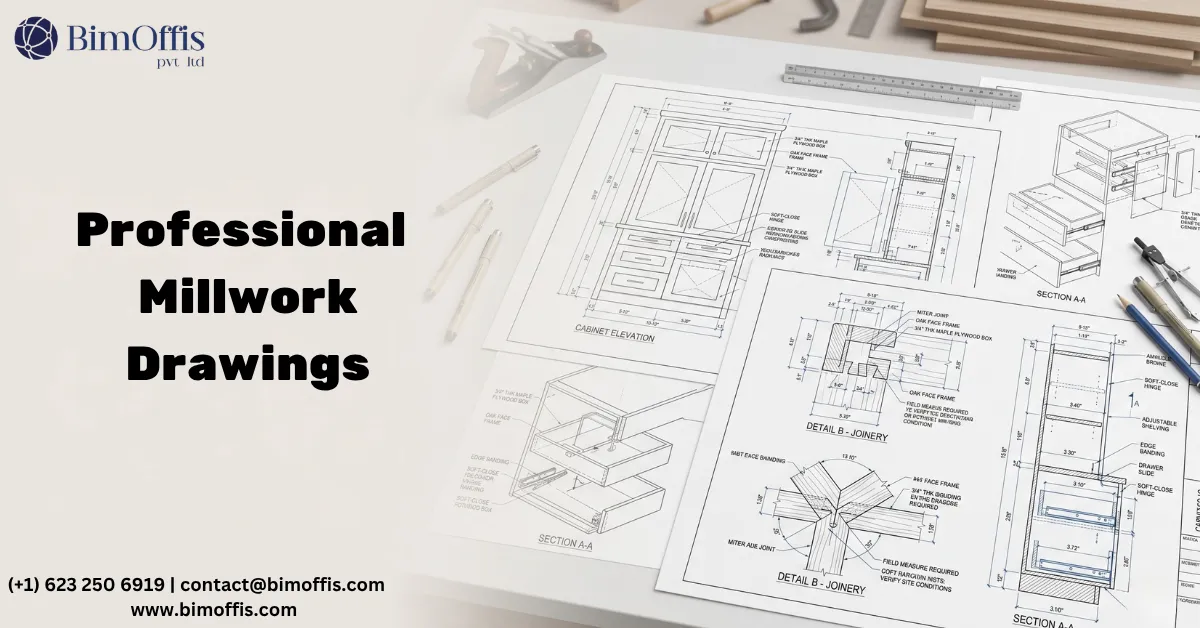
Professional millwork shop drawing services produce large-scale detail drawings for every condition of this type. These aren’t generic details that approximate the design intent. Instead, they are specific details that show exactly how each condition works for the specific piece in the specific location.
Furthermore, these details serve two audiences at once. On one hand, fabricators need them to understand how to build the piece correctly. On the other hand, designers need them to confirm that the proposed approach achieves the visual result the design requires. Because of this dual purpose, good detail drawings communicate clearly to both parties without forcing either one to guess.
What Good Details Include
A well-produced detail drawing shows the exact geometry of the condition at a scale where every element reads clearly. In particular, it shows material thicknesses, substrate types, and finish boundaries, and it also shows how adjacent elements relate to the millwork piece. Above all, it shows the specific dimensions the workshop needs for correct fabrication, rather than leaving the fabricator to derive them from the overall drawing.
Comprehensive Hardware Schedules
Why Hardware Is Not a Secondary Consideration
Hardware causes some of the most common millwork problems on fit-out projects. For example, a hinge might carry the wrong weight rating for the door leaf, or drawer runners might not provide the extension length the design requires. Likewise, pull handles might not align with the visual geometry of the face frame, and soft-close mechanisms might conflict with the specified hinge type.
To prevent these issues, professional millwork shop drawing services produce comprehensive hardware schedules that specify every hardware item for every piece of millwork in the package: manufacturer, model number, finish, fixing requirements, and any dimensional implications for the piece that houses the hardware.
This level of specification removes the ambiguity that leads to hardware problems. As a result, the fabricator orders exactly what the drawings specify, and the designer can then confirm that every hardware item meets the design requirements before the fabricator commits to an order.
Material and Finish Specifications
Clarity That Prevents Substitution Problems
Substrate choices, veneer species and cut, paint or lacquer finish specifications, edge treatment details, and any specialist finish requirements need unambiguous specification in professional millwork shop drawing services. Without this clarity, the fabricator ends up making material decisions that may or may not match the design intent.
Moreover, these specifications should reference specific products where the design intent requires them, rather than describing performance requirements that multiple products could satisfy. Where performance specifications make sense, however, the drawings should clarify the approval process for proposed substitutions. This way, the designer retains control over what actually gets used.
Coordination With Site Conditions and Adjacent Trades
The Feature That Prevents the Most Expensive Problems
Professional millwork shop drawing services coordinate the millwork design against the actual site conditions and against the work of adjacent trades. This feature prevents the most expensive category of millwork problem: fabricated pieces that don’t fit because nobody produced the shop drawings against verified existing conditions.
How Good Coordination Works
To begin with, professional providers require site surveys or verified as-built dimensions before producing drawings for pieces where fit against existing conditions matters most. Next, they coordinate the millwork drawings against the electrical drawings to ensure panel positions, outlet locations, and data point positions work correctly with the millwork design. In the same way, they coordinate against the mechanical drawings to ensure HVAC grilles, diffusers, and any mechanical elements housed in or adjacent to millwork pieces are correctly accommodated.
Additionally, good providers coordinate against the architectural drawings, along with any other trade packages that share interfaces with the millwork. Consequently, they show these interfaces clearly on the millwork drawings, rather than leaving the coordination to happen on site, where fixing problems costs more.
Revision Management and Documentation
Why Version Control Matters
Millwork shop drawing packages go through revisions. For instance, designers request changes, site conditions force dimensional adjustments, and hardware substitutions change the fabrication requirements. Because of this, professional millwork shop drawing services manage these revisions with clear version control, which ensures everyone on the project works from the current revision and that the change history stays documented.
Poor revision management is, unfortunately, a surprisingly common problem, and it creates real project headaches. Picture this: the fabricator works from revision two while the designer comments on revision three. As a result, those comments no longer align with what the fabricator plans to build, so the revisions get incorporated incorrectly and the fabricated pieces don’t match the approved drawings.
To avoid this, professional millwork shop drawing services maintain clear revision registers. Also, they issue drawings with explicit revision marks that show what changed between versions, and they communicate revision status clearly to every party involved. Finally, they keep the approved drawing set as a distinct document from the working drawing set, so no ambiguity ever creeps in about which drawings the fabricator is building from.
Responsive Communication and Turnaround
The Feature That Keeps Projects Moving
Even the most technically accurate millwork shop drawings won’t serve a project well if the turnaround time doesn’t fit the project programme. After all, millwork has lead times that directly affect the fit-out schedule. When shop drawing review and revision cycles run longer than the programme allows, therefore, the fabrication start date slips, and the installation date follows right behind it.
To manage this, professional millwork shop drawing services understand these programme implications and plan their turnaround accordingly. First, they set realistic turnaround commitments at the start of the engagement. Second, they communicate proactively when they need additional information, rather than waiting and letting the programme slip. Third, they process revision requests efficiently, so approved drawings reach the fabricator without unnecessary delay.
Throughout the process, these providers also maintain responsive communication with the design team. For example, they answer production questions quickly, and they route coordination queries to the right people. As a result, the Structural shop drawing process runs as a collaborative engagement, not a series of document submissions separated by long gaps.
The Bottom Line
In short, professional millwork shop drawing services deliver accurate dimensions, clear detail drawings, comprehensive hardware schedules, unambiguous material specifications, coordinated site conditions, disciplined revision management, and responsive communication. Each of these features, in turn, contributes to the outcome that interior designers and contractors actually need: millwork that arrives on site matching the approved drawings and installs without problems.
Providers who deliver all of these features consistently are, therefore, the ones worth working with on projects where millwork quality matters. Finding them before a difficult project, rather than after, ranks among the better investments any design or contracting team can make.
Get a Custom Millwork Shop Drawing Quote.
Frequently Asked Questions from Clients
What are Millwork Shop Drawing Services?
They provide detailed drawings for the fabrication and installation of custom millwork.
What features are included in professional millwork shop drawings?
Dimensions, materials, finishes, hardware, joinery details, and installation instructions.
Why are millwork shop drawings important?
They improve accuracy, reduce errors, and ensure smooth project execution.
Who benefits from millwork shop drawing services?
Architects, interior designers, contractors, manufacturers, and fabricators.
Can millwork shop drawings improve project coordination?
Yes, they help all stakeholders work from accurate and consistent documentation.
Which projects require millwork shop drawing services?
Residential, commercial, retail, hospitality, and office interior projects.