Mechanical 3D modeling services have changed how industrial equipment gets designed, validated, and manufactured. The change is not subtle. For engineering teams that have made the shift from 2D drawing-based workflows to proper 3D modeling, the before and after is stark enough that most would not go back regardless of the additional investment the transition required.
Let me explain why by starting with the problem that mechanical 3D modeling services exist to solve.
Industrial equipment design is complex in ways that 2D drawings handle poorly. A pump assembly involves dozens of components that need to fit together precisely, connect to adjacent systems accurately, and function correctly under operational loads. A pressure vessel needs to meet dimensional requirements, structural requirements, and regulatory requirements simultaneously. A conveyor system needs to route through a plant environment that carries its own spatial constraints.
Communicating all of that through 2D plan, elevation, and section drawings is possible. It is also slow, error-prone, and increasingly inadequate for the precision and coordination that modern industrial equipment design requires.
Mechanical 3D modeling services address this directly.
What Mechanical 3D Modeling Services Actually Cover
From Concept to Manufacturing-Ready Models
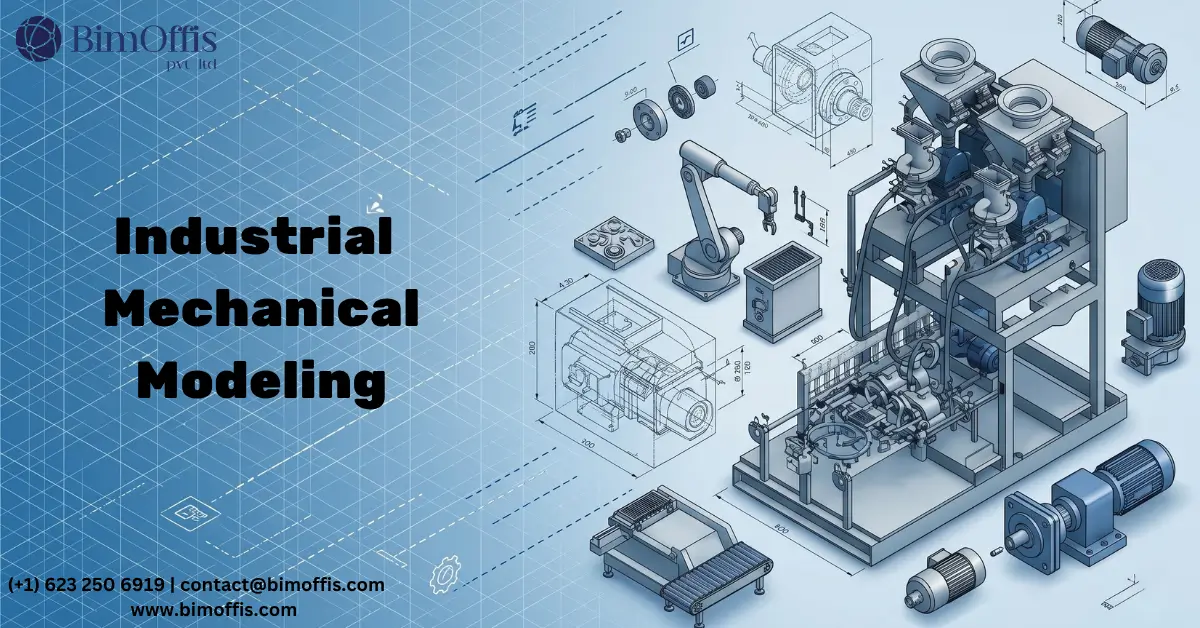
Mechanical 3D modeling services cover the full range of work involved in taking an industrial equipment design from initial concept through to manufacturing-ready documentation. This is not simply producing a 3D visualisation of the equipment. It is building an accurate, parametric digital model that serves as the foundation for engineering analysis, design validation, manufacturing documentation, and downstream integration with the plant or facility the equipment will sit in.
The scope of mechanical 3D modeling services on a typical industrial equipment project covers several areas. Conceptual 3D modeling explores the overall configuration and spatial arrangement of the equipment at an early stage. Design decisions remain flexible and cheap to change at this point. Detailed component modeling works out every part of the assembly at manufacturing precision, with correct geometry, correct tolerances, and correct material definitions. Assembly modeling brings the components together to confirm that they fit correctly. Furthermore, manufacturing documentation generates from the 3D model automatically, including fabrication drawings, parts lists, and material specifications.
Why Mechanical 3D Modeling Improves Industrial Equipment Design
Design Validation Before Anything Gets Made
The most significant advantage mechanical 3D modeling services bring to industrial equipment design is the ability to validate the design thoroughly before manufacturing starts.
In a 2D drawing workflow, the first real test of a design is often when the components arrive at assembly. If they do not fit together correctly, the problem gets discovered at the worst possible moment. Reworking a component after manufacture costs significantly more than adjusting a model before manufacture. Furthermore, some manufactured components cannot be corrected without complete remakes.
Mechanical 3D modeling catches these problems during design. When the complete assembly exists as an accurate 3D model, every component relationship is visible and verifiable. Clearances between moving parts get checked against the model. Interference between adjacent components gets flagged automatically. Access requirements for maintenance get evaluated against the assembled geometry.
The result is a design that the team has validated in three dimensions before manufacturing starts. Components that come off the production line fit together correctly on the first attempt rather than requiring rework that costs time and money the project did not budget for.
Supporting Engineering Analysis
Mechanical 3D modeling services also support the engineering analysis that industrial equipment design requires. Structural analysis, thermal analysis, fluid flow analysis, and fatigue analysis all become significantly more manageable when the design exists as an accurate 3D model rather than a collection of 2D drawings.
Finite element analysis runs directly against the 3D model geometry. The analysis results show the design team where stresses are highest, where material can be removed without compromising structural performance, and where the design needs reinforcement to meet the required safety factors. Consequently, the engineering analysis feeds back into design decisions rather than validating a design that is already fixed.
Furthermore, computational fluid dynamics analysis can model how fluids, gases, or heat move through the equipment in its operational condition. For industrial equipment where performance depends critically on flow characteristics, this analysis during design development prevents the performance problems that would otherwise only become apparent during commissioning.
Coordinating With the Surrounding Plant
Industrial equipment does not exist in isolation. It sits in a plant environment with adjacent equipment, pipework connections, structural steelwork, and access requirements that all need coordinating against the equipment design.
Mechanical 3D modeling services support this coordination by making the equipment model available for integration with the broader plant model. The equipment model sits in the plant environment and the design team can check immediately whether the equipment fits in its allocated space, whether the connection points align with the adjacent pipework, whether the maintenance access routes are clear, and whether the lifting path for installation is unobstructed.
This coordination during design is where mechanical 3D modeling services prevent the most expensive problems. An equipment installation that requires significant plant modifications to accommodate a piece of equipment that did not quite fit its intended location always costs more than the modeling work that would have caught it during design.
What Good Mechanical 3D Modeling Looks Like in Practice
Parametric Models That Support Design Development
Good mechanical 3D modeling does not produce static geometry representing one version of the design. It produces parametric models where design changes propagate correctly through the assembly when a parameter changes.
When the design team decides to increase the vessel diameter, a parametric model updates all of the components that depend on that diameter automatically. The flanges resize. The supports reposition. The nozzle connections update. The manufacturing documentation reflects the changed design. Consequently, design development becomes significantly more efficient because changes do not require manual updates to every affected component and drawing.
Models That Drive Manufacturing Documentation
Manufacturing documentation for industrial equipment, including fabrication drawings, assembly drawings, parts lists, and material specifications, should derive from the 3D model rather than a separate manual exercise alongside it.
When manufacturing documentation generates from the model, the drawings always reflect the current design. Changes to the model flow through to the drawings automatically. The parts list reflects the current component definitions. The material specifications reflect the current material selections. Moreover, the dimensional information in the drawings is consistent with the model because it comes from the model rather than manual entry into a separate drawing.
This documentation accuracy matters for manufacturing. A fabrication drawing with a dimension that does not match the 3D model produces a component that does not fit the assembly. When the drawing and the model share the same source, that discrepancy cannot occur.
Integration With Plant and Facility Models
Mechanical 3D modeling services that integrate with the broader plant or facility BIM model deliver significantly more value than those that produce stand-alone equipment models.
When the equipment model sits in the plant model, the coordination checks that matter for installation become possible during design. Pipework connection alignments, structural clearances, access route verification, and maintenance space confirmation all happen in the context of the real plant environment rather than in isolation. Consequently, the equipment arrives on site and installs in the way the design intended rather than requiring modifications to fit conditions that were not fully understood during design.
Where Mechanical 3D Modeling Services Make the Most Difference
Complex Multi-Component Assemblies
Mechanical 3D modeling services deliver the most value on equipment designs with high component counts and complex assembly relationships. Rotating machinery, heat exchangers, pressure vessels with multiple nozzle connections, and conveyor systems with many interacting elements all benefit significantly from the interference checking and assembly validation that accurate 3D modeling makes possible.
Equipment Subject to Regulatory Compliance
Industrial equipment that needs to meet regulatory standards, including pressure vessels, lifting equipment, and safety-critical process equipment, benefits from mechanical 3D modeling in two ways. The analysis capabilities that 3D modeling supports help demonstrate compliance during design. Additionally, the accurate manufacturing documentation that derives from the model supports the certification and inspection process.
Equipment Installed in Dense Plant Environments
Any equipment installed in a plant environment where space is limited and coordination with adjacent systems is critical benefits from mechanical 3D modeling services that integrate with the plant model. The coordination value of knowing that the equipment fits its space and connects correctly to adjacent systems before it arrives on site is consistently worth the investment.
The Bottom Line
Mechanical 3D modeling services improve industrial equipment design by solving problems that 2D drawing workflows handle poorly. Design validation before manufacture catches assembly problems when fixing them costs modeling time rather than manufacturing cost. Engineering analysis runs against accurate geometry and feeds back into design decisions. Coordination with the surrounding plant environment happens during design rather than during installation.
The industrial equipment designs that consistently deliver manufactured components fitting together correctly, meeting their performance requirements, and installing in their plant environments without significant modification are almost universally the ones where mechanical 3D modeling services were applied properly from early design through to manufacturing documentation.
Accelerate your equipment design by working with our mechanical 3D modeling experts to create precise, production-ready CAD models.
Frequently Asked Questions from Clients
What are Mechanical 3D Modeling Services?
They create detailed 3D CAD models for mechanical components and equipment.
Which industries use Mechanical 3D Modeling Services?
Manufacturing, industrial, automotive, aerospace, and energy sectors.
What software is used for Mechanical 3D Modeling?
SolidWorks, Autodesk Inventor, AutoCAD, and Creo are widely used.
How do 3D models improve equipment design?
They enhance visualization, accuracy, and manufacturing efficiency.
Can Mechanical 3D Modeling reduce design errors?
Yes, it helps identify issues before production begins.
Why outsource Mechanical 3D Modeling Services?
Outsourcing provides expert support, faster turnaround, and cost-effective solutions.