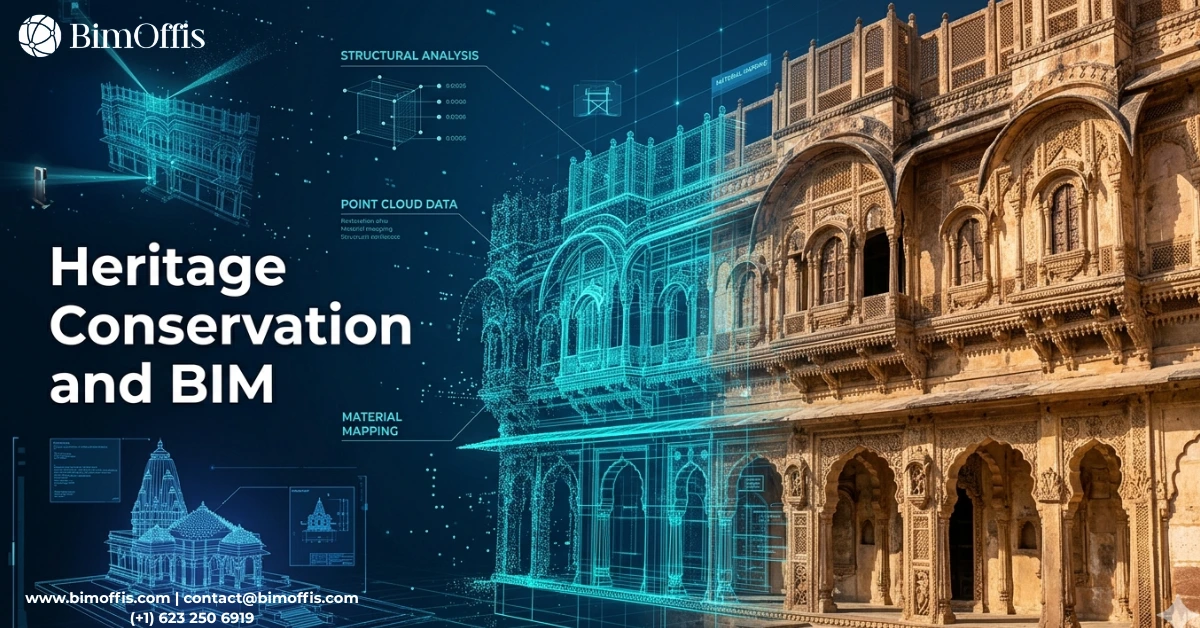
Heritage buildings are gateways to our history, cultural significance, architectural innovation, and stories of the past. However, preserving these structures is not easy, as they face structural wear, environmental threats, and usability requirements. To address these challenges, Building Information Modelling (BIM) offers a transformational approach by combining tradition with modern technology.
What is BIM?
Building Information Modelling (BIM) is a digital representation of a structure’s physical and functional characteristics. In other words, it acts as a “digital twin” of a heritage structure. Furthermore, it uses tools such as laser scanning and photogrammetry to create precise 3D models.
BIM for Heritage Conservation
1. Accurate Documentation
Firstly, BIM ensures accurate documentation of heritage structures.
- 3D Scanning: It captures every detail of the structure, including cracks, contours, and ornaments.
- Digital Archive: It creates a reliable baseline for future restorations.
2. Data Integration
Moreover, BIM integrates historical data efficiently.
- It combines old blueprints, archival photos, and previous restoration records.
- As a result, it maintains authenticity while applying modern interventions.
3. Condition Assessment
In addition, BIM helps assess structural conditions.
- It identifies structural weaknesses and material degradation.
- Therefore, teams can prioritize repairs based on data insights.
4. Simulation and Testing
Another advantage is simulation capability.
- It tests restoration techniques and materials before implementation.
- Additionally, it simulates environmental impacts such as temperature and humidity changes.
5. Enhanced Collaboration
BIM also improves collaboration among stakeholders.
- Architects, historians, and engineers can work on a shared platform.
- Consequently, communication becomes seamless with real-time updates.
6. Future-Proofing
Finally, BIM supports long-term preservation.
- It acts as a living digital archive.
- Thus, it enables ongoing maintenance and adaptive reuse.
Real-Life Applications of BIM in Heritage Conservation
- Notre-Dame Cathedral, Paris: BIM models created before the 2019 fire helped guide restoration by preserving intricate details.
- St. Peter’s Basilica, Vatican City: Continuous analysis and maintenance are possible through detailed digital models.
- Sydney Opera House, Australia: BIM supports regular monitoring and maintenance of this UNESCO World Heritage Site.
Challenges in Using BIM
Despite its advantages, BIM has some challenges:
- High Initial Costs: Small sites require a lot of investment in both laser scanning and model creation.
- Skill Gaps: Use of BIM tools requires specialized training which conservation teams need.
- Data Management: The data you store and process is large and robust infrastructure is required.
The Future of BIM in Heritage Conservation
Looking ahead, BIM will become even more powerful with new technologies:
- AI Integration: Predictive maintenance and automated analysis
- Virtual Reality (VR): Immersive educational experiences
- Generative Design: Reconstruction of lost heritage elements
Conclusion
In conclusion, heritage conservation goes beyond preserving physical structures. It also protects the stories, culture, and legacy they represent. Therefore, BIM plays a crucial role by bridging the gap between the past and the future. By adopting BIM, we can ensure that heritage sites remain preserved, functional, and inspiring for generations to come.
Frequently Asked Questions from Clients
What is BIM in heritage conservation?
BIM (Building Information Modelling) is a digital method used to create accurate 3D models of heritage buildings for preservation, restoration, and maintenance.
Why is BIM important for heritage buildings?
BIM helps by improving planning, reducing errors, and avoiding unnecessary rework.
How does BIM help in documenting heritage structures?
BIM uses technologies like 3D laser scanning and photogrammetry to capture detailed information, including cracks, textures, and architectural features.
What is a digital twin in heritage conservation?
A digital twin is a virtual replica of a heritage building that reflects its real-world structure and condition.
Can BIM store historical data?
Yes, BIM can integrate old drawings, archival photos, and past restoration records into one unified digital model.
How does BIM help in condition assessment?
BIM identifies structural issues, material damage, and weak areas, helping teams plan repairs effectively.