Tall buildings look clean and perfect once they are finished. But during construction, things are usually far from perfect. There are meetings, design changes, coordination issues, delays, and constant back-and-forth between teams. That is the reality of most high-rise projects.
And to be honest, MEP coordination is where things become difficult.
A high-rise building is not handled by one team alone. Architects work on design, structural engineers focus on the building frame, MEP teams handle services, contractors manage execution, and site teams try to keep everything moving on schedule. All of them are connected. If one thing changes, something else is affected too.
That’s why BIM has become such an important part of high-rise construction.
Why Coordination Becomes a Problem
In small projects, teams can usually solve issues quickly. But high-rise buildings are different because everything is happening at a larger scale.
There are more floors, more systems, more workers, and more chances for mistakes.
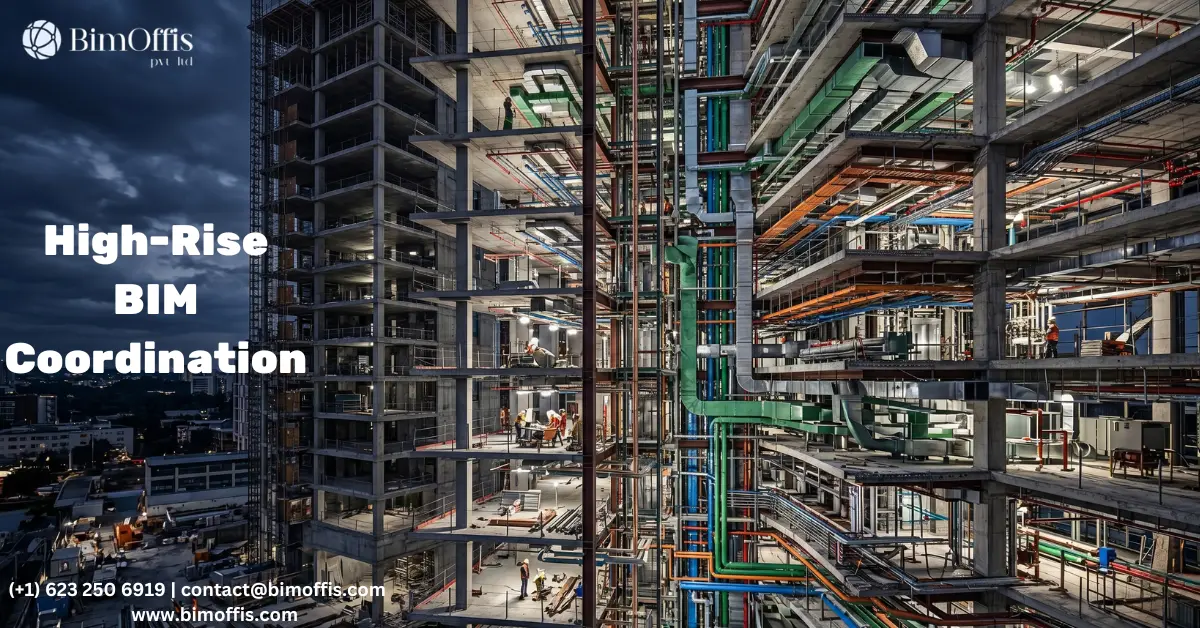
For example, if a duct line clashes with a beam on one floor, the same issue might repeat on ten other floors as well. A small error can suddenly become a major site problem.
And most of the time, these issues don’t come from bad work. They happen because different teams are working on different parts of the project at the same time.
That is where coordination starts becoming complicated.
The Old Way Was Stressful
Earlier, many construction companies relied mostly on 2D drawings. Teams checked layouts manually and tried to coordinate using separate files and printed plans.
The problem was simple, not everyone always had the latest information.
One team updated drawings while another team continued working from older versions. Site engineers often discovered clashes only after installation started.
Then work stopped.
Calls started.
Meetings increased.
And deadlines became harder to manage.
Anyone who has worked on a tower project has probably seen this happen.
How BIM Actually Helps
BIM makes coordination easier because everyone works on a shared model instead of disconnected drawings.
Architects, engineers, and contractors can review the same project information together. If something changes, the update becomes visible to all teams.
That reduces confusion.
Instead of finding problems during construction, teams can catch many issues early during the design stage itself.
This is one of the biggest reasons BIM is now widely used for high-rise projects.
Clash Detection Saves a Lot of Trouble
One of the most useful things in BIM is clash detection.
In simple terms, it helps teams identify where systems are overlapping before work starts on-site.
For example:
- A plumbing pipe passing through a structural beam
- HVAC ducts blocking electrical trays
- Fire sprinkler lines conflicting with ceiling layouts
Without BIM, these problems are often discovered late. Fixing them during construction costs both time and money.
With BIM, teams can solve many of these issues digitally before workers even begin installation.
That makes the construction process smoother.
High-Rise Projects Need Better Planning
Tall buildings are difficult because different activities happen together.
Concrete work may continue on upper floors while electrical and finishing work starts below. Materials need to move constantly. Labor teams need proper scheduling. Equipment needs space.
Without planning, sites become chaotic very quickly.
BIM helps project managers understand the sequence of work more clearly. Teams can plan activities floor by floor and coordinate work better.
That helps reduce unnecessary delays.
BIM Is Becoming Normal in Construction
A few years ago, BIM was seen as something extra. Now many companies treat it as a basic requirement, especially for large projects.
Clients expect faster delivery, fewer mistakes, and better coordination. BIM helps companies meet those expectations more effectively.
And in high-rise construction, where even small mistakes can create expensive problems, that support becomes very valuable.
Conclusion
The truth is, high-rise projects are complicated by nature. There are too many teams, systems, and moving parts involved for coordination to ever feel easy.
But BIM helps make the process more manageable.
Using BIM for High-Rise Buildings allows teams to communicate better, detect issues earlier, and handle complex projects with less confusion during construction.
And when a project involves hundreds of people working together on one tower, better coordination can make a huge difference.
Ready to find out what your project will cost? Find out here.
Frequently Asked Questions from Clients
What is BIM in high-rise construction?
BIM is a digital process that helps architects, engineers, and contractors work together using one shared building model.
Why is BIM important for high-rise buildings?
High-rise projects involve many systems and teams. BIM helps reduce coordination mistakes and improves project management.
How does BIM help avoid construction clashes?
BIM software detects conflicts between structural, electrical, plumbing, and HVAC systems before construction starts.
Can BIM reduce project delays?
Yes, BIM improves planning and coordination, which helps teams avoid rework and unnecessary delays.
Who uses BIM in a high-rise project?
Architects, structural engineers, MEP consultants, contractors, and project managers all use BIM during different project stages.
Is BIM only useful during design?
No, BIM is also useful during construction, scheduling, quantity estimation, and facility management after project completion.