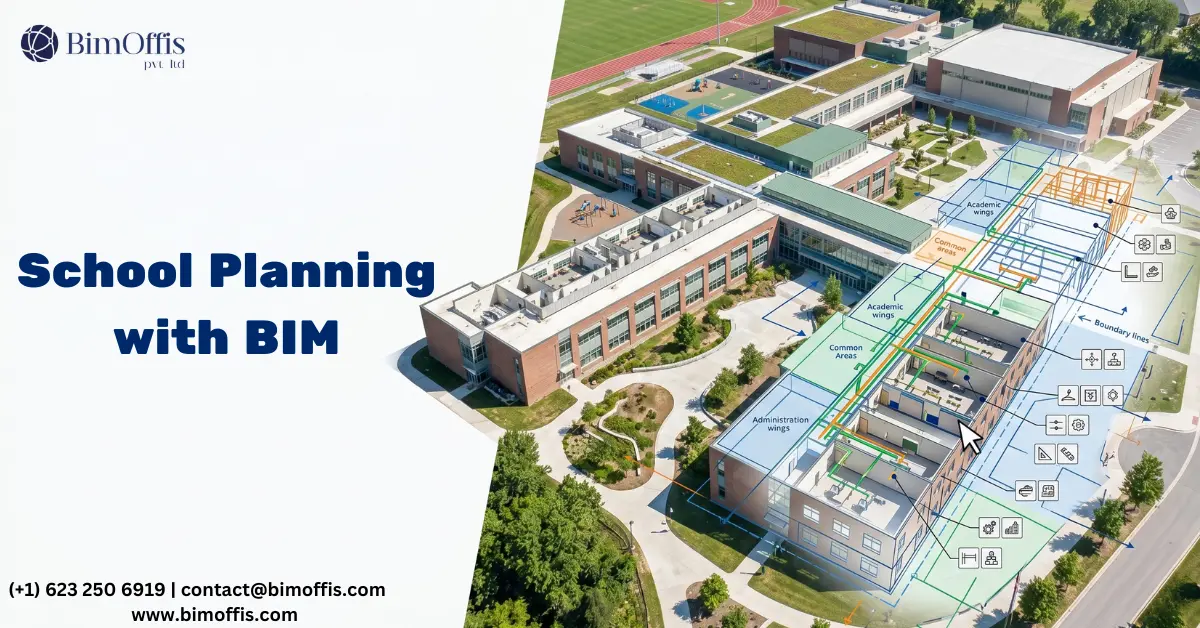
School buildings are more complicated than they look.
Walk into any well-designed school, and what you see on the surface is classrooms, corridors, a hall, maybe a library. What you don’t see is everything that had to go right before that building opened. The acoustic separation between teaching spaces. The ventilation strategy keeps classrooms comfortable without expensive mechanical cooling. The structural grid allows flexible room layouts as the school grows over time. The fire evacuation routes designed for five hundred children moving at once.
Getting all of that right before construction starts is exactly where BIM for school building design earns its place. And the schools that benefit from proper BIM coordination are noticeably better buildings, cheaper to build, better to learn in, and easier to manage for decades afterwards.
Why Schools Are Actually a Great Fit for BIM
Some building types don’t need BIM’s full coordination depth. Simple, repetitive structures with standard systems can get away with less. School buildings sit at the other end of that spectrum, and for reasons that aren’t always obvious at first.
Think about what’s actually inside a secondary school serving fifteen hundred students. The MEP load rivals that of a small commercial office. Science labs need specialist ventilation systems. The sports hall has structural spans that interact with roof drainage and lighting in ways that need careful coordination. Seminar rooms have acoustic requirements that conflict with the structural solutions that work best everywhere else. Standard solutions stop applying room by room almost immediately.
Then there’s the lifespan question. A school built today will likely serve students for fifty years or more. Teaching methods will change. Technology will change. The student population will shift. Buildings designed with genuine flexibility, tested and documented properly in a BIM model, adapt to those changes far better than ones where flexibility was an afterthought added at the end of the design process.
And school projects run on fixed deadlines that don’t move. Students need to be in the building by September. That’s not a target. That’s a fact. BIM coordination that catches construction problems before they reach the site helps projects hit those dates without the rework and delays that push completions back and blow budgets wide open.
What BIM Actually Does on a School Project
It Answers the Hard Spatial Questions Early
The earliest and most undervalued use of BIM on a school project is spatial planning. Before detailed design locks anything in, the model tests whether the brief actually fits the site.
Can the required classrooms fit the footprint while still meeting natural light requirements? Does the circulation strategy actually work when five hundred students change rooms at the same time? Is the relationship between noisy spaces and quiet spaces sensible given how the site sits?
These questions used to get answered through 2D layouts and a lot of manual checking and hoping. In a BIM environment they get answered in three dimensions with actual spatial data, before the design has committed to anything expensive or painful to change.
It Coordinates the Systems That Nobody Sees
Science labs need specialist ventilation. Kitchens have extraction and gas supply requirements that interact with the structure above. Sports halls have spans that affect how roof drainage and lighting work together. IT infrastructure runs through every part of the building.
Getting all of that coordinated properly before construction is where BIM pays back most directly on school projects. Clash detection between structural elements and MEP services routinely catches conflicts that would have caused real delays and significant cost on site. The coordination work done in the model saves multiples of its cost in avoided rework. Every experienced school contractor who’s worked on a properly coordinated BIM project knows this firsthand.
It Tests Acoustic and Environmental Performance
This matters more on school buildings than on almost any other project type. Acoustic performance directly affects how well students learn. A classroom with poor separation from adjacent spaces, or with reverberation times that make speech hard to follow, makes learning genuinely harder. That’s not a design preference. It’s backed by research.
BIM for school building design lets acoustic modeling happen alongside spatial design rather than as a separate check tacked on at the end. Wall constructions, floor build-ups, and ceiling systems get tested against acoustic requirements in the model. Conflicts between acoustic needs and structural or MEP decisions surface early when they’re still straightforward to resolve.
The same logic applies to environmental performance. Daylighting analysis, natural ventilation modeling, and thermal performance assessment all connect to the BIM model in ways that mean design decisions get tested against real criteria rather than assumed to be fine.
It Makes Phased Construction on Occupied Sites Manageable
Many school projects happen on occupied sites. Construction gets phased around school terms. Students stay in one part of the building while another part gets rebuilt around them.
That planning challenge is real and the consequences of getting it wrong are serious. BIM handles phased school projects well. The model shows exactly what gets built in what sequence. Temporary works, hoarding lines, access routes, and construction interfaces between phases all get planned and tested before work starts. Site teams work from a documented sequence that genuinely reduces the risk of disrupting the school while construction runs alongside it.
The Value That Keeps Going After Handover
Here’s something that rarely makes it into project conversations but matters enormously to the people actually running schools.
A well-built BIM model doesn’t stop being useful when the building opens. It becomes the record of what was built, where everything is, and how every building system works. Maintenance teams use it to locate services, plan replacements, and manage the building intelligently over its lifetime. When renovation or extension work comes along fifteen years later, the model is the starting point rather than an expensive survey exercise.
For education authorities managing large estates of school buildings, that ongoing value compounds significantly. Asset management, lifecycle planning, energy performance tracking, and future capital project planning all benefit from accurate as-built BIM models. The investment made during design and construction pays back across the life of the building in ways that are hard to put a precise number on but very easy to appreciate once you’ve seen it working properly.
What the Best School BIM Projects Have in Common
The school projects that genuinely get the most from BIM aren’t the ones with the biggest budgets or the most sophisticated software. They’re the ones where a few things happen consistently.
BIM gets involved during briefing and concept design, not just at technical design stage when the important spatial decisions are already locked in. All disciplines coordinate in a shared model from the start rather than working in parallel and trying to merge things together later. Acoustic and environmental performance get tested in the model throughout design rather than checked once at the end. And the model gets handed over properly in a state that actually serves the people maintaining the building for the next fifty years.
That’s the standard worth aiming for on a school project. And on a building type where design quality directly affects the quality of education for hundreds of children over decades, getting that standard right genuinely matters more than most people say out loud.
Ready to find out what your project will cost? Find out here.
Frequently Asked Questions from Clients
Why is BIM useful for school building design?
Schools have specialist ventilation, acoustic requirements, and tight deadlines. BIM coordinates all of it before anyone sets foot on site.
When should BIM get involved in a school project?
Early. During briefing and concept design, not after the important decisions are already locked in.
How does BIM help with acoustics in schools?
Acoustic performance gets tested in the model during design. Problems surface early when they’re still cheap to fix.
How does BIM handle phased construction on occupied sites?
The model plans the full build sequence. Hoarding lines, access routes, and construction interfaces get sorted before work starts, keeping disruption to students minimal.
Is BIM useful after the school opens?
Yes. Maintenance teams use the model to locate services, plan repairs, and manage the building for decades afterward.
What do the best school BIM projects have in common?
Early involvement, all disciplines in one coordinated model, performance testing throughout design, and a proper model handover at the end.