Why BIM Visualization Matters for School Building Projects
I want to start with something that happened on a school project I heard about from an architect friend.
The design team had spent months developing the project. Every detail was carefully resolved and properly coordinated. During the presentation to the school governors, the architects explained each major decision clearly. The governors approved the scheme, everyone shook hands, and the project moved forward.
Six months later, however, the principal visited the construction site for the first time. By then, the building was already well into construction. After walking through the structure, he said something along the lines of:
“I didn’t realize the hall was going to be that small.”
The surprising part was that the hall matched the approved brief exactly. Its dimensions were clearly shown on every drawing. The problem was not the design itself. The issue was that the principal had never been able to truly visualize the space from a floor plan alone, and nobody had presented it in a more understandable way.
Unfortunately, stories like this are common on school projects. More importantly, most of them are completely avoidable.
Why Drawings Alone Are Not Enough
Architects sometimes forget that technical drawings are a specialist language.
Reading a floor plan accurately takes years of experience. Understanding sections, elevations, and spatial relationships is not intuitive for most people. Architects develop the ability to mentally combine two-dimensional information into a three-dimensional understanding over time. School clients rarely have that training, nor should they be expected to.
School principals are experts in education and leadership. Governors focus on accountability and decision-making. Department heads understand teaching requirements in detail, while facilities managers know how buildings operate day to day. Each person brings valuable knowledge to the project.
Despite that, many key design conversations still rely heavily on technical drawings that non-design professionals struggle to interpret confidently.
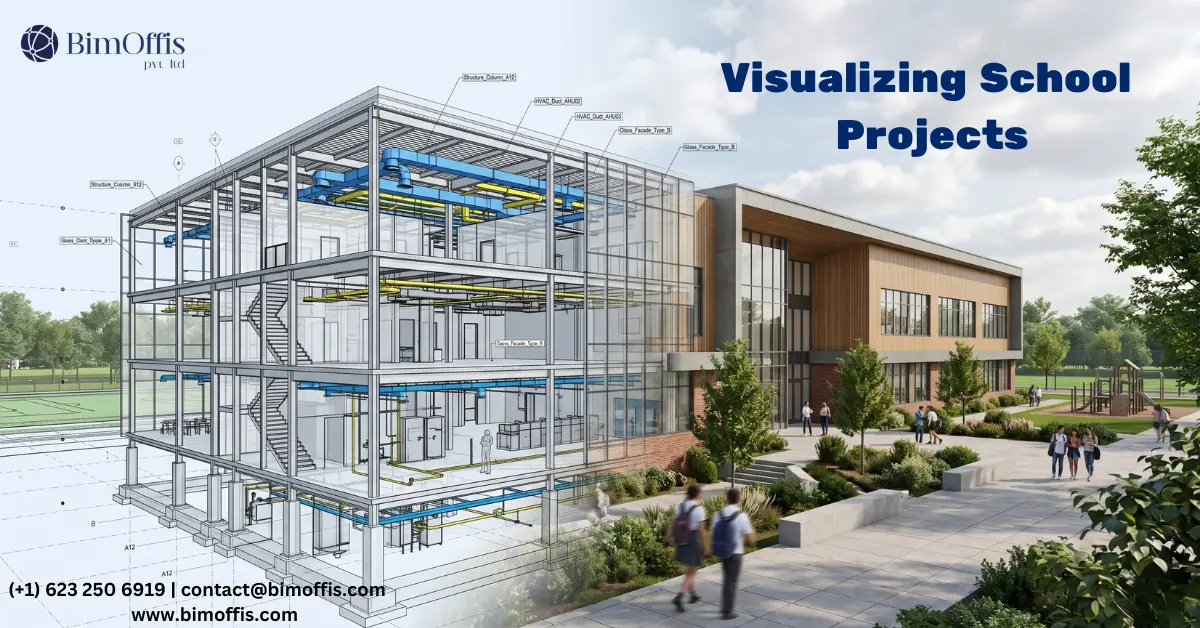
BIM visualization for school buildings changes this completely. Instead of forcing stakeholders to interpret drawings, it allows them to experience the design directly. As a result, the people making decisions can engage with the BIM project more meaningfully.
What BIM Visualization Actually Means
The term “BIM visualization” is often used loosely, so it is worth clarifying what it really involves.
A marketing render is not the same thing as BIM visualization. Marketing images are usually created for planning submissions, presentations, or brochures. They are polished, carefully lit, and sometimes slightly idealized to make the building look attractive.
While these images can be visually impressive, they do not necessarily help people understand how the building will function in reality.
How BIM Visualization Differs From Marketing Renders
True BIM visualization comes directly from the live coordinated model. That means it reflects the building exactly as designed, including real dimensions, accurate spatial relationships, and embedded performance data.
Stakeholders can walk through corridors as students would during a normal school day. They can understand how daylight enters classrooms during winter afternoons or see how construction phases affect existing buildings that must remain operational.
The purpose is completely different from a marketing render. One is designed to sell an image. The other is designed to improve understanding before construction begins.
The People Who Need to Understand the Design
A school project involves far more people than just architects and contractors.
The principal understands school culture and operational priorities. Heads of department know what their teaching spaces need to function properly. The SENCO considers accessibility and additional learning needs. Caretakers think about maintenance and long-term operation. Parent governors represent the wider community perspective.
Every one of these people holds valuable knowledge that should influence the final design.
The challenge is that none of them should need architectural training just to participate in design discussions.
Why Better Understanding Improves Design Decisions
Once people can properly visualize the building, the quality of feedback changes immediately.
For example, showing a head of science a BIM walkthrough of the proposed department often leads to highly specific observations. They may notice that a prep room door swings the wrong way, identify glare issues near fume cupboards, or question whether enough bench space exists for practical lessons.
That kind of feedback improves the design significantly because it comes from genuine understanding rather than polite approval.
Most users can engage far more confidently when they see the building instead of trying to interpret technical drawings.
What BIM Visualization Does Particularly Well
Helping People Experience Space
One of the biggest advantages of BIM visualization is its ability to communicate scale, atmosphere, and character.
Libraries, performance spaces, dining halls, and sixth-form areas all rely heavily on spatial quality. Floor plans alone rarely communicate how those spaces will actually feel.
A governor walking through a virtual library may immediately comment that the space feels too institutional or lacks warmth. That insight is valuable early in design. Without visualization, the same issue might only become obvious after construction is complete.
Checking the Brief Against the Design
School briefs contain detailed requirements around room sizes, adjacencies, and operational relationships.
Visualization allows the people who wrote those requirements to verify them directly without needing to interpret technical drawings.
This helps identify issues earlier, when changes are still inexpensive and relatively easy to implement.
Making Environmental Quality Easier to Understand
Environmental analysis becomes far more accessible when presented visually.
Teachers can quickly understand whether a classroom receives sufficient natural light during winter or whether glare may affect teaching conditions. Reaching those conclusions from technical data tables alone would be difficult for most non-specialists.
Visual information allows stakeholders to participate more actively in discussions about comfort, sustainability, and building performance.
Improving Community Consultation
School consultation processes often rely too heavily on drawings that local communities struggle to interpret.
Showing BIM visualizations creates much more productive conversations. People respond to spaces they can actually see and understand. Questions become more specific, concerns become more relevant, and the feedback becomes genuinely useful for the design team.
Making BIM Visualization Truly Effective
Effective visualization is not simply a single walkthrough shown once during a governors meeting.
Different stakeholders need different information at different stages of the project. Principals may focus on circulation and safeguarding. Department heads need detailed views of teaching spaces. Governors often care more about overall quality and scale. Facilities managers may prioritize plant access and maintenance routes.
Targeted visualization creates significantly more value than one generic presentation intended for everyone.
Why the Live Model Matters
The most useful BIM visualizations always connect directly to the live coordinated model.
That connection ensures every design change updates automatically within the visualization itself. Stakeholders therefore see the current design rather than outdated material produced months earlier.
Maintaining that accuracy is essential because decisions should always be based on what is actually being designed and built.
The Bottom Line
School buildings shape educational experiences for decades. Decisions made during design will affect students, teachers, and staff every single day for fifty years or more.
Those decisions deserve input from people who fully understand what they are approving.
BIM visualization for school buildings closes the communication gap between technical design teams and the people commissioning the project. Once that gap disappears, better decisions happen earlier, costly mistakes reduce significantly, and the final building aligns much more closely with the school’s real needs.
That outcome is always worth investing in properly.
Ready to find out what your project will cost? Find out here.
Frequently Asked Questions from Clients
What is BIM visualization for school buildings?
It shows the design using walkthroughs and spatial models drawn from the live BIM model. Real design information in a format anyone can understand, not marketing renders.
Why do school clients struggle with traditional drawings?
Reading drawings is a specialist skill. Most principals, governors, and department heads never learned it. BIM visualization removes that barrier.
When should BIM visualization be used on a school project?
Early. During concept and design development, before the important decisions are locked in and expensive to change.
How does it help with community consultation?
It shows the actual proposal in a format people can read. Questions become specific, concerns connect to something real, and the consultation actually produces useful outcomes.
Does the visualization update when the design changes?
Yes. When it connects to the live model, every design change updates automatically. The client always sees the current design.
What is the biggest benefit on a school project?
Better decisions made earlier by people who genuinely understand what they are deciding. Problems get caught during design, not after construction when nothing can be changed.