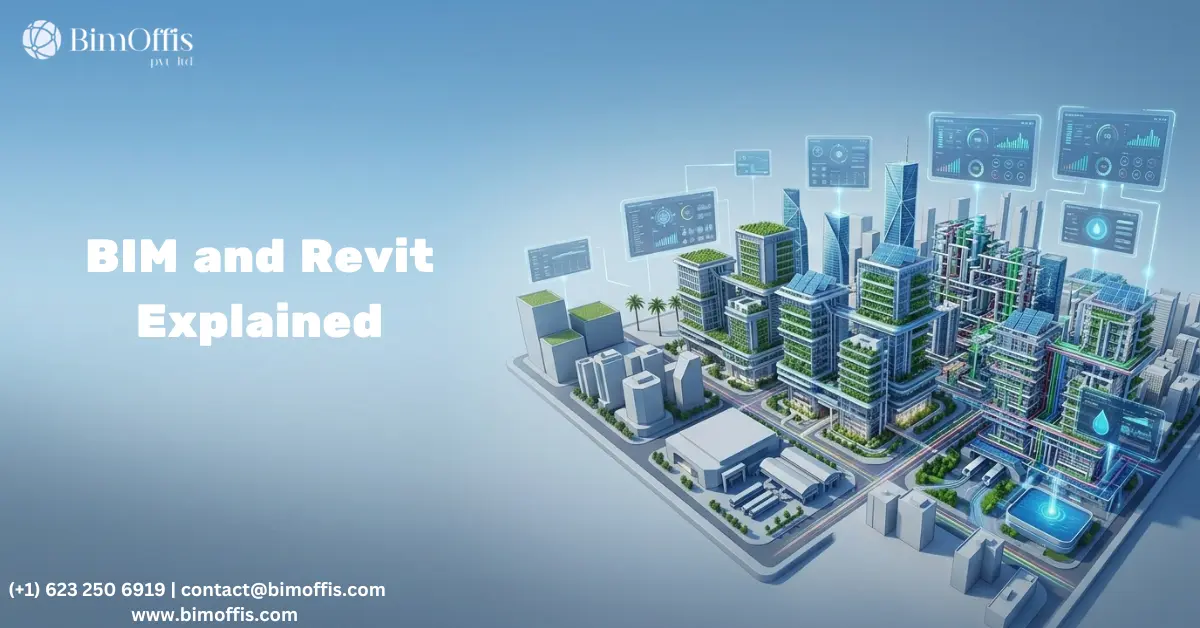
Understanding BIM and Revit: They Are Not the Same Thing
A few years ago, I sat in a project kickoff meeting when a client asked our team, “Are you BIM-ready?”
Our project lead confidently replied, “Yes, we work in Revit.”
The client paused, smiled politely, and moved on.
Later, I realised that answer completely missed the point. More importantly, many professionals in this industry make the same mistake without even noticing it.
The Confusion Is Everywhere And It’s Costing Projects
Walk into any architecture or engineering office today and ask what BIM is. Most people will say “it’s 3D modeling” or “it’s Revit.” However, both answers fall short.
This misunderstanding creates real problems. When teams confuse a process with a tool, projects suffer. For example:
- Teams struggle to coordinate across disciplines
- Information gets lost during handovers
- Clients don’t receive what they requested
- Teams discover clashes on-site instead of in the model
- Costs increase because teams fail to track design changes properly
So, let’s clear this up properly.
What Is BIM? A Process, Not a Program
BIM stands for Building Information Modeling. However, instead of focusing on the full form, focus on what actually matters: information management.
BIM defines how teams create, manage, and share data throughout a project lifecycle.
Specifically, BIM answers:
- Who creates data, and who owns it at each stage
- How teams share information across disciplines
- Which standards (such as ISO 19650) guide the process
- How teams transfer data from design to construction to operations
- How stakeholders manage the full lifecycle, from concept to demolition
In practice, BIM solves common project issues. For instance, teams can detect clashes early, align drawings across disciplines, and track design changes effectively. As a result, everyone works from a single, reliable source of truth.
What Is Revit? A Tool That Supports BIM
Revit is Autodesk’s BIM authoring software. Over the years, it has become an industry standard for architectural and engineering modeling, and for good reason.
Unlike traditional drafting tools, Revit offers:
- Intelligent elements (walls include material, cost, and performance data)
- Parametric modeling, so updates automatically reflect across all views
- Multi-discipline collaboration through linked models
- Built-in clash detection before construction begins
- Live schedules and quantities extracted directly from the model
Because of these capabilities, Revit supports BIM workflows effectively. However, using Revit does not automatically mean you are doing BIM.
You Can Use Revit Without Doing BIM
In reality, many teams use Revit incorrectly. They rely on it for drafting but ignore the BIM process.
Here are common signs of that problem:
- Teams build models only to generate 2D drawings
- They don’t use a Common Data Environment (CDE)
- They ignore naming conventions and information standards
- They fail to prepare proper data handovers
- They never use models for coordination or clash detection
In these cases, teams use the tool, but not the process.
On the Other Hand, BIM Doesn’t Depend on Revit
BIM remains software-independent. Teams can implement it using different tools, such as:
- ArchiCAD
- Bentley OpenBuildings
- Vectorworks
Additionally, open formats like IFC (Industry Foundation Classes) allow teams to exchange data across platforms.
Therefore, success depends on how teams manage information, not which software they use.
Simply put: BIM is the standard. Revit is just one way to achieve it.
BIM Goes Beyond 3D Modeling
Many people associate BIM with 3D modeling. However, real BIM delivers much more value.
The industry defines multiple BIM dimensions:
- 4D BIM – Construction sequencing and scheduling
- 5D BIM – Cost estimation linked to model elements
- 6D BIM – Sustainability and energy performance analysis
- 7D BIM – Facilities management and long-term asset data
Importantly, these capabilities depend on structured data and workflows, not software alone.
BIM vs Revit: Quick Comparison
| Aspect | BIM | Revit |
|---|---|---|
| What is it? | A process and methodology | A software tool |
| Ownership | Defined by standards (e.g., ISO) | Owned by Autodesk |
| Software dependency | No | Yes |
| Scope | Entire building lifecycle | Design and documentation |
| Measured by | Data quality and standards | Modeling skills |
Why This Difference Actually Matters
When you understand the difference between BIM and Revit, you start asking better questions:
- Are we following proper information standards, or just modeling?
- Can we hand over structured, usable data to the client?
- Are we solving problems early, or reacting on-site?
- Will the building owner actually benefit from our model?
Today, leading firms don’t just invest in software. Instead, they focus on delivering true BIM processes, and they can prove it.
That’s the difference that sets them apart.
Ready to find out what your project will cost? Find out here.
Frequently Asked Questions from Clients
Is BIM and Revit the same thing?
No. BIM is a process and way of working. Revit is software made by Autodesk. One is the strategy, the other is the tool.
Can I do BIM without Revit?
Yes, absolutely. BIM can be done using ArchiCAD, Bentley, Vectorworks or other platforms. BIM is not limited to any one software.
If I use Revit daily, does that mean I'm doing BIM?
Not necessarily. Many teams use Revit just for 3D drafting without following any BIM standards or data management process. Using Revit and doing BIM are two different things.
Which is more important to learn, BIM or Revit?
Both, but for different reasons. Learn Revit as a practical skill. Understand BIM as a professional standard. One gets you the job, the other makes you better at it.
What is BIM used for in real projects?
BIM is used for team coordination, clash detection, cost tracking, construction sequencing, energy analysis and facilities management across the full life of a building.
Is BIM only for big construction projects?
No. BIM works on projects of all sizes. Even small residential or commercial projects benefit from better coordination and data management.