In the modern construction industry, Building Information Modeling (BIM) is no longer optional, it is a necessity. However, as projects become more complex and involve more stakeholders, a major question arises: Should you use OpenBIM or ClosedBIM?
This choice defines how your team communicates, how data is stored, and how much freedom you have throughout the project’s lifecycle. Let’s explore both approaches to help you decide which one fits your needs.
Understanding ClosedBIM: The “Walled Garden”
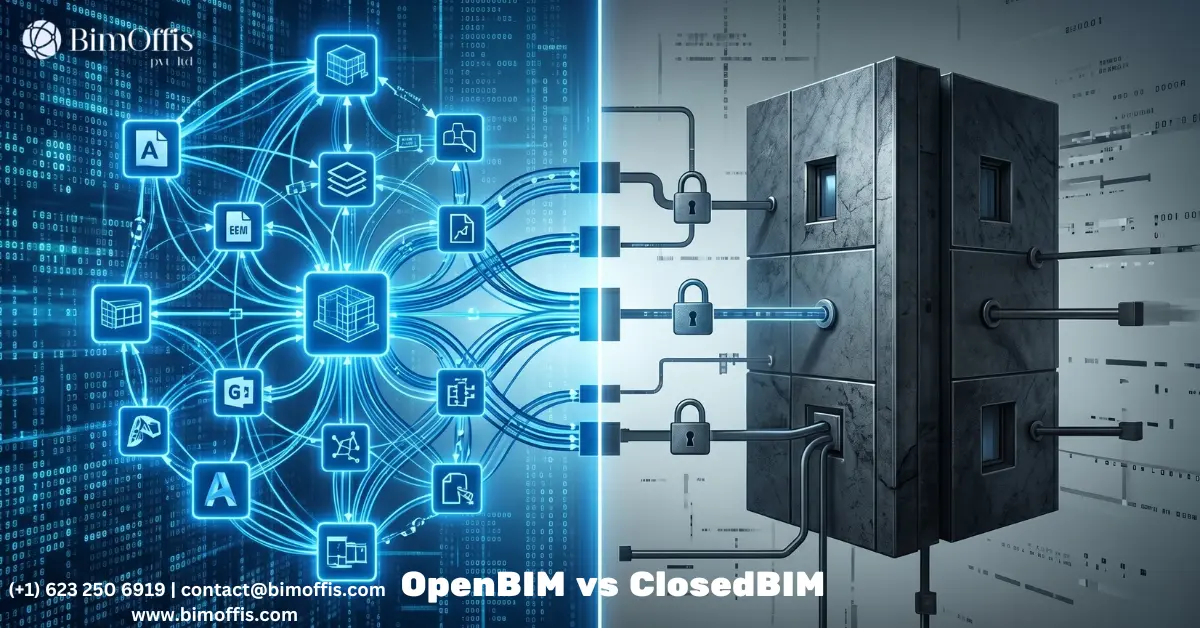
ClosedBIM, often called proprietary BIM, is a workflow where all project participants use the same software family. For instance, if the architect, structural engineer, and MEP specialist all use Autodesk Revit, they are working in a ClosedBIM environment.
The Advantages of ClosedBIM
- Seamless Integration: Since everyone uses the same software, there is no need to “translate” files. Everything from 3D geometry to deep metadata stays perfectly intact.
- Lower Technical Risk: You don’t have to worry about data being lost during exports. The “round-trip” of information is smooth.
- Speed: For internal teams, ClosedBIM is often faster because there is no need to coordinate different file formats or spend time on complex data mapping.
The Disadvantages of ClosedBIM
- Vendor Lock-in: You are tied to one software company. If they raise their prices or change their terms, you have no choice but to pay.
- Limited Collaboration: If you find a world-class consultant who uses a different software, they might struggle to work with you, or you might be forced to exclude them.
Understanding OpenBIM: The “Universal Language”
OpenBIM is a collaborative approach based on open standards. It allows different professionals to use different software while sharing data through universal formats like IFC (Industry Foundation Classes). It’s like sending an email; it doesn’t matter if you use Gmail and the receiver uses Outlook, the message gets through.
The Advantages of OpenBIM
- Complete Flexibility: You can choose the best software for each specific task. A structural team can use Tekla for detailing, while the architect uses Archicad for design.
- Long-term Data Ownership: Data belongs to the building owner, not the software vendor. Because IFC files are open-source, you can still open and read your building data 20 or 30 years from now.
- Competitive Fairness: It allows smaller firms with different software to compete for big projects, fostering a more inclusive industry.
The Disadvantages of OpenBIM
- The “Translation” Factor: Exporting data from one software to a universal format requires skill. If not handled correctly, some minor details or parametric “intelligence” can be lost.
- Setup Time: It requires a clear set of rules (Information Requirements) at the start of the project to ensure everyone’s data aligns correctly.
Key Comparison: At a Glance
| Feature | ClosedBIM | OpenBIM |
| Software Strategy | Single platform (e.g., all Revit) | Multiple platforms (Revit, Archicad, etc.) |
| Data Format | Proprietary (.rvt, .pln) | Open Standard (.ifc, .bcf) |
| Best For | Internal projects & small teams | Large-scale, public & diverse projects |
| Future Proofing | Dependent on the vendor | High (independent of vendors) |
Which Approach is Better?
The answer depends on who you are and what you want to achieve.
When ClosedBIM is Better:
If you are a small to medium-sized firm where everyone is already trained on a single platform, ClosedBIM is the most efficient choice. It removes the technical headache of file conversions and allows your team to focus entirely on design and construction. It is “easier” in the short term.
When OpenBIM is Better:
If you are a building owner, a government agency, or a large contractor, OpenBIM is far superior. It ensures you aren’t held hostage by one software company’s pricing.
More importantly, it ensures that the “Digital Twin” of your building remains accessible for the entire life of the structure. Many governments now mandate OpenBIM for public projects to ensure transparency and longevity.
The Final Verdict
While ClosedBIM offers immediate convenience and speed, OpenBIM is the future of the AEC (Architecture, Engineering, and Construction) industry. It promotes better collaboration, protects your data for the long term, and allows for a more diverse and specialized workforce.
In reality, most modern projects use a hybrid model. They use ClosedBIM for internal work and OpenBIM for external coordination. However, as software becomes better at handling open formats, the barriers to OpenBIM are disappearing.
Ready to find out what your project will cost? Find out here.
Frequently Asked Questions from Clients
What is the difference ClosedBIM and OpenBIM?
- ClosedBIM: Everyone uses the same software (e.g., all Revit).
- OpenBIM: Everyone uses different software and shares files using a universal format (IFC).
Which is easier to use?
ClosedBIM is easier. Since everyone uses the same tool, files open perfectly without any extra setup.
Which is more flexible?
OpenBIM is more flexible. You can hire the best experts even if they use different software than you.
Will I lose data in OpenBIM?
There is a small risk. Moving data to a universal format (IFC) is like “translating” a language; if not done carefully, some details might be missed.
Which is better for the building owner?
OpenBIM. It ensures the owner can open their building
Do I have to choose only one?
Many firms use ClosedBIM for their internal design and OpenBIM to coordinate with external partners.