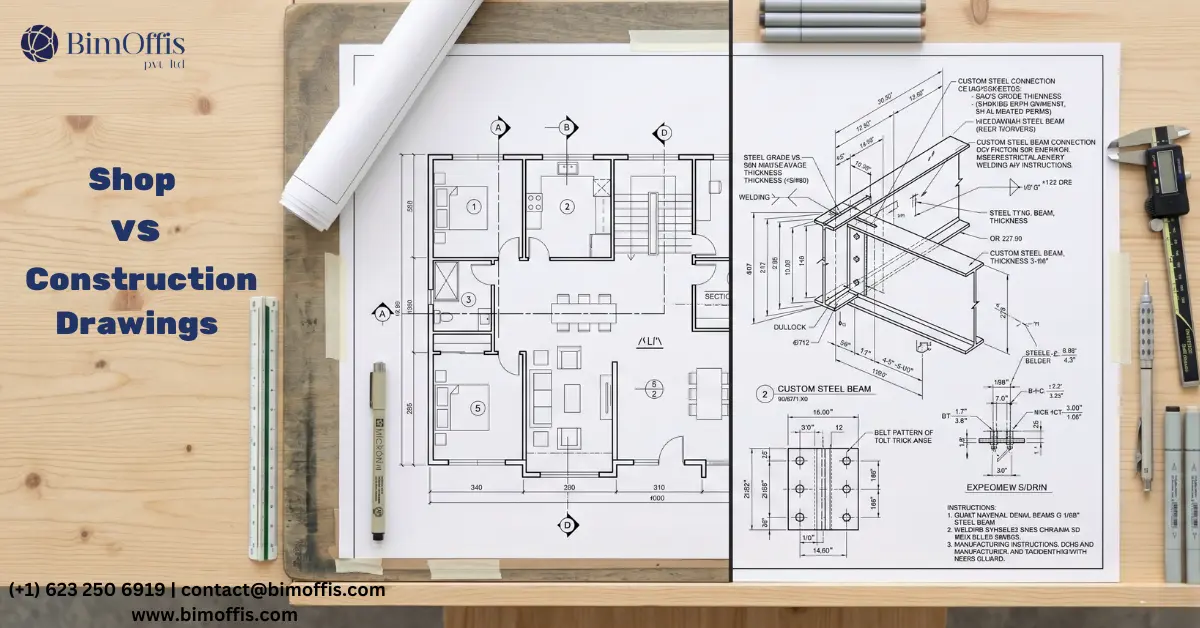
Construction Drawings vs Shop Drawings: What’s the Actual Difference?
If you’re new to construction, these two terms can get confusing pretty quickly. At a glance, construction drawings and shop drawings sound similar. But once you start working on a project, you realize they do very different jobs.
Let’s go through it in a simple way, no heavy jargon.
What Are Construction Drawings?
Construction drawings come first. Architects and engineers put them together during the design stage, before any work begins on site.
They show the overall idea of the project. You’ll see layouts, dimensions, structural elements, and system routes. Basically, they explain what the building should look like when everything is done.
For example, you can look at a floor plan and understand how spaces connect. You can also see where columns sit, how thick the walls are, and where services like plumbing or electrical lines will run.
At the same time, these drawings are not just for reference. They are part of the official contract. They also go to local authorities for approval. So if something doesn’t match later, people check these drawings first.
You’ll usually find the following in a construction drawing set:
- Floor plans
- Site layout
- Structural details
- MEP systems
- Elevations and sections
- Notes about materials and finishes
Now here’s something worth pointing out. These drawings don’t explain everything in detail. They show what needs to be built, but they don’t go into fabrication-level instructions.
Say there’s a steel staircase. The drawing will show its size, position, and general design. But it won’t tell a fabricator how to cut or weld each piece. That part comes later.
What Are Shop Drawings?
Shop drawings enter the scene once the project moves forward and real planning begins.
These are created by the people who actually build things: fabricators, subcontractors, and suppliers. Each one works on their own scope.
Unlike construction drawings, shop drawings zoom in. They don’t try to explain the whole building. Instead, they focus on one component at a time.
Let’s take the same staircase again. A shop drawing will break it down completely. You’ll see exact measurements, material type, weld details, and connection points. In some cases, even the installation steps are included.
So instead of a general idea, you get precise instructions.
Typical shop drawings include:
- Exact dimensions and tolerances
- Weld and connection details
- Bolt positions and anchors
- Material specifications
- Fabrication and installation notes
- Manufacturer details
Because of this, shop drawings are much more detailed. The people building components rely on them daily. They can’t work with rough concepts they need clarity.
Key Difference
| Factor | Construction Drawings | Shop Drawings |
|---|---|---|
| Who creates them | Architects and engineers | Contractors or fabricators |
| When created | During design phase | After contract, before fabrication |
| Main purpose | Define design intent | Show how to build or install |
| Level of detail | System-wide overview | Component-specific detail |
| Legal role | Part of contract documents | Submitted for review and approval |
| Who reviews them | Building department and owner | Architect or engineer of record |
Why Both Are Needed
A lot of people assume one set of drawings should be enough. In practice, that rarely works.
Construction drawings can’t cover every small detail. There are too many components, and many depend on specific manufacturers.
For example, an architect might specify a curtain wall system. But they don’t design how a particular company makes it. That includes things like tolerances, joint details, or fixing methods.
That’s where shop drawings help.
They fill in the missing pieces. And when they’re done properly, they make life easier for everyone involved.
Here’s what usually improves:
- Problems show up earlier, before work starts
- Teams don’t have to guess details
- Communication becomes clearer
- The final result matches the design more closely
Without shop drawings, people start making assumptions. And that’s where mistakes happen.
What Happens During Approval?
Before anything goes into production, shop drawings go through a review process.
First, the fabricator prepares them. Then the contractor checks if everything fits with the rest of the project. After that, the architect or engineer reviews them.
This step helps confirm that the design hasn’t changed unintentionally.
Even after approval, one thing stays the same: the fabricator is still responsible for the final product. Approval doesn’t shift that responsibility.
A Simple Way to Remember It
If you forget everything else, just keep this in mind:
Construction drawings show what the building should look like.
Shop drawings show how it will be made and installed.
Both are important. One sets the direction, the other handles the execution.
When teams use both properly, projects tend to run smoother. There’s less confusion, fewer mistakes, and better results overall.
Ready to find out what your project will cost? Find out here.
Frequently Asked Questions from Clients
What is the main difference between shop drawings and construction drawings?
Construction drawings show what needs to be built. Shop drawings show how it will be built. One comes from the architect. The other comes from the fabricator or contractor.
Who prepares shop drawings?
The contractor, subcontractor, fabricator, or supplier prepares shop drawings. Not the architect.
Who prepares construction drawings?
The architect and engineering team prepare construction drawings during the design phase of the project.
When are shop drawings made?
Shop drawings are made after the contract is signed and before fabrication begins. They are part of the pre-construction planning process.
Are construction drawings and shop drawings the same document?
No. They are completely different documents made by different people at different stages of the project.
What happens if shop drawings are rejected?
The fabricator revises them based on the architect’s comments and resubmits. This continues until the drawings are approved.