Introduction: The Current State of BIM
Walk into any major construction project in the United States today, and you will find BIM running somewhere in the background. Maybe the structural engineer is using it. Maybe the MEP team has it open on their laptops.
However, here is the thing: most projects are still only scratching the surface of what BIM in the USA construction can actually do.
I have spoken to project managers who treat it like a 3D drafting tool. Similarly, I have met contractors who only open the model when there is a clash to resolve. Honestly, that is a missed opportunity.
Because what is coming in the next five to ten years is going to make today’s BIM usage look like the early days of email, functional, yes, but nowhere near its real potential.
The Honest Picture of BIM Adoption in the US Right Now
Nobody is going to tell you this in a vendor webinar, so let me say it plainly. BIM adoption in America is uneven.
On one hand, the big players, your top-tier general contractors, large architecture firms, and federal infrastructure projects, are running strong. They have dedicated BIM managers, internal standards, and workflows that actually function.
However, go one level below that and things get patchy fast. A lot of mid-size contractors are still figuring out how to make BIM part of their daily process rather than something they do at the start of a project and then ignore.
Meanwhile, small subcontractors, many of them have never opened a Revit file in their lives.
That is not a criticism. Instead, it is just where the industry is. And it matters because the gap between the firms that have figured BIM out and the ones that haven’t is going to get much wider in the years ahead.
What AI Is Actually Doing to BIM Right Now
Forget the hype for a second. Here is what is genuinely happening on real projects.
Generative design tools built into platforms like Autodesk Revit now let design teams feed in their constraints and receive multiple layout options back almost instantly.
For example, budget ceiling, floor area, structural requirements, and energy targets, you put it all in, and the software explores combinations that would take a human team weeks to work through manually.
As a result, some firms are using this in early schematic design, while others are using it to optimize structural systems. Either way, it is saving real time.
On the construction side, machine learning is being used to compare current project progress against historical data from past jobs. If your schedule is starting to look like three other projects that all ran late in the same phase, the system flags it early.
In other words, not after the delay happens, but before it does.
For anyone who has sat through a painful project debrief asking “why didn’t we see this coming,” that kind of tool feels almost too good to be true. However, it is real, and it works.
Digital Twins Are Coming, and They Change Everything
Most people in construction have heard the term digital twin by now. However, far fewer understand what it actually means for their work.
Here is a simple way to think about it. Your BIM model today is essentially frozen at the point of handover.
The owner gets the model, maybe uses it for facilities management for a year or two, and then it slowly drifts out of sync with the real building. As a result, the model becomes a historical document rather than a living tool.
A digital twin flips that completely. It stays connected to the real building through sensors, smart systems, and live data feeds.
For example, the building’s energy consumption, equipment performance, and occupancy patterns, all of it flows back into the model continuously.
Therefore, facility managers can see exactly what is happening and predict maintenance issues before anything actually breaks down.
Right now in the US, hospitals, airports, and large corporate campuses are leading the way on this.
However, as the technology gets cheaper and easier to implement, it will move into standard commercial real estate and eventually into larger residential developments.
The BIM model you build today is going to follow that building for its entire lifespan. So, that should change how seriously you take model quality from the very first week of a project.
Cloud Collaboration Removed the Coordination Excuse
For years, coordination failures on construction projects were blamed on people working off different versions of drawings.
For example, the architect had one set, the structural engineer had another, and the subcontractor was working off something printed three weeks ago. As a result, it caused rework and cost overruns.
However, that problem is essentially solved now.
Cloud-based BIM platforms mean everyone is looking at the same model, updated in real time, regardless of where they are sitting.
A detailer in Texas, a project executive in New York, and a site foreman in Arizona are all working off the same live information.
Interestingly, coordination failures still happen. And when you dig into why, it is almost never a technology problem anymore.
Instead, it is a process problem, such as teams that have not established clear responsibilities or firms that have not trained their people properly.
The tools work. However, the human side is still catching up.
Sustainability Goals Are Pushing BIM Further
Green building is not optional anymore for most serious developers in the US.
Whether it is LEED targets, energy code compliance, or investor pressure around ESG commitments, sustainability is now a requirement rather than a nice-to-have.
Because of this, BIM fits naturally into the process.
The model already contains most of the information you need, material quantities, building envelope performance, and mechanical system specifications.
Therefore, energy modeling tools connect directly to BIM data, and carbon calculations can be done during design instead of after construction.
The next big push will be around embodied carbon.
In fact, several US states are moving toward requiring this type of reporting on public projects.
Firms with clean, data-rich BIM models will handle this much more easily than those scrambling later.
What the Next Five Years Actually Look Like
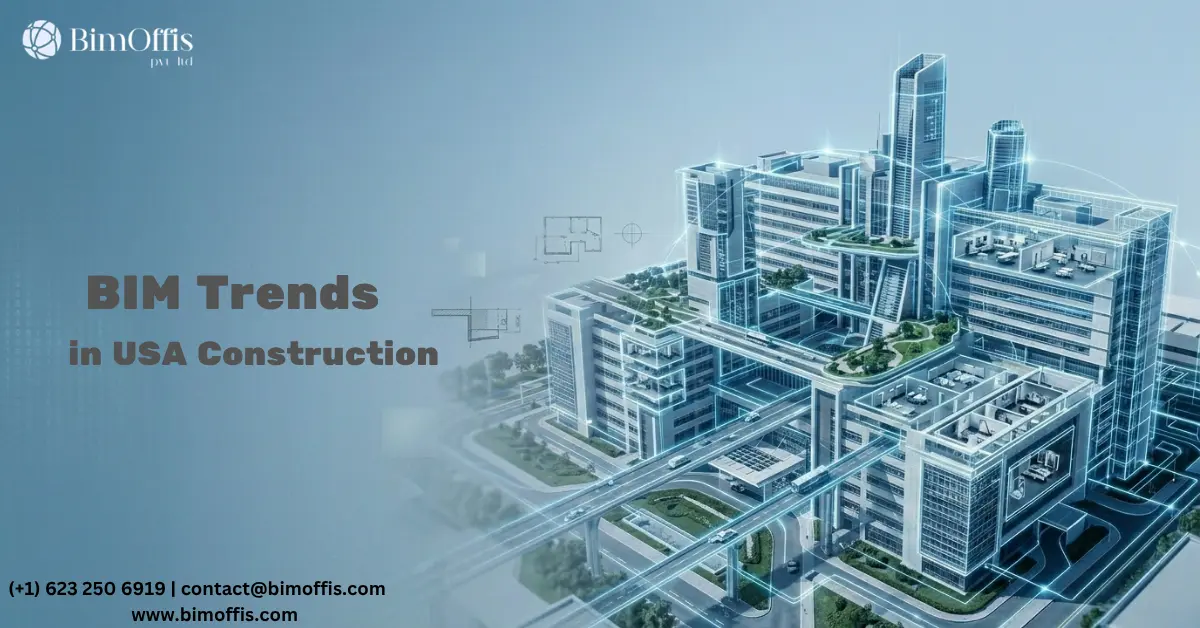
Here is my honest read on where BIM in the USA construction is heading:
- First, AI design tools will become a baseline expectation
- Next, digital twins will become standard for long-term operations
- At the same time, prefab and modular construction will grow significantly
- Additionally, augmented reality will reduce rework and errors
- Finally, smaller firms will adopt BIM as tools become simpler
However, firms that wait too long may find themselves locked out of certain project types.
Final Thoughts
Technology does not fix a bad process. BIM does not make a disorganized project team organized.
However, it does give a well-run team more leverage, better information, earlier visibility into problems, and cleaner handoffs.
The firms winning with BIM in the USA construction right now are not the ones with the most software licenses.
Instead, they are the ones who built real internal competency, standardized their workflows, and treated the model as something valuable beyond permits.
That is the real competitive advantage, and it is still available to anyone willing to build it.
. Ready to find out what your project will cost? Find out here.
Frequently Asked Questions from Clients
What is BIM in simple words?
BIM is a smart 3D model of a building. It contains all the information materials, cost, size, and structure in one place. Everyone on the project uses the same model, which reduces mistakes and saves time.
Is BIM required in the USA?
On government projects, yes. Agencies like GSA already require it. On private projects, most big developers expect it even without a legal requirement.
What is the difference between BIM and CAD?
CAD gives you drawings. BIM gives you a smart model with real data attached. A wall in BIM knows its material, cost, and thickness. A CAD wall is just lines on a screen.
Do small construction companies need BIM?
Yes. Tools are now cheaper and cloud-based. Small firms that ignore BIM are slowly getting left out of bigger project teams that require it.
What is a digital twin in construction?
A digital twin is a live version of your BIM model that stays connected to the real building after construction. Sensors keep it updated so owners can monitor performance and predict maintenance issues.
How does BIM help with green building?
BIM already holds all the building data materials, energy systems, and performance specs. This makes sustainability reporting, LEED certification, and carbon tracking much faster and more accurate.