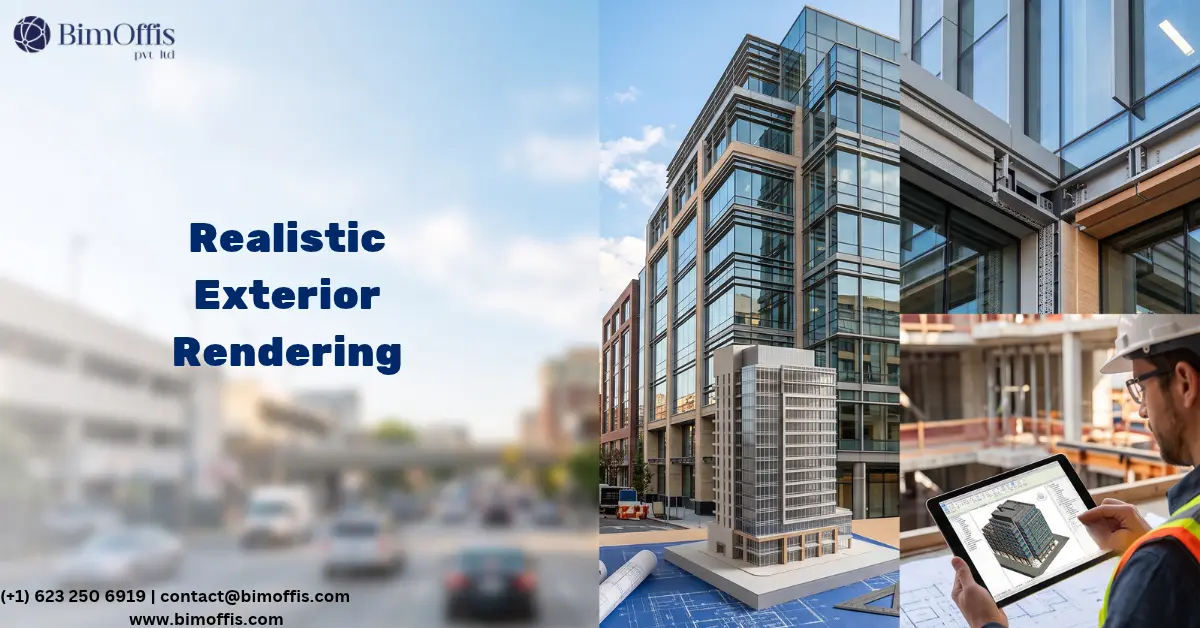
Exterior rendering services produce the photorealistic visualizations that show a building as it will look before a single foundation gets dug. They are the visual communication tool that developers use to sell units off-plan, that architects use to win competitions and gain planning approval, and that design teams use to evaluate and refine design decisions before those decisions get committed to construction.
Let me start with something that architecture firms and property developers both know from experience.
The first impression a building makes on a client, a buyer, a planning authority, or an investor almost always comes from a rendered image rather than from the building itself. The building takes months or years to construct. The rendered image exists from the moment the design is sufficiently developed to visualise. That rendered image sets expectations, communicates quality, and builds or undermines confidence in the project long before the building is complete.
When exterior rendering services deliver genuinely convincing, accurate, high-quality visualizations, they build the confidence that drives the project forward. When they deliver mediocre renders that look like what they are, digitally produced approximations of a building that does not yet exist, they undermine confidence rather than building it.
Understanding what good exterior rendering services actually involve and how to find a provider who delivers them consistently is worth the time for any company that regularly commissions this type of work.
What Exterior Rendering Services Actually Produce
The Range of Outputs
Exterior rendering services cover a wider range of outputs than a single category description suggests.
Still renderings are the most commonly commissioned output. A photorealistic still image of the building from a specific viewpoint at a specific time of day in a specific environmental context. A well-executed exterior still rendering is genuinely indistinguishable from a photograph of the completed building at the viewpoint shown. These images serve marketing materials, planning submissions, investor presentations, and client design approvals.
Multiple still renderings of the same building from different viewpoints at different times of day give the full picture that a single image cannot. The main entrance approach in morning light. The rear facade overlooking the landscape at dusk. The building from across the street in the context of the surrounding neighbourhood. The rooftop terrace looking back at the facade. A complete set of exterior still renderings tells the visual story of the building from every angle that matters.
Animated exterior visualizations, or flythroughs, move the camera through and around the building rather than showing it from a fixed viewpoint. The camera establishes the building in its landscape setting, approaches the facade, moves around the perimeter, rises to show the building from above, and comes to rest at the primary entrance. A quality exterior flythrough communicates the building in its context more completely than any number of still images.
Furthermore, real-time exterior visualizations using game engine technology allow the viewer to move around the exterior freely rather than following a predetermined camera path. This interactive format is increasingly used for significant development projects where the client or investor wants the freedom to explore the building from any viewpoint rather than the viewpoints the renderer selected.
What Makes Exterior Rendering Services Good
Accuracy to the Actual Design
The most important quality in any exterior rendering is that it accurately represents the real building. Not an idealised version. Not a building that is slightly larger, or better proportioned, or made from better materials than the actual specification. The real building.
This matters for practical reasons as well as ethical ones. In property development, a marketing rendering that shows a building significantly more appealing than what gets built creates dissatisfied buyers, legal exposure, and reputational damage that far outweighs the short-term marketing benefit of the enhanced image. Planning authorities increasingly scrutinise the relationship between submitted visualizations and completed buildings, and significant discrepancies create regulatory problems that take years to resolve.
Good exterior rendering services work from accurate architectural models with the actual material specifications, the actual window proportions, the actual facade details, and the actual site context. The rendering shows what will actually be there rather than what the developer would ideally like to show.
Context That Feels Real
The quality of the site context surrounding the building in an exterior rendering determines how convincing the complete image feels. A beautifully rendered building floating in a generic landscape context does not convince anyone. A building sitting naturally in an accurately represented version of its real site context reads as genuinely real.
Good exterior rendering services research the site context. They work from survey data, satellite imagery, site photographs, and street-level reference material to create a context environment that represents the real surroundings accurately. The adjacent buildings have the right character, scale, and materials. The streetscape has the right texture. The landscape has the right vegetation species and maturity level.
This contextual accuracy is what makes the viewer see the building in its real environment rather than in a studio backdrop. It is also what makes the rendering useful for planning submissions where the building’s relationship to its context is precisely what the planning authority is assessing.
Lighting That Communicates the Design
Lighting in an exterior rendering is a design decision, not a technical setting. The time of day chosen for the primary rendering determines whether the building reads as welcoming or imposing, warm or cool, contextual or isolated. The quality of the sky and its light affects every surface in the image. The balance between natural light and artificial light from the building’s interior at dusk renderings communicates something specific about the building’s character and use.
Good exterior rendering services make lighting decisions with the same care that a professional photographer brings to a location shoot. They choose the time of day that makes the building look its best and most accurately represents its design intent. They manage the balance between sky, sunlight, shadow, and reflected light to produce images that have the visual character of a great architectural photograph rather than a technically correct but emotionally flat digital output.
Material Quality That Convinces
The materials shown on the building facade in an exterior rendering determine how convincingly the image reads as a real building rather than a digital model. Stone that looks like real stone with the correct surface variation, the correct reflectance, and the correct response to light. Glass that behaves like real glass, reflecting the sky and the surroundings while showing the interior spaces through it. Metal panels with the subtle surface variation that real metal has rather than the perfect uniformity that a default renderer produces.
Achieving this material quality requires both high-quality material assets and the skill to apply and calibrate them correctly in the rendering environment. Good exterior rendering services invest in genuinely high-quality material libraries and in the expertise to use them in ways that produce renders where every surface behaves exactly as the real material would.
How Exterior Rendering Services Serve Different Industries
Real Estate Development
Exterior rendering services serve real estate developers most directly through their impact on pre-sales performance. A development that shows buyers a convincing, accurate exterior rendering of the building they are purchasing commits to a visual representation that builds purchase confidence. Buyers who can see the building convincingly before it exists make faster, more committed purchase decisions than those looking at design drawings and trying to imagine the finished result.
Furthermore, exterior rendering services support the planning submissions and community consultation processes that most significant residential and commercial developments require. High-quality visualizations that accurately show how the development will sit in its context address the concerns of planning authorities and community groups more effectively than technical drawings that require architectural expertise to interpret.
Architecture and Design
Architecture firms use exterior rendering services to communicate design quality in competition entries, in client presentations, and in awards submissions where the image is the primary communication medium.
In a design competition, the rendering quality directly affects how the design quality is perceived. A strong design presented through mediocre renders loses to a comparable design presented through exceptional renders because the jurors’ perception of design quality is inevitably influenced by the visual quality of the presentation. Exterior rendering services that understand how to present architectural design at its most compelling are worth significantly more to an architecture firm than those that produce technically competent but visually generic images.
Property and Asset Management
Property companies and asset managers use exterior rendering services when repositioning existing assets, launching new commercial developments, and communicating portfolio quality to investors and institutional partners.
An existing commercial building undergoing refurbishment needs exterior rendering services that can show the proposed transformation from the existing condition to the planned new character. A new commercial development needs exterior rendering services that can communicate the building’s quality and its potential as a commercial environment to prospective tenants who need to evaluate it before committing to a lease.
How to Choose the Right Exterior Rendering Services Provider
Look at Work on Similar Projects
The most reliable way to evaluate an exterior rendering services provider is to look at their work on projects similar to the one you are commissioning. A provider with a strong portfolio of residential exterior renders may produce weaker commercial exterior renders because the lighting approach, the material quality priorities, and the contextual character that makes a convincing residential render are different from what makes a convincing commercial render.
Ask specifically for examples of exterior rendering work on projects of similar scale, building type, and material palette to yours. Review those examples critically for accuracy, material quality, lighting, and context rather than for the overall visual impressiveness of the portfolio.
Ask About the Process
Good exterior rendering services providers can describe their production process clearly and specifically. How do they receive and process the architectural model? What information do they need about materials and specifications? How do they handle the context environment around the building? What is their revision process when the architectural design changes?
A provider with a clear process is demonstrating the professional discipline that produces consistent results. A provider with a vague or improvised-sounding process is revealing that their quality depends on individual talent rather than reliable method.
Evaluate Communication Quality
The communication quality of an exterior rendering services provider during the briefing and sales process is the best predictor of the communication quality during production. Providers who ask thoughtful questions about the project, the context, the target audience, and the design intent during the briefing process are demonstrating the understanding of client needs that produces renders aligned with what the client actually needed rather than what the renderer assumed they needed.
The Bottom Line
Exterior rendering services matter because the rendered image of a building is often the primary communication medium through which architects, developers, and property companies present their projects to the audiences whose decisions determine whether those projects succeed.
Accurate representations of the real design, convincing context that places the building in its real environment, lighting decisions made with the care of professional photography, and material quality that makes every surface read as genuine are what separate exterior rendering services that build confidence and drive decisions from those that produce visually competent but emotionally unconvincing images.
Finding a provider who consistently delivers all of these qualities requires looking beyond the showreel to the actual work, understanding the production process, and evaluating communication quality as carefully as technical capability.
Bring architectural concepts to life with professional exterior rendering services that deliver realistic visuals for presentations, marketing, and client approvals.
Frequently Asked Questions from Clients
What are exterior rendering services?
Exterior rendering services create realistic visualizations of a building before construction is completed.
What types of exterior rendering outputs are available?
Common outputs include photorealistic still images, multiple exterior views, animated flythroughs, and real-time visualizations.
Why are exterior rendering services important for real estate projects?
They help developers present projects to buyers, investors, planning authorities, and other stakeholders before construction.
What makes a high-quality exterior rendering?
Accurate design details, realistic site context, natural lighting, and convincing materials create high-quality exterior renders.
How do exterior rendering services support architects?
They help architecture firms present designs for client approvals, competitions, planning submissions, and awards.
How should you choose an exterior rendering services provider?
Review similar project work, understand the production process, and evaluate communication and revision capabilities.