Walk into any steel fabrication shop and you’ll see workers cutting, drilling, and welding beams that will eventually hold up a warehouse, a hospital, or a parking structure. None of that work starts on the shop floor, though. It starts on a screen, weeks earlier, with drawings precise enough to tell a welder exactly where to place every bolt hole. That’s structural steel detailing, and honestly, a fabricator without it is just guessing.
Here’s what detailing actually does, why fabricators can’t skip it, and what tends to go wrong when someone tries.
What Structural Steel Detailing Actually Involves
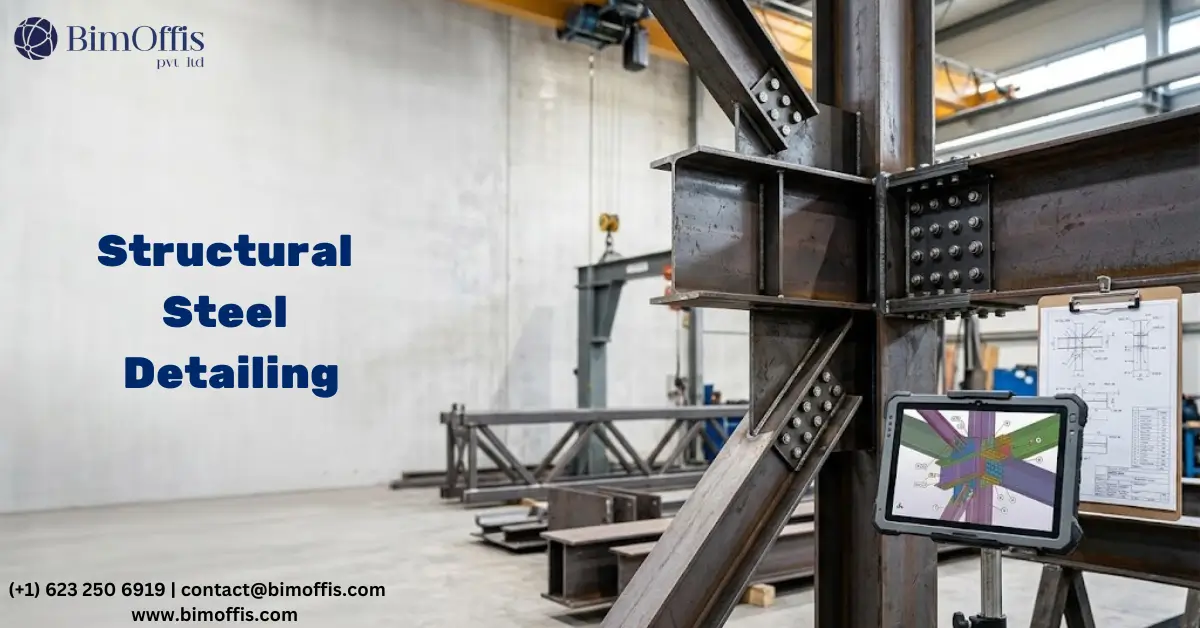
A structural engineer’s drawing gives you the big picture: beam sizes, column locations, general layout. What it doesn’t give you is the stuff a fabricator actually needs to build anything – bolt patterns, weld sizes, connection angles, precise dimensions down to the millimeter. That’s the detailer’s job. They take the engineering intent and turn it into shop drawings the fabrication crew can actually work from.
Detailers also produce erection drawings, which tell the crew on site how every piece is supposed to come together once it arrives at the job. Skip this translation step and you’re asking fabricators to interpret design intent on their own, in a trade where a couple of millimeters can mean the difference between a piece that fits and one that doesn’t.
Why Fabricators Depend on Accurate Detailing
It Prevents Mistakes That Get Expensive Fast
Steel doesn’t really forgive small errors. A hole drilled off by two millimeters, a weld at the wrong angle – either can mean a piece that simply won’t fit once it’s on site. And because fabrication happens off-site, any mistake caught during erection means cutting, re-drilling, or sometimes remaking the whole piece. That’s not a quick fix. It’s a delay that pushes back everything scheduled after it.
Good detailing catches these problems on paper, before anyone touches the steel. Fabricators end up trusting the drawings they’re handed, which sounds small but changes everything about how smoothly a shop runs.
It Keeps Every Trade From Colliding
Steel doesn’t exist in isolation on a job site. Ductwork needs to pass through certain clearances, electrical conduit needs its own path, plumbing has its own requirements – and all of that has to be worked out before steel goes up, not after. Detailers cross-check their drawings against other trades to catch these conflicts early.
Without that coordination, you can end up with a beam built exactly to spec that happens to sit right where an HVAC duct needs to go. Nobody wants to discover that on site with a crane already in position.
It Speeds Up the Fabrication Process Itself
Fabricators work on tight margins and tighter schedules, so clarity matters more than people outside the trade tend to realize. Solid shop drawings let a shop plan its cutting sequence, order the right steel in the right amounts, and feed data straight into CNC machines. Good detailing isn’t only about getting things right – it genuinely speeds the whole process up.
The opposite is also true. Vague or incomplete drawings mean the shop floor keeps stopping to call the engineer and ask what a detail actually means. Every one of those calls costs time nobody budgeted for.
It Keeps the Project Within Code
Every structural connection has to satisfy building codes – AISC standards in the US, or the local equivalent elsewhere. Detailers build that compliance into the connections themselves, checking bolt capacities, weld strength, and load paths as they go.
Fabricators generally aren’t the ones verifying code compliance; they’re building to the drawings in front of them. If those drawings are wrong, nobody finds out until an inspector catches it – and by then the steel’s already fabricated, maybe already installed.
What Happens When Detailing Gets Rushed
Cutting corners on detailing rarely saves the time people think it will. Instead, it tends to show up later as rework, blown schedules, and arguments about who’s actually responsible for the mistake. A missing connection detail can force a crew to improvise something on site, which is exactly the kind of inconsistency detailing exists to avoid in the first place.
There’s a liability angle too. If a connection fails inspection, or worse, fails structurally, people go looking for documentation. Clear, engineer-reviewed shop drawings give everyone a record of how the structure was actually meant to go together – which matters a lot more than it sounds like until you need it.
Detailing Is Also a Business Advantage
Beyond avoiding disasters, good detailing wins fabricators repeat work. Contractors and engineers notice which fabrication shops send back clean, coordinated drawings with no surprises, because it makes everyone else’s job easier too. That reputation sticks, and it brings business back.
It also shortens timelines, which clients care about more than almost anything else. In an industry this competitive, being known as reliable can matter just as much as being cheap.
The Bottom Line
Structural steel detailing is what turns an engineer’s design into something a fabricator can actually build without guessing. It catches expensive mistakes early, keeps steel from colliding with every other trade on the job, speeds up fabrication, and keeps everything within code.
For fabricators, detailing isn’t a step you can skip to save a few days. It’s the foundation the rest of the process sits on. Rush it, and the cost comes back later – in rework, delays, and arguments that a few careful hours of drawing would have avoided entirely.
Improve steel fabrication accuracy by working with our structural steel detailing experts for precise shop and erection drawings.
Frequently Asked Questions from Clients
What is Structural Steel Detailing?
It is the process of creating detailed drawings and models for steel fabrication and erection.
Why do steel fabricators need structural steel detailing?
It provides accurate information for cutting, drilling, welding, assembling, and installing steel components.
What drawings are included in steel detailing?
Shop drawings, fabrication drawings, erection drawings, and detailed connection drawings.
Which software is used for steel detailing?
Tekla Structures, Autodesk Revit, Advance Steel, and AutoCAD are commonly used.
How does steel detailing reduce fabrication errors?
Detailed models and drawings provide precise dimensions, connections, quantities, and component information.
What are the benefits of outsourcing steel detailing?
Outsourcing can provide specialized expertise, faster turnaround, accurate documentation, and scalable project support.