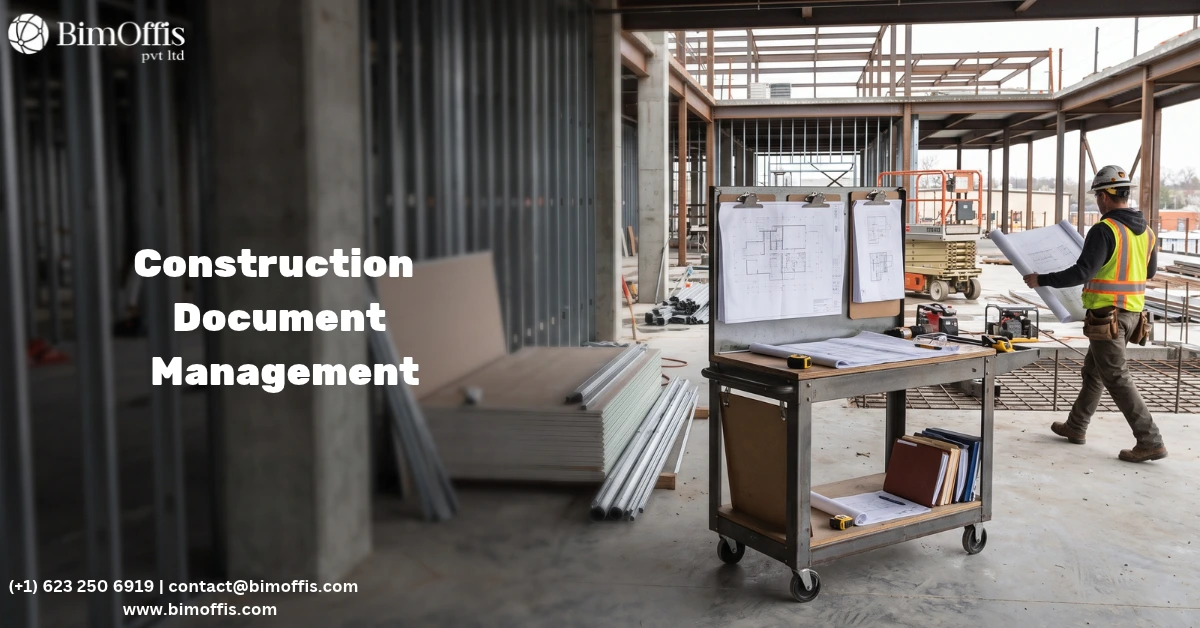
Construction document management decides whether project information reaches the right people. It also decides whether they get the right version at the right time.
Project managers, architects, and contractors all know this from direct experience.
A complex building project produces a huge volume of documents. Drawings, specifications, shop drawings, RFI responses, change orders, and inspection reports move constantly between the design team, contractor, subcontractors, and client. On a large commercial project, this adds up to thousands of documents across dozens of categories. The project may run for several years.
When teams manage documents well, the right people have the right information. The contractor builds from current approved drawings. Subcontractors price from the correct specification. The design team reviews shop drawings against the current design. The project manager tracks progress against the current programme.
When teams manage documents poorly, the wrong people hold the wrong information. The contractor builds from superseded drawings, and the work needs redoing. The subcontractor prices from an incorrect specification and submits a variation claim later. The design team approves a shop drawing that references an outdated design. Each of these situations costs more to fix than good document management would have cost to prevent.
What Construction Document Management Involves
More Than a Filing System
Construction document management demands far more than a tidy folder structure. It covers document creation, review, approval, distribution, revision, and archiving. It applies to every document type and every project participant across the whole project lifecycle.
A document management system for a complex project handles several functions at once:
- Transmittal management tracks every document that moves between parties. It records what the sender issued, when, and to whom.
- Revision control gives every participant the current approved version. It also stops them from using a superseded one by accident.
- Review and approval workflows route documents to the right reviewers in sequence. They track each document’s status from submission to final approval.
- RFI management handles requests for information. These arise when the construction team needs detail that the contract documents do not provide.
- Change management handles instructions, change orders, and design revisions. These modify the scope, specification, or programme of the contract.
- Shop drawing management handles the submission, review, and approval of fabrication drawings. Subcontractors and suppliers produce these before manufacturing begins.
Each function must work reliably across the full project scope. A single gap can cause serious trouble. An unrecorded transmittal, a revision that misses an affected party, or a lost RFI can trigger a construction problem or a contractual dispute. That dispute can cost far more than the whole document management effort.
Why Construction Document Management Quality Matters
The Direct Link Between Document Quality and Project Outcomes
Poor document management creates a predictable set of problems. Experienced project teams recognise them immediately.
Work built from superseded drawings is the most common and most expensive consequence. Contractors without a reliable process sometimes build from an earlier version. The work no longer matches the current design, so the team must redo it. The rework cost and the programme delay both trace back to the document management failure.
Slow RFI responses create information gaps. These gaps stop work or force the contractor to make field decisions without knowing the design intent. On the critical path, an unanswered RFI halts all dependent work. Every day without a response is a day the work does not proceed. Good document management records each RFI, routes it to the correct party, and secures a response within the contractual timeframe.
Undocumented change orders create disputes at project completion. Imagine a site manager instructs a change verbally, and nobody documents it. The contractor later claims for it, and the client disputes the claim. Good document management avoids this. It formally issues, prices, and agrees every change before the work starts.
The Key Elements of Good Construction Document Management
A Common Data Environment
A common data environment (CDE) is the foundation of good document management. It is a shared platform where all project participants store, manage, and access project documents. Everyone works from the same source.
A CDE removes the risk of different parties using different versions of the same document. The contractor accesses drawings from the same place as the architect and the engineer. When the architect issues a revised drawing, the contractor sees it there and receives a notification through the same system. The transmittal record also lives in the CDE. Any later query about when a revision went out, and to whom, gets an instant answer.
Good CDE practice gives every document a unique identifier. That identifier follows the document through every revision. It includes the project code, document type, discipline, sequential number, and revision level. The revision level changes with each update, but the rest of the identifier stays constant. This lets the team trace any document from the current version back to the original issue.
Revision Control That Eliminates Version Confusion
Revision control affects construction quality more directly than any other element. When it works, everyone builds from the current approved version. When it fails, participants work from different versions and produce inconsistent work.
Good revision control marks every superseded document as superseded once the new revision goes out. The mark appears on the document and in the system. Anyone who opens the file sees at once that it is not the current version. Good revision control also alerts every affected participant when a revision touches their scope of work.
The notification must be specific enough to be useful. A message saying “the drawing changed” tells the contractor very little. A better notification explains which element changed, why it changed, and what it means for construction. With that detail, the contractor can assess the effect on their work and programme.
RFI Management That Protects Programme
RFI management has the most direct programme impact. An RFI marks a gap in project information. The contractor cannot move past that gap until the design team fills it. The speed and quality of the response decide how long the dependent work waits.
Good RFI management starts with a clear process. Every participant should understand it before construction begins. The process defines who can raise an RFI and how they submit it. It names who routes each RFI to the correct respondent. It also sets the required response time and explains how the team issues and records responses.
Good RFI management also includes a review step before issue. Some RFIs ask questions that the contract documents already answer. Issuing them wastes the design team’s time. Other RFIs affect several disciplines and need one coordinated response. The review step catches both situations and handles them properly.
Change Management That Controls Scope
Change management controls the scope, specification, and cost of the project during construction. Every change needs a formal process. The team must quantify the cost, assess the programme impact, and win client approval before the work starts. They must also record what both parties agreed.
Robust change management keeps the final account accurate. Both parties understand and agree on the cost of every change. Weak change management turns the final account into a battleground. The contractor claims for changes, the client disputes them, and the resolution can take months. Sometimes it ends in legal proceedings.
Good change management follows five rules. Every change instruction:
- comes from an authorised party,
- arrives in writing before the work starts,
- describes the scope change clearly,
- states the agreed cost and programme impact, and
- receives the contractor’s formal acknowledgement before work proceeds.
The Bottom Line
Construction document management for efficient project workflows keeps the right information flowing to the right people at the right time throughout the project lifecycle.
Good document management gives you projects where the contractor builds from current approved drawings. RFI responses arrive fast enough to protect the programme. Teams document changes before work proceeds. The project record then supports a clean final account.
Getting document management right is not bureaucratic overhead. It is one of the most direct investments a project team can make. It delivers the project on time, within budget, and free from the disputes that poor document management consistently creates.
Improve project workflows with professional construction document management services that organize files, simplify collaboration, and support better document control.
Frequently Asked Questions from Clients
What is construction document management?
Construction document management organizes, controls, reviews, distributes, and archives project documents throughout the project lifecycle.
Why is document management important in construction?
It helps teams access the correct project information and current document versions, reducing errors, delays, and rework.
What is a Common Data Environment (CDE)?
A CDE is a shared digital platform where project teams store, manage, review, and access the latest project information.
How does revision control improve construction workflows?
Revision control helps teams identify current approved documents and prevents them from accidentally using superseded versions.
How does RFI management support project delivery?
RFI management tracks information requests and responses so design gaps are resolved quickly without unnecessary project delays.
How does construction document management reduce disputes?
It creates a clear record of drawings, approvals, changes, transmittals, and communications that supports accountability and reduces misunderstandings.