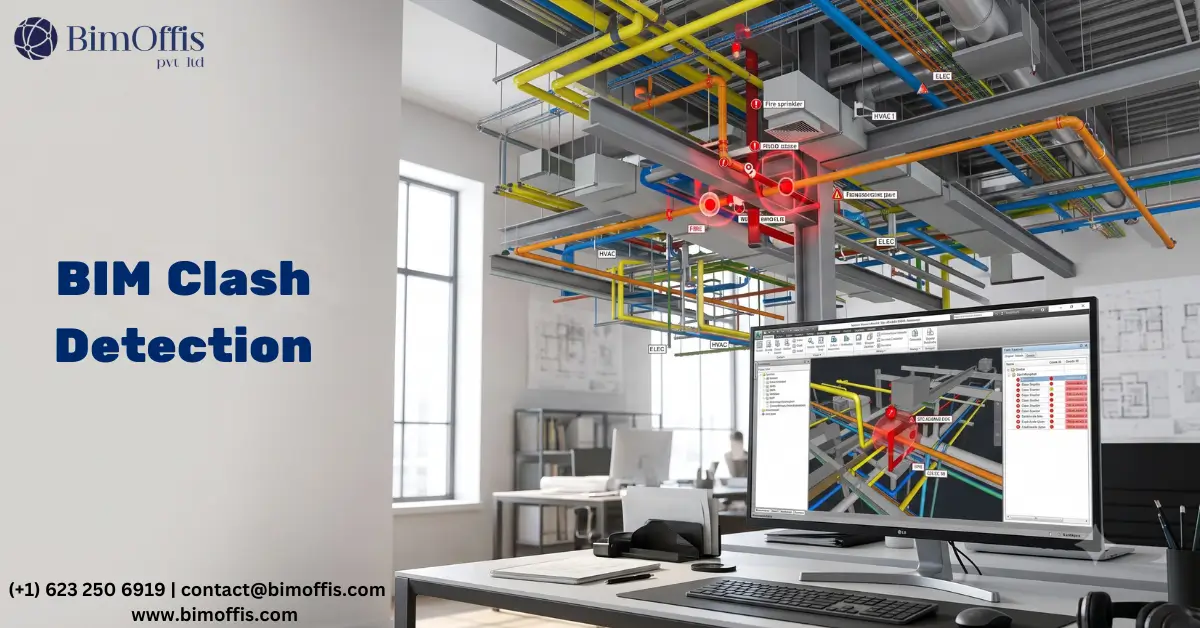
BIM clash detection is the single most direct mechanism through which BIM saves money on construction projects. Not theoretically. Not on average across a dataset. On real projects, in measurable ways, with consequences that show up in budgets and programmes.
Let me start with something that makes the value of BIM clash detection concrete rather than abstract.
On a large healthcare project, a mechanical engineer routes a chilled water main through a ceiling zone. A structural engineer, working in parallel, places a transfer beam through the same zone. The two teams exchange drawings at a coordination meeting. They overlay them and miss the conflict. The overlay shows a two-dimensional intersection. Neither engineer recognises it as a three-dimensional clash at the specific elevations both elements occupy.
Six months later, the crew installs the structural steelwork. The mechanical contractor arrives to start pipework installation and discovers the conflict on site. The chilled water main needs to reroute around the transfer beam. The reroute affects the adjacent pipework coordination. Plumbing and fire protection contractors had planned their work around the original route. Three trades stop work in the zone while the redesign gets resolved.
The cost of that situation is significant. The cost of the BIM clash detection that would have caught it during design is a fraction of that.
Understanding the specific benefits of BIM clash detection makes the investment decision clear. This is especially true for project teams still treating coordination as something that happens through drawing overlay and periodic coordination meetings.
Benefit One: Finding Coordination Problems When They Are Cheap to Fix
The Cost Curve of Construction Problems
Research across the construction industry consistently shows that the cost of fixing a problem grows as the project advances. A conflict resolved during schematic design costs almost nothing. The same conflict, resolved during design development, costs more. Resolve it during construction documents and it costs significantly more again. Discover it on site during installation, and the cost can be an order of magnitude higher than it would have been at the design development stage.
BIM clash detection pushes conflict discovery to the earliest possible point in the project timeline. All discipline models exist in the same coordinated environment. Clash detection runs regularly throughout design development. As a result, the conflicts that would otherwise surface on site surface in a coordination meeting instead.
The resolution at that point costs a model update and a discussion between the affected disciplines. It costs no standing time, no rework, no programme delay, and no variation claim. Consequently, the financial return on BIM clash detection investment on complex projects is not marginal. It is substantial.
Benefit Two: Reducing Rework During Construction
Rework Is the Most Expensive Category of Construction Cost
Rework means physical work that a crew has to do twice. It happens when work conflicted with something else, or when someone did it incorrectly the first time. Rework represents one of the largest categories of avoidable cost on complex construction projects. A significant proportion of that rework traces back to coordination failures that BIM clash detection would have caught.
Consider a cable tray that a crew installs through a space another trade needed. Or pipework that has to come down because structural elements installed later conflicted with its routing. Or MEP services that require rerouting because the coordination drawings showed a different installation scenario from what actually went in on site.
BIM clash detection eliminates this category of rework systematically. The team coordinates the installed positions of all elements in three dimensions before any installation starts. As a result, the physical conflicts that produce rework simply do not arise in the same volume. Trades that would otherwise deal with the downstream effects of another trade’s rework can proceed on their planned sequence instead.
Benefit Three: Improving Programme Predictability
How Coordination Failures Destroy Programmes
Coordination failures on site do not just cost money. They cost time. On construction projects where programme matters, time is money in its most direct form.
When a coordination failure stops installation in a zone, the impact extends beyond the specific conflict. The trades sequenced to follow the affected work cannot proceed. The team cannot hand over the areas planned for following trades on the planned date. Acceleration costs accumulate as the team tries to recover the programme. The disruption to the carefully planned installation sequence can take weeks to fully recover from.
BIM clash detection improves programme predictability. It removes the coordination failures that are the primary cause of unplanned programme disruption. The team plans the installation sequence against a coordinated model. Coordination gets genuinely resolved before installation starts. As a result, the site runs closer to the planned sequence, and acceleration costs do not accumulate.
Benefit Four: Supporting Better Procurement
Accurate Quantities From Coordinated Designs
BIM clash detection supports more accurate procurement in ways that are not always obvious. But the financial value is direct.
When ductwork, pipework, cable tray, or other MEP systems get rerouted during coordination, the quantities of those systems change. Routes get longer or shorter. Routes that change direction require additional fittings at those points. The number of support hangers changes too.
These coordination changes happen in the BIM model rather than on site. The updated model reflects the current coordinated design. The quantities the team derives from the model reflect the current coordinated routes too. Procurement decisions rest on accurate, current numbers rather than on quantities from designs that changed significantly during coordination.
Prefabrication raises the stakes further. When it is part of the mechanical or electrical contractor’s delivery strategy, BIM clash detection becomes essential to making it reliable. Prefabricated sections built to coordinated model dimensions arrive on site and install without field modification. Sections built to pre-coordination dimensions may not fit when they arrive. That turns the efficiency gain from prefabrication into an added cost of refabrication.
Benefit Five: Protecting Relationships Between Trades
Coordination Failures Create More Than Direct Costs
The direct financial costs of coordination failures are significant. The indirect costs are also real. They show up in ways that affect projects beyond the specific failure event.
A trade’s installation has to stop because another trade’s work conflicts with it. That single event puts a dent in the relationship between those trades. When the same pattern repeats across multiple failures on one project, the working relationship between contractors deteriorates. That affects how they work together for the rest of the job.
BIM clash detection prevents this by removing most of the coordination failures that create inter-trade conflict. Installation proceeds as coordinated, without the conflicts and rework that come from poor coordination. Working relationships between trades stay productive rather than adversarial. A site where trades work cooperatively runs more efficiently for everyone.
Benefit Six: Creating a Better Record for Facilities Management
Clash Detection Creates Coordination Documentation
Good BIM clash detection practice produces a clash log. It documents every coordination issue identified, who resolved it, how they resolved it, and when they verified the resolution in the model. This log becomes a project record with value beyond the construction phase.
For facilities management teams working with the as-built model, the coordination documentation shows how the building’s systems relate to each other. It also shows why certain routing decisions were made. A maintenance intervention requires accessing systems in a tight ceiling void. The coordination record helps the facilities team understand the constraints that shaped the installation, rather than encountering them as surprises.
Future renovation or fit-out projects need to coordinate new systems against existing ones. The clash detection record and the coordinated as-built model provide the most reliable existing conditions information available. That reduces the uncertainty that traditionally makes renovation project coordination so challenging.
The Bottom Line
BIM clash detection delivers benefits that compound across the full project lifecycle. Teams find problems during design rather than on site. They eliminate rework before it occurs. They improve programme predictability, support procurement accuracy, protect trade relationships, and give facilities management better documentation to work from.
Some teams understand these benefits and invest in proper BIM clash detection throughout design development. They treat it as a continuous coordination process, not a one-time pre-construction check. Those are the teams that consistently deliver complex projects with fewer surprises and better outcomes than teams still relying on manual coordination methods.
That is what the top benefits of BIM clash detection look like in practice. On any project where coordination complexity makes failures both likely and expensive, those benefits are worth investing in properly.
Prevent costly construction conflicts before they reach the site by working with our BIM clash detection experts for accurate project coordination.
Frequently Asked Questions from Clients
What is BIM Clash Detection?
BIM Clash Detection identifies conflicts between architectural, structural, and MEP systems before construction begins.
What is the main benefit of BIM Clash Detection?
It helps prevent costly construction errors and rework by resolving conflicts during the design stage.
How does BIM Clash Detection reduce project costs?
Early clash identification reduces material waste, labor costs, rework, and construction delays.
Which software is used for BIM Clash Detection?
Autodesk Navisworks, Revit, and Solibri are commonly used for clash detection.
Can BIM Clash Detection reduce construction delays?
Yes. Resolving design conflicts before site work helps maintain smoother construction workflows.
Who benefits from BIM Clash Detection Services?
Architects, engineers, contractors, fabricators, and project managers can all benefit from coordinated BIM models.