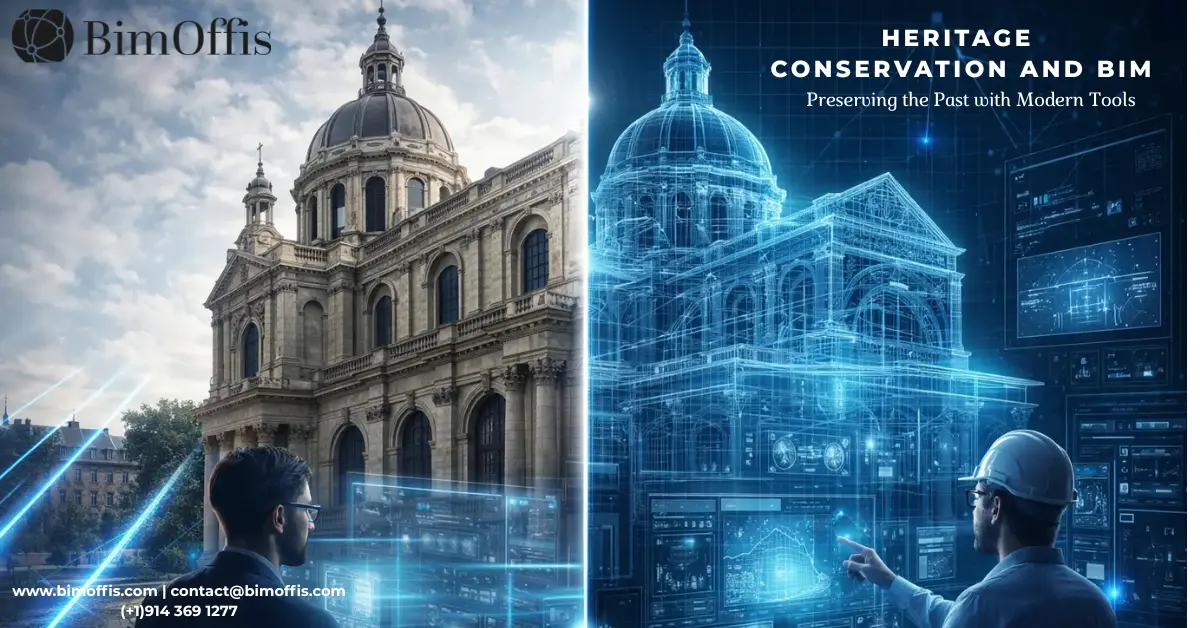
Heritage buildings are gateways to our history, cultural significance, architectural innovation and stories of yore. Although these structures are not easy to preserve as they are battling structural wear, environmental threat, and the requirement for usability. A transformational approach to overcome these challenges is provided via Building Information Modelling (BIM), combining tradition with the latest technology.
What is BIM?
Building Information Modelling (BIM) is a digital representation of a structure’s physical and functional characteristics. As a “digital twin” of the heritage structure, it then uses tools such as laser scanning and photogrammetry to create a precise 3D model of the individual heritage structure.
BIM for Heritage Conservation
1. Accurate Documentation
3D Scanning: It captures every detail of the structure, including cracks, contours and ornaments, nothing is missed.
Digital Archive: It acts as a baseline for future restorations.
2. History of Data Integration
The model combines old blueprints, archival photos and previous restoration records.
It maintains its authenticity by keeping the interventions modern, but drawing from historical techniques.
3. Condition Assessment
Structural weaknesses and material degradation are identified.
It prioritizes repairs by data insights.
4. Simulation and Testing
Tests restoration on slippage techniques and material without errors.
It simulates changes in the structure based on the environment: i.e., temperature or humidity changes.
5. Enhanced Collaboration
It offers a shared platform for architects, historians, engineers who together with the rest of the stakeholders, explore and debate the implications of particular design strategies for the future.
Implements a functional communication system with seamless updates during the whole project.
6. Future-Proofing
Is a living digital archive for future generations.
It supports ongoing maintenance and adaptive reuse.
BIM in Heritage conservation has real life applications
- Notre-Dame Cathedral, Paris: How the ongoing restoration was guided by the 2019 fire is thanks to 2019 BIM models that preserved every intricate detail of the structure created before the fire.
- St. Peter’s Basilica, Vatican City: Continuous analysis and maintenance of this architectural marvel is possible with detailed digital models.
- Sydney Opera House, Australia: Regular maintenance and monitoring of this UNESCO World Heritage Site is preserved and made possible by BIM.
Heritage Projects and Challenges in Using BIM
- High Initial Costs: Small sites require a lot of investment in both laser scanning and model creation.
- Skill Gaps: Use of BIM tools requires specialized training which conservation teams need.
- Data Management: The data you store and process is large and robust infrastructure is required.
BIM and The Future of Heritage Conservation
With advancements in BIM technology, future applications could include:
- AI Integration: Predictive maintenance and automation of analysis.
- Virtual Reality (VR): An application that creates immersive tours for use in education.
- Generative Design: Reconstructing lost pieces of heritage structures.
Conclusion
Preserving physical structures is no longer heritage conservation; heritage conservation entails ensuring the stories, culture and legacy that physical structures contain. BIM bridges the old and new, ensuring heritage sites that are restored, maintained and future proofed. To keep these monuments of the past inspiring and educating future generations, we achieve by adopting BIM.