3D walkthrough animation has quietly become one of the most powerful tools real estate developers and sales teams have in the USA today. The reason isn’t complicated. Buyers make better decisions when they can actually see what they’re buying. And in a market where a huge chunk of residential and commercial properties sell before construction even finishes, giving buyers that visual experience before the building exists is exactly the problem 3D walkthrough animation solves.
Here’s something that plays out in real estate sales offices across the country all the time.
A buyer walks into a sales office to look at an off-plan condominium in Miami. There’s a floor plan on the wall and a scale model on the table. The buyer studies the floor plan, asks a couple of questions about ceiling heights and finishes, and says they’ll think about it. Then they leave. And more often than not, they don’t come back.
The truth is, that unit was probably exactly what they wanted. They just couldn’t picture it. A floor plan gives you square footage, sure, but it doesn’t tell you what the living room feels like on a Sunday morning when the light pours in through south-facing windows. It doesn’t show you how the kitchen flows into the living area. And it definitely doesn’t let you stand on the terrace and take in the view.
That’s the gap 3D walkthrough animation fills. In a competitive real estate market, that gap is exactly what turns interest into a signed contract.
What 3D Walkthrough Animation Actually Does for Real Estate
Turning a Floor Plan Into an Experience
A floor plan is, at its core, a technical document. It communicates dimensions and spatial relationships well enough to anyone trained to read one. But for most buyers, a floor plan means mentally translating flat lines into three-dimensional space, and that translation is imperfect at best and impossible for a lot of people.
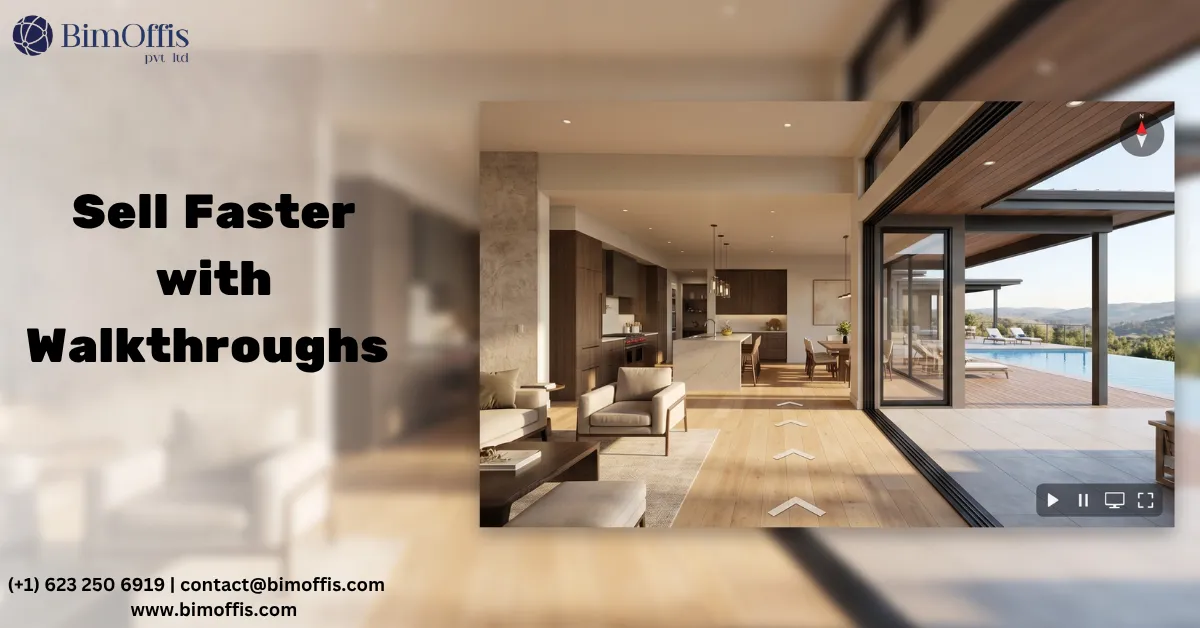
3D walkthrough animation removes that translation step entirely. The buyer isn’t reading the space anymore, they’re experiencing it. The camera moves through the property the way a person actually would, starting at the entrance and drifting through the living areas, into the bedrooms, out onto the terrace. Suddenly the buyer sees proportions, light, finishes, and how everything connects, in a way that feels real rather than theoretical.
This is also where the emotional side of buying kicks in. People don’t buy floor plans. They buy a picture of their future life in a space. A good walkthrough animation gives them that picture before a single wall is built.
Answering Questions Before They Turn Into Hesitation
Every sales team hears the same questions from off-plan buyers, over and over. Will the bedroom feel dark? Does the open-plan layout actually work in real life? How do the finishes look together at full scale? What’s the view from the living room really like?
These are hard questions to answer with drawings alone. But a 3D walkthrough answers them almost instantly. The buyer sees the light in the bedroom for themselves. They watch the open-plan layout come together. They see the finishes side by side in context, not on a swatch board. A visual answer, in short, is a lot more convincing than a verbal one.
And when questions get answered instead of left hanging, hesitation disappears. That’s really the whole game for sales teams in the US market, this is the most direct financial payoff of using 3D walkthrough animation.
How This Specifically Helps USA Real Estate
Pre-Sales That Support Construction Financing
Development in the US leans heavily on pre-sales to unlock construction financing. Lenders want proof of committed buyers before they’ll release funds, and developers need enough pre-sales at the right prices to make the numbers work before construction even begins.
3D walkthrough animation speeds that whole process up by giving buyers the confidence to commit before there’s anything to physically stand in. A development marketed with high-quality animation tends to hit its pre-sale targets faster than one leaning on floor plans and brochure renders. That means the financing threshold gets reached sooner, construction starts earlier, and the whole timeline shrinks.
For big residential projects in states like California, Florida, New York, and Texas, where pre-sale thresholds can be steep, that kind of acceleration is worth far more than what the animation itself costs.
Reaching Buyers Who Aren’t Local
Real estate in the US pulls buyers from all over the country, and often from overseas too. A Miami condo tower might attract buyers from New York and Chicago as easily as from abroad. A tech-corridor office building in Austin might pull investors from the West Coast who’ve never even set foot in the city.
3D walkthrough animation gives these remote buyers essentially the same experience as someone walking into the sales office in person. They can experience the property from wherever they happen to be. And once that animation lives on a website, gets emailed out, or shows up on social media, it reaches people who would never have visited a physical sales office during pre-sales anyway.
That reach matters a lot in the US, where the buyer pool is often spread across an entire continent rather than concentrated in one city.
Standing Out in a Crowded Market
Major US cities usually have several developments competing for the same buyers at the same time. The ones that pull ahead are simply the ones that communicate best.
A development shown through professional 3D walkthrough animation just presents itself on a different level than floor plans, scale models, or basic render images can manage. Buyers comparing several options tend to spend more time with, and feel more connected to, whichever one gave them a real visual experience. That extra engagement shows up later as higher conversion rates and stronger pricing power.
What Actually Makes a 3D Walkthrough Animation Work Well
It Has to Match the Real Design
The single most important thing about any 3D walkthrough for real estate is accuracy. If the animation shows more generous proportions than the real unit, finishes that won’t actually be delivered, or light that the real building orientation could never produce, it’s setting up expectations the finished property can’t meet.
At handover, that gap between animation and reality creates unhappy buyers, and sometimes it creates legal problems too. Good animation starts from the real design and the real specs, meaning the proportions are accurate, the finishes are the ones buyers will actually get, and the lighting reflects the building’s actual orientation and window sizes.
Get that right, and the accuracy builds trust rather than eroding it at the exact moment that trust matters most.
The Quality Has to Match the Development
The quality of the animation itself sends a signal about the quality of the development. Photorealistic animation with accurate materials, realistic lighting, and smooth camera work tells buyers the developer takes the product seriously.
Cheap-looking animation does the opposite, and it can actually hurt buyer confidence rather than help it. In premium markets like Manhattan, Miami Beach, or Beverly Hills, animation quality is basically part of the brand.
The Camera Needs to Tell the Right Story
Where the camera goes determines whether the animation actually shows off the development’s best features or just wanders around aimlessly. Good walkthrough animation follows roughly the route a real buyer would take, starting at the entrance and moving through the spaces in an order that shows them at their best.
The important moments get room to breathe. The view from the terrace lingers long enough to actually register. The connection between the kitchen and living area gets shown from the angle that makes the open-plan layout make sense. The master suite gets framed in a way that communicates both its size and the quality of the finish.
And the camera movement itself should feel smooth and deliberate, not mechanical. Ideally, it feels like someone who knows the property well is showing you around, not like you’re watching a software demo.
The Bottom Line
3D walkthrough animation helps real estate sales in the USA because it gives buyers what they actually need to make a confident decision on something that doesn’t exist yet. It replaces the mental guesswork of floor plans with a direct visual experience. It answers the questions that would otherwise turn into hesitation. It reaches buyers who are nowhere near the sales office. And it speeds up the pre-sales process that so much US development financing depends on.
The developments that end up with the strongest pre-sales, the fastest buyer commitments, and the best pricing power in competitive US markets are almost always the ones that invested in good 3D walkthrough animation and actually used it well throughout the sales process.
Showcase your property with stunning visuals by connecting with our 3D walkthrough animation experts to create immersive buyer experiences.
Frequently Asked Questions from Clients
What is a 3D Walkthrough Animation?
It is a realistic animated visualization that showcases a property before construction.
How does 3D Walkthrough Animation help real estate sales?
It gives buyers a clear view of the property, increasing engagement and confidence.
Who uses 3D Walkthrough Animation Services?
Real estate developers, architects, builders, and marketing agencies.
Can 3D Walkthrough Animations improve property marketing?
Yes, they attract more buyers and enhance online marketing campaigns.
Which properties benefit from 3D Walkthrough Animation?
Residential, commercial, mixed-use, and luxury real estate projects.
Why is 3D Walkthrough Animation popular in the USA?
It helps developers present projects effectively and accelerate sales.