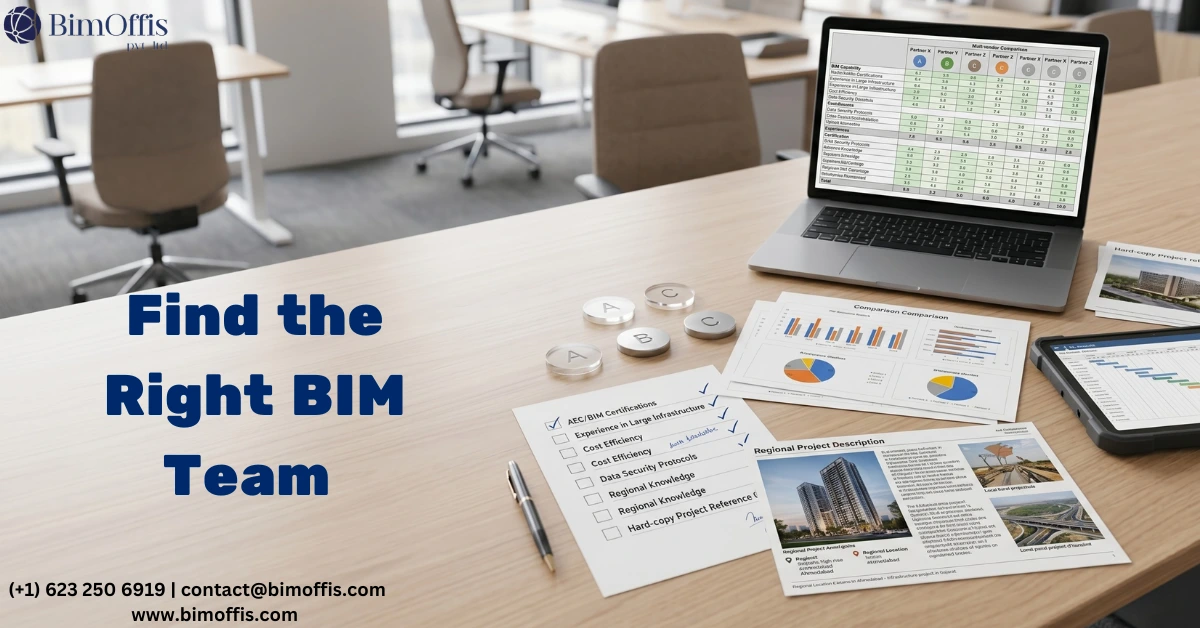
Finding a reliable BIM outsourcing partner in India is harder than most firms expect. The challenge is not a lack of options, there are hundreds of companies offering BIM services. The real problem is that most of them sound exactly the same.
Almost every website repeats the same promises: quality work, on-time delivery, experienced teams, and long lists of software tools placed beside generic construction images. After reviewing a few companies, everything starts to blend together.
So how do you identify a BIM outsourcing company in India that is genuinely capable of handling your projects?
Why India Has Become a Global BIM Outsourcing Hub
Many people still assume outsourcing to India is only about reducing labor costs. While cost savings are important, that explanation no longer tells the full story.
Over the last decade, cities such as Pune, Hyderabad, Ahmedabad, and Chennai have developed highly experienced BIM teams that regularly work with UK, US, Australian, and Middle Eastern firms.
These are not entry-level teams learning Revit for the first time. Many Indian BIM professionals have spent years delivering clash coordination, MEP modeling, construction documentation, and LOD 400 models for international projects.
Several factors make India a strong outsourcing destination:
Cost savings of 40–60% compared to maintaining the same work in-house in Western countries
Strong English communication skills that simplify collaboration
Faster project turnaround because teams can work across time zones
Long-term experience across architecture, structure, and MEP disciplines
The financial advantage is real, but the biggest benefit often comes from combining technical expertise with speed and scalability.
How to Evaluate a BIM Outsourcing Company in India
Choosing the right outsourcing partner requires more than comparing prices. A structured evaluation process helps you avoid delays, poor coordination, and expensive revisions later in the project.
1. Review Real Project Work, Not Marketing Material
A polished website does not guarantee technical capability. Instead of spending time on promotional pages, ask for actual project deliverables.
Look for examples such as:
Coordination reports
Live model screenshots
Clash detection summaries
Construction documentation sets
Multi-disciplinary BIM models
While reviewing their portfolio, consider these questions:
Have they completed projects with a similar level of complexity?
Can they demonstrate coordination between structural, HVAC, electrical, and plumbing systems?
Do they provide real clash reports from completed projects?
Have they worked under UK, US, or Australian BIM standards?
If a company only shares generic sample files or avoids detailed discussions, that should raise concerns early.
2. Evaluate More Than Just Revit Skills
Almost every BIM outsourcing company in India uses Revit. That alone should not be treated as a qualification.
A stronger BIM partner will also have expertise in supporting platforms and workflows, including:
Navisworks for clash detection and coordination
BIM 360 or Autodesk Construction Cloud for cloud collaboration
Tekla Structures for structural steel detailing
Dynamo or Grasshopper for automation and parametric workflows
AutoCAD for 2D documentation and drafting support
The best outsourcing firms usually have dedicated specialists for each discipline instead of assigning one small team to handle everything.
Evaluate Their Internal QA Process
Quality control is where many outsourcing relationships begin to fail. Problems often appear several weeks into a project when revisions increase and coordination issues start affecting deadlines.
Rather than asking whether they have a QA process, ask specific operational questions:
Who reviews the model before delivery?
Is the reviewer separate from the modeler?
Do they run internal clash detection checks before submission?
How are revisions tracked across multiple review cycles?
What is their average turnaround time for updates?
Experienced BIM teams can answer these questions clearly and confidently. Vague answers usually indicate weak internal systems.
4. Confirm Their Knowledge of International BIM Standards
This step becomes especially important if your projects follow international compliance standards.
A capable BIM outsourcing company should understand:
ISO 19650 for UK information management and common data environments
AIA BIM Protocol standards used in the United States
BIMForum LOD Specifications for defining model development levels
Australian BIM Framework requirements for Australian projects
You should also ask them to explain:
Their file naming conventions
How they organize shared project data
Their approach to common data environments (CDEs)
How they manage version control during coordination
Teams with genuine international experience will provide detailed and practical answers.
Communication Can Make or Break the Project
Even highly skilled BIM teams can become difficult to work with if communication is inconsistent.
A professional outsourcing partner should provide:
A dedicated BIM coordinator
Fast responses during overlap working hours
Clear technical discussions instead of only schedule updates
Regular progress meetings and reporting
One effective way to evaluate communication is to send a technical question during the proposal stage. Observe how quickly they respond, how clearly they explain the issue, and whether they ask intelligent follow-up questions.
That interaction often reveals far more than a sales presentation.
Clarify Pricing Before Signing Any Agreement
Low pricing can become expensive if the project scope is not clearly defined from the beginning.
Before finalizing the contract, confirm:
How many revision rounds are included
Which file formats will be delivered
Whether clash detection is included in the quoted cost
How scope changes are handled
What happens if deliverables fail to meet agreed standards
Hourly pricing offers flexibility but can become unpredictable. Fixed-cost pricing is easier to manage financially, although it requires a clearly defined project scope.
For long-term partnerships, a dedicated BIM team model may provide better efficiency and consistency.
Red Flags to Watch Out For
Even after shortlisting companies, pay attention to warning signs such as:
No real client references
Extremely low pricing compared to competitors
No technical questions during discussions
Missing NDA or formal contract agreements
Sales representatives answering technical BIM questions
One issue alone may not be a dealbreaker, but several together usually indicate a risky partnership.
Why a Pilot Project Is Worth Doing
If you are still uncertain after initial discussions, start with a paid pilot project.
Assign a limited scope, such as:
One building floor
A single discipline
A coordination package
A small documentation set
Then evaluate the results carefully:
Was the model clean and properly organized?
Did the team communicate clearly throughout the process?
How did they handle unclear instructions or missing information?
Were revisions completed quickly and accurately?
A short pilot project reveals far more about a company’s capabilities than multiple sales meetings ever will.
Final Thoughts
The best BIM outsourcing company in India is rarely the cheapest or the most heavily marketed.
The right partner is the one that communicates clearly, asks thoughtful technical questions, delivers accurate work consistently, and handles project challenges professionally.
Careful evaluation at the beginning of the relationship can prevent major coordination problems later. Run a pilot project, review their technical process thoroughly, and avoid making decisions based only on pricing.
A reliable BIM partner should improve project efficiency, not create additional management work for your internal team.
Ready to find out what your project will cost? Find out here.
Frequently Asked Questions from Clients
Why should I outsource BIM work to India?
India has skilled BIM professionals, good English communication, and costs 40–60% less than hiring in-house in the UK or US. You also get overnight turnaround since teams work in a different time zone.
What BIM services can Indian companies handle?
Most experienced firms cover architectural modeling, structural detailing, MEP coordination, clash detection, shop drawings, quantity takeoffs, 4D scheduling, and point cloud to BIM services.
How do I know if a BIM company in India is reliable?
Ask for a real project portfolio, check client references, and run a small pilot project before committing. A reliable company will have no problem showing their actual work.
Will language and time zone be a problem?
Not with the right partner. Most professional BIM outsourcing companies in India have English-speaking teams and dedicated coordinators who overlap with UK, US, or Australian working hours.
Is my project data safe with an Indian BIM company?
A trustworthy company will sign an NDA, use secure servers, and have a clear data privacy policy. Always ask about data security before sharing any project files.
What software should a good BIM company in India know?
At minimum, Revit, Navisworks, AutoCAD, and BIM 360. For specialized work, also look for Tekla, Dynamo, and Civil 3D depending on your project type.