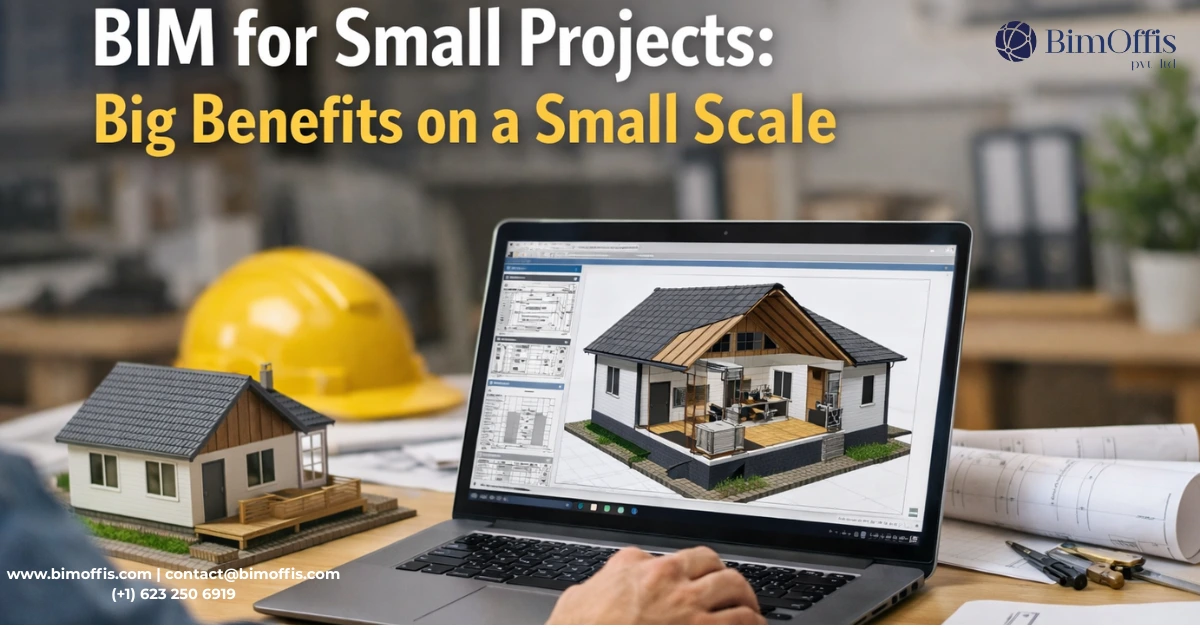
BIM Services You might think that BIM for small projects is only useful for large developments, but it can bring significant advantages even on a smaller scale. This technology helps every team involved collaborate efficiently and meet project expectations.
Key Advantages of BIM for Small Projects
Positive Outcome
BIM allows us to visualize and render ideas to the client, which helps them understand the design better. A model with 3D rendering gives the client a better vision as to what they can expect from the project.
Accuracy
BIM enables architects to get a clear understanding of the project, thereby allowing them to budget the projects accordingly and stick to it. With small projects, it is highly important to stay within the budget and BIM allows doing exactly that. It is easier to do calculations while keeping all the design factors in mind.
Efficient Work
With BIM, you can easily make changes when required so it makes it easier to update the project for a smaller firm. For a small project, you already need to put in a lot of effort at once and there are numerous things you need to take care of, and making mistakes cannot be one. BIM saves you from reworks, hence increases work efficiency. This will also help you focus on the design completely while giving your best.
The BIM process typically follows four key stages
- Planning: Establishing goals and constraints
- Modeling: Creating detailed, data-rich 3D models
- Coordination: Resolving design conflicts across disciplines
- Handover: Delivering a complete model for future use
For small projects, BIM scales beautifully. You don’t need high-end enterprise tools to start; cloud-based platforms and outsourced partners make BIM both accessible and affordable.
Despite all the benefits that BIM has to offer for small-scale businesses, the BIM process has not been adopted to a great extent.
Let’s find out the reason behind that in the following section.
Why Are Small Projects Lagging Behind BIM Adoption?
One of the major reasons why building information modelling and 3D modeling BIM is not picking up when it comes to small-scale projects is because many firms assume that BIM is too expensive, too complex, or simply not worth the effort for a project under 5,000 sq. ft.
Moreover, there’s also a skills gap: many small teams lack BIM-trained staff and worry about the learning curve.
Not only that, many project and building owners can’t see a clear ROI of 3D modelling BIM until they get big bills for the cost of rework, delays, and miscommunication.
However, the reality is shifting now. The BIM ecosystem is evolving to include smaller-scale needs, with tailored solutions and flexible models.
And if you are already considering using the BIM process for your small-scale project, we have some good news and more reasons for you!
How Does Revit Clash Detection Work for Small Projects?
Clash detection is one of the biggest issues when it comes to projects in the AEC industry. And the good news is, 3D modeling BIM solves that issue beautifully.
It allows project teams to detect design conflicts even before construction begins. To give you some idea, picture this: An HVAC duct runs right through a lighting layout in the same ceiling zone. Without BIM, this issue gets caught during installation, costing time, money, and client trust.
Nonetheless, with Revit clash detection, these conflicts are identified during the design phase itself! And there are many disciplines of federated BIM model that works together to flag geometry overlaps, clearance issues, and routing conflicts automatically.
For small-scale projects, where space is limited and teams are lean, clash detection prevents disproportionately large setbacks.
How to Overcome the Common Challenges of BIM for Small Projects?
If you are concerned about the challenges that will occur for the BIM process and how you can overcome them, we get it totally!
BIM may sound like a heavy lift for small-scale projects, but it doesn’t have to be.
If you think that building information modelling for small-scale projects will cost you high setup costs, you can simply overcome that challenge by using cloud-based platforms or outsourcing BIM modeling to experienced partners.
At Smart CADD, we’ve worked with dozens of lean AEC teams. Our flexible engagement models help you get started without hiring in-house BIM experts.
Cost Implications: Is BIM Worth the Investment?
Let’s talk about the main concern that most of the stakeholders have when it comes to small-sized projects in the AEC industry – costs.
Most of the time, on paper, the BIM process seems like an added expense. But in reality, it’s more about long-term savings.
For example, if you are investing $5K in the outsourced BIM support, you are preventing the damage of at least $50,00 that may occur due to rework, delays, and miscommunication.
So when you look at the BIM process with regards to the complexity of your project, rather than size, you can make better decisions. You don’t need a full-fledged BIM department, you just need the right tools and the right partner to work with.
But how do you decide if the BIM partner you are planning to work with is the right fit for you or not?
Conclusion
Implementing BIM will only add value to a smaller project and with each step, bring something new to the table. Every project will benefit from the previous and the cost set for the project will be justified, and the project will be delivered within the timeline.
BIM is changing the face of construction, so why not try it?
It has so many benefits it is time and cost-efficient. Think and contact BIM Services if you wish to go ahead with BIM. We are a team of experienced architects, mechanical engineers, BIM/CAD technicians, and design experts.
If you would like to know more about BIM Services and our projects, visit our website Bimoffis.