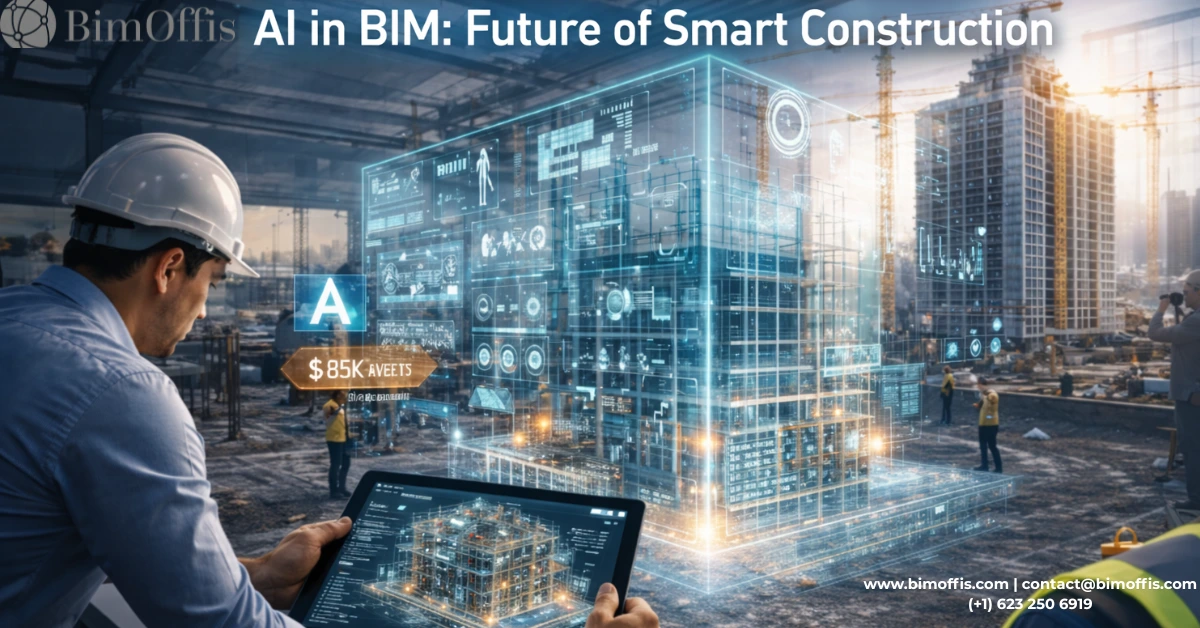
The integration of Building Information Modeling (BIM) with Artificial Intelligence (AI) is transforming the AEC (Architecture, Engineering, and Construction) industry by enhancing productivity, precision, and project outcomes.
Construction work is not the same as it used to be.
Earlier, most of the work depended on manual effort and personal experience. Because of that, delays, budget issues, and mistakes were quite normal. People accepted it as part of the process.
Now things are slowly changing. One big reason behind this change is the use of AI along with BIM.
A lot of people talk about “smart construction,” but in real life, it simply means using better tools to avoid problems and save time.
Understanding This in a Simple Way
BIM is not just a 3D drawing. It is more like a complete digital version of a building. It includes details like size, materials, cost, and timeline. Everything is in one place.
AI is nothing complicated. It just works with data. It looks at past information and gives suggestions based on that.
What difference does AI make in BIM?
BIM already helps in planning and coordination.
But when AI is used with it, the work becomes a bit easier. Instead of reacting after a problem happens, teams can get an idea earlier.
That’s the main difference.
Traditional construction vs. AI-driven BIM processes
| Aspect | Traditional method | AI-enhanced BIM |
| Clash detection | Manual reviews | Automated real-time detection |
| Design optimization | Based on experience | AI-driven suggestions |
| Scheduling | Fixed, often inaccurate | Dynamic, data-driven |
| Cost estimation | Prone to errors | AI-assisted precision estimates |
| Maintenance planning | Reactive | Predictive via digital twins |
| Sustainability analysis | Post-design stage | Integrated from concept stage |
The role of AI in enhancing sustainability in construction
- AI analyzes materials for low carbon footprint to ensure buildings are more eco-friendly. Studies show that buildings consume more than 50% of the power generated worldwide
- AI-driven processes optimize HVAC systems for energy efficiency. This allows inhabitants and users to be more comfortable and yet pay smaller energy bills.
- AI effectively supports green certification processes- LEED, BREEAM- to speed up the process to acquire the certification.
How AI and BIM can improve safety on construction sites
Safety on construction sites is a critical aspect for the AEC industry, human resource and expenses must be protected. Let us discuss the role BIM AI integration can play in this:
- AI predicts high-risk zones and sequences for contractors and construction teams to take necessary steps. Measures to make processes safer and provide safety gear to workers may be initiated accordingly.
- AI-powered cameras detect unsafe practices that are often not possible for human supervisors. This makes the overall construction environment safer and more productive.
- BIM models highlight structural stress points in advance. Corrective measures can be taken accordingly to make it safer for construction professionals.
Expert insights
“AI’s synergy with BIM is not just a trend but the foundation for the next generation of smart buildings.”
– Dr. Lisa Raymond, CTO, Construct Tech AI Labs.
“We reduce rework by 40% and project delivery time by 25% after adopting AI-integrated BIM solutions.”
– Carlos Mendes, Project Manager, Smart Build Ltd.
Real-world case studies
The Edge, Amsterdam
- Used AI-enabled BIM to optimize energy consumption; one of the greenest buildings in the world
- The Edge has achieved the world’s highest BREEAM rating.
HS2 Railway Project, UK
- Architects employed AI and BIM for early clash detection and scheduling to make the project efficient and absolutely safe for all
- The project administration was able to save millions in cost overruns, as a result
Shanghai Tower, Shanghai
- Architects and structural engineers integrated AI for wind-load simulation and structural optimization for the skyscraper design through BIM to make it safe from natural forces
Conclusion
BIM and AI are reshaping how the AEC industry designs, plans, and executes construction projects today. BIM AI is revolutionizing every phase of construction- from predictive planning and real-time clash clash detection to enhanced sustainability and safety. It offers the way to produce smarter, safer, and more efficient buildings and built environments.